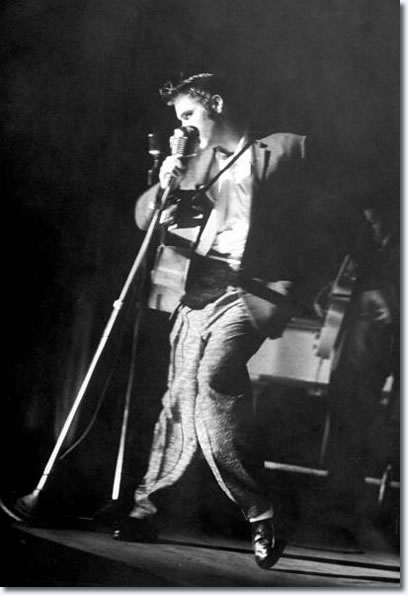
ELVIS PRESLEY WAS ONE PERFORMANCE AWAY FROM JAIL IN 1956 — A JUDGE, POLICE CAMERAS, AND SIX SOLD-OUT SHOWS WERE WAITING FOR HIM!
Jacksonville, Florida. August 1956.
Imagine walking onto a stage knowing that a judge is watching your every move, police officers are waiting with cameras, and arrest warrants are already prepared with your name on them.
That was the terrifying reality facing Elvis Presley in Jacksonville, Florida, in August 1956.
At just 21 years old, Elvis was already one of the most controversial entertainers in America. Millions of teenagers adored him. Parents feared him. Religious leaders condemned him. And now, one powerful judge was prepared to send him to jail if he dared to perform the way he had before.
The accusation was shocking: impairing the morals of minors.
Yes, Elvis Presley, the young singer who was transforming American music, was facing the possibility of arrest simply because of the way he moved his body on stage.
And what happened next would become one of the strangest and most unforgettable episodes in rock ‘n’ roll history.
In the summer of 1956, Elvis was practically unstoppable. His records were selling millions of copies, teenage girls were screaming wherever he appeared, and his performances were creating scenes that local authorities struggled to control.
According to Life magazine, fans were collecting water from his swimming pool and even fighting over strands of his hair. His popularity was no longer just a musical phenomenon. It had become a national obsession.
During his August tour of Florida, Elvis performed 25 shows across seven cities in only nine days. But Jacksonville was different.
The city remembered what had happened during his earlier appearance. Teenage girls had reportedly rushed the stage, screaming and grabbing at Elvis until nearly all his clothes were torn away.
Local officials were determined not to let history repeat itself.
Religious leaders joined the attack. Reverend Robert Gray publicly described Elvis as an example of spiritual degeneracy. Others demanded that authorities stop what they considered dangerous and immoral entertainment.
But the biggest threat came from Juvenile Court Judge Marion Gooding.
He was not bluffing.
Life magazine reported that Gooding had arrest warrants prepared and was ready to sign and serve them if Elvis repeated his supposedly scandalous movements.
Think about that for a moment. A young musician was about to perform six sold-out shows while knowing that one wrong movement could potentially put him behind bars.
The judge reportedly established strict boundaries. Elvis could wiggle from side to side, but the controversial back-and-forth hip movements had to stop.
On August 10 and 11, the Florida Theatre became the center of an extraordinary confrontation.
Thousands of excited teenagers lined the streets, desperate to see the man everyone was talking about. Tickets cost just $1.25 in advance and $1.50 at the door.
But this was no ordinary concert.
Police officers were stationed inside the theatre. Some reportedly carried movie cameras. According to the theatre’s historical account, officers sat in the orchestra pit while Judge Gooding watched from the back row.
Elvis had nowhere to hide.
Every movement mattered.
When the performance finally began, something unexpected happened.
Instead of unleashing the wild stage presence that had made him famous, Elvis noticeably toned down his act. Guitarist Scotty Moore later recalled that Elvis stood almost completely flat-footed throughout the show.
The King of Rock ‘n’ Roll was practically standing still.
But Elvis was not about to surrender his personality entirely.
During the performance, he reportedly teased the judge by wiggling his little finger.
That tiny gesture would become legendary.
It was almost as if Elvis had discovered a way to challenge authority without technically crossing the line.
And the irony was extraordinary: the man who had driven an entire generation of teenagers crazy was now entertaining thousands of people while barely moving his body.
So what happened to those arrest warrants?
Nothing.
Judge Gooding took no further action. According to the Florida Historical Society, after witnessing the performance himself, he was apparently satisfied with Elvis’s behavior.
Even more surprising, the judge reportedly allowed his own daughters to attend the concerts.
Years later, his son David Gooding recalled that his father had been very pleased with the way Elvis conducted himself.
In fact, the judge eventually became a lifelong Elvis fan. He continued watching the singer whenever he appeared on television.
Just imagine that transformation: a man who had once threatened to put Elvis behind bars eventually became one of his admirers.
The story did not end there.
During his famous 1968 television special, Elvis himself recalled the incident. He remembered being watched by state police officers and having to stand still, explaining that the only thing he could move was his little finger.
That little finger had become a symbol of one of the strangest battles between entertainment and authority in American history.
And the Florida Theatre itself survived long after that unforgettable weekend. Although it closed in 1980, the historic building was purchased by a nonprofit organization in 1981, added to the National Register of Historic Places in 1982, and reopened in 1983.
Today, the story of those six performances remains an extraordinary reminder of just how powerful Elvis’s influence had become.
He had challenged musical conventions, shocked conservative America, and transformed popular culture. Yet in Jacksonville, he faced something far more unusual than hostile critics or angry parents.
He faced a judge with arrest warrants.
And somehow, he walked away without being arrested.
No confirmed record shows that those warrants were ever signed.
But perhaps the most remarkable detail is this: the judge who once threatened to put Elvis Presley in jail eventually became a fan who watched him on television.
In August 1956, Jacksonville was ready to arrest the King. Instead, it witnessed the birth of a legend’s most unexpected weapon: one tiny, defiant little finger.