ELVIS PRESLEY WAS ALMOST FORGOTTEN… THEN A 5-YEAR-OLD GOSPEL RECORD SHOCKED THE WORLD!
A Forgotten Recording • A Secret in the Vault • An Unbelievable Comeback
Imagine being Elvis Presley in the spring of 1965.
Just a few years earlier, you had been the undisputed King of Rock and Roll. Millions of fans screamed your name. Your records dominated the charts. Your movies filled theaters. You were arguably the most famous entertainer on the planet.
But suddenly, everything was changing.
The Beatles had conquered America. The Rolling Stones were preparing to unleash “(I Can’t Get No) Satisfaction.” A new generation of musicians was taking over the airwaves, and the world seemed to have found its new heroes.
And what about Elvis?
He was stuck in Hollywood, making one forgettable movie after another. Critics were mocking his films. His soundtracks were becoming increasingly predictable. His career, once unstoppable, appeared to be losing its magic.
He hadn’t scored an American Top 10 hit in more than two years. In Britain, it had been almost two years since his last number-one single.
Many people wondered whether the King was finally finished.
Then something extraordinary happened.
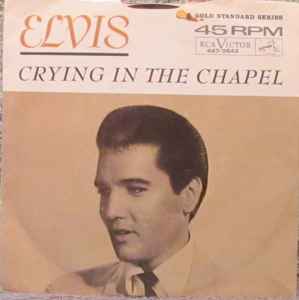
On April 6, 1965, RCA Records released a song that Elvis had recorded FIVE YEARS earlier. It wasn’t a rock-and-roll explosion. It wasn’t a teenage love song. It wasn’t even a recording Elvis had particularly liked.
It was a quiet, deeply emotional gospel hymn called “Crying in the Chapel.”
The recording had been sitting forgotten in RCA’s vault since October 1960.
And when it finally reached the public, it delivered one of the most unexpected comebacks of Elvis Presley’s career.
But the story behind that song is even more remarkable than its success.
It begins not in Hollywood, not in Memphis, and certainly not on a concert stage.
It begins in a small church in Fort Worth, Texas.
In the early 1950s, songwriter Artie Glenn was struggling with a serious back condition. According to his family’s account, he made a personal promise to God: if he survived his medical ordeal, he would become a better man.
He underwent spinal surgery, and thankfully, it was successful.
When he recovered enough to leave home, he went to the nearest church he could find: Loving Avenue Baptist Church.
There, sitting quietly inside the chapel, something unexpected happened.
He began to cry.
Not because he was suffering, but because he was overwhelmed with gratitude. He had been given another chance at life.
By the time he returned home, a melody and chorus had begun forming in his mind. That evening, he completed a song inspired by the emotional experience.
He called it “Crying in the Chapel.”
Artie gave the song to his 17-year-old son, Daryl Glenn, who performed with his father’s band, the Rhythm Riders.
They recorded a demonstration in a small Fort Worth studio and sent it to music publishers.
One after another rejected it.
Nobody seemed interested.
Eventually, a small publisher named Valley Publishers agreed to take a chance. In May 1953, Valley Records released Daryl Glenn’s recording.
What happened next was extraordinary.
The song began spreading across America. June Valli recorded a version that reached number four on the American charts. Rex Allen took it into the Top 10. Ella Fitzgerald and other artists also recorded their own interpretations.
Then came the Orioles, a Baltimore vocal group whose version reached number one on the R&B chart and became their only million-selling record.
By August 1953, four different versions of “Crying in the Chapel” were appearing on the American pop charts simultaneously.
The song had become a national sensation.
And somewhere in Memphis, a young man who would eventually become the greatest rock-and-roll superstar of his generation was quietly carrying a lifelong love for gospel music.
His name was Elvis Presley.
Long before the screaming crowds, the television appearances, and the Hollywood fame, Elvis had been a deeply religious young boy who loved singing in church.
His mother remembered that when he was only two years old, he would climb down from her lap during church services, run toward the choir, and try to sing along.
He grew up listening to gospel quartets, particularly the Statesmen and the Blackwood Brothers. Their harmonies and emotional performances left a permanent impression on him.
In 1954, before becoming famous, Elvis even auditioned for a local gospel quartet called the Songfellows.
He didn’t get the job.
Think about that for a moment.
The man who would eventually sell hundreds of millions of records had once been rejected from a gospel singing group.
But he never abandoned his love for spiritual music.
Even after becoming a rock-and-roll sensation, Elvis continued attending gospel performances and spending time with the singers he admired.
In 1960, after returning from two years of military service, he finally got the opportunity he had wanted for years: recording an entire gospel album.
On October 30, 1960, Elvis entered RCA Studio B in Nashville with the Jordanaires.
They worked through the night, eventually creating the material for an album called “His Hand in Mine.”
During those sessions, Elvis recorded “Crying in the Chapel.”
According to Jordanaires singer Neal Matthews, Elvis was feeling particularly good that night. He played around with the song before recording it in just a few minutes.
But there was a problem.
The performance apparently failed to satisfy everyone involved. Elvis and the Jordanaires were reportedly unhappy with the result, and after three takes, they moved on.
The song was left off the album.
Some accounts have suggested that disagreements involving publishing rights also played a role in its delayed release, although that explanation remains disputed.
Whatever the real reason, the recording disappeared into RCA’s vault.
For five long years, nobody heard it.
Meanwhile, Elvis’s career entered a difficult period.
He continued making movies, including “Blue Hawaii,” “Girls! Girls! Girls!,” “Kissin’ Cousins,” and “Viva Las Vegas.”
The films made money, but many critics believed his musical creativity was being sacrificed for commercial success.
Then came January 1964.
The Beatles arrived in America, and the entire music industry changed almost overnight.
The British Invasion transformed popular music. Younger audiences were discovering new sounds, new personalities, and new idols.
Elvis suddenly seemed like yesterday’s news.
And then RCA remembered something hidden in its archives.
A forgotten gospel recording.
With Easter approaching, the timing seemed perfect.
On April 6, 1965, “Crying in the Chapel” finally appeared as a single.
Nobody could have predicted what followed.
The song began climbing the American charts, eventually reaching number one on the Easy Listening chart, where it remained for seven weeks.
On the Billboard Hot 100, it climbed to number three.
And look at the competition it faced.
The Beatles had “Ticket to Ride.” The Beach Boys had “Help Me, Rhonda.” The Byrds were making waves with “Mr. Tambourine Man,” while the Rolling Stones were preparing to dominate the summer with “(I Can’t Get No) Satisfaction.”
Yet a slow gospel hymn recorded five years earlier was competing with all of them.
In Britain, the story became even more spectacular.
On June 17, 1965, “Crying in the Chapel” reached number one, giving Elvis his first British chart-topper in nearly two years.
It briefly lost the top position before reclaiming it for a second week.
The record also reached number one in Australia, Ireland, Italy, Norway, and South Africa.
It sold more than a million copies, becoming Elvis’s first million-selling single since “Return to Sender” in 1962.
The King had returned.
But there was something fascinating about this comeback.
Elvis hadn’t reclaimed his position through a revolutionary rock-and-roll song or a trendy new musical style.
He had done it by returning to the music that had shaped his soul long before the world knew his name.
And the story didn’t end there.
In 1966, Elvis returned to the studio to record another gospel album, “How Great Thou Art.”
RCA wasn’t particularly enthusiastic about the project, but Elvis insisted.
The album eventually won him his first Grammy Award.
In fact, all three competitive Grammy Awards Elvis won during his lifetime were for gospel recordings.
That tells us something extraordinary about the man behind the legendary image.
For Elvis, gospel wasn’t simply another musical genre. It was something deeply personal.
Even during his Las Vegas years, when the crowds were screaming and the spotlight was burning, gospel remained his refuge.
Members of the Sweet Inspirations, the vocal group who performed behind him, remembered that after his shows, Elvis would sometimes invite them upstairs to his hotel suite.
There, away from the crowds, they would spend hours singing gospel songs together.
Then came August 16, 1977.
Elvis Presley died at Graceland at just 42 years old.
Two days later, at his private funeral, gospel singers from the groups he had admired throughout his life gathered to pay their final respects.
James Blackwood of the Blackwood Brothers was asked to sing “How Great Thou Art.”
Before the performance, Elvis’s orchestra leader, Joe Guercio, approached him with a deeply emotional request.
He had conducted that song for Elvis hundreds of times.
Now, he wanted the honor of conducting it one final time.
Blackwood agreed.
As the music filled the room, Guercio stood nearby, conducting through his tears.
It was a heartbreaking farewell to a man whose love for gospel music had never disappeared.
And even after Elvis’s death, “Crying in the Chapel” continued its remarkable journey.
The song returned to the British charts in the weeks following his passing, as fans rushed to buy his records again.
Daryl Glenn, the teenager who had first recorded the song written by his father, died in 1990 at the age of 54.
But the song lived on.
In 2005, forty years after Elvis’s original release, “Crying in the Chapel” returned to the British Top 10, reaching number two.
A song born from one man’s tears of gratitude in a small Texas church had traveled across generations, continents, and musical revolutions.
And perhaps that is the most astonishing part of this entire story.
A songwriter who nearly lost his health found inspiration in a moment of prayer.
A 17-year-old boy gave that inspiration its first voice.
A future superstar who once failed a gospel audition recorded his own version.
A record company locked it away for five years.
And just when the world seemed ready to move on from Elvis Presley, that forgotten recording emerged to remind everyone who he really was.
The Beatles had changed the world. The Rolling Stones were taking over the charts. But Elvis Presley still had something nobody could take away from him.
His voice. His faith. And the music that had been in his heart since childhood.
Sometimes, the greatest comeback doesn’t begin with a brand-new hit.
Sometimes, it begins with a song everyone thought had been forgotten.
And sometimes, the tears that change history are not tears of sadness.