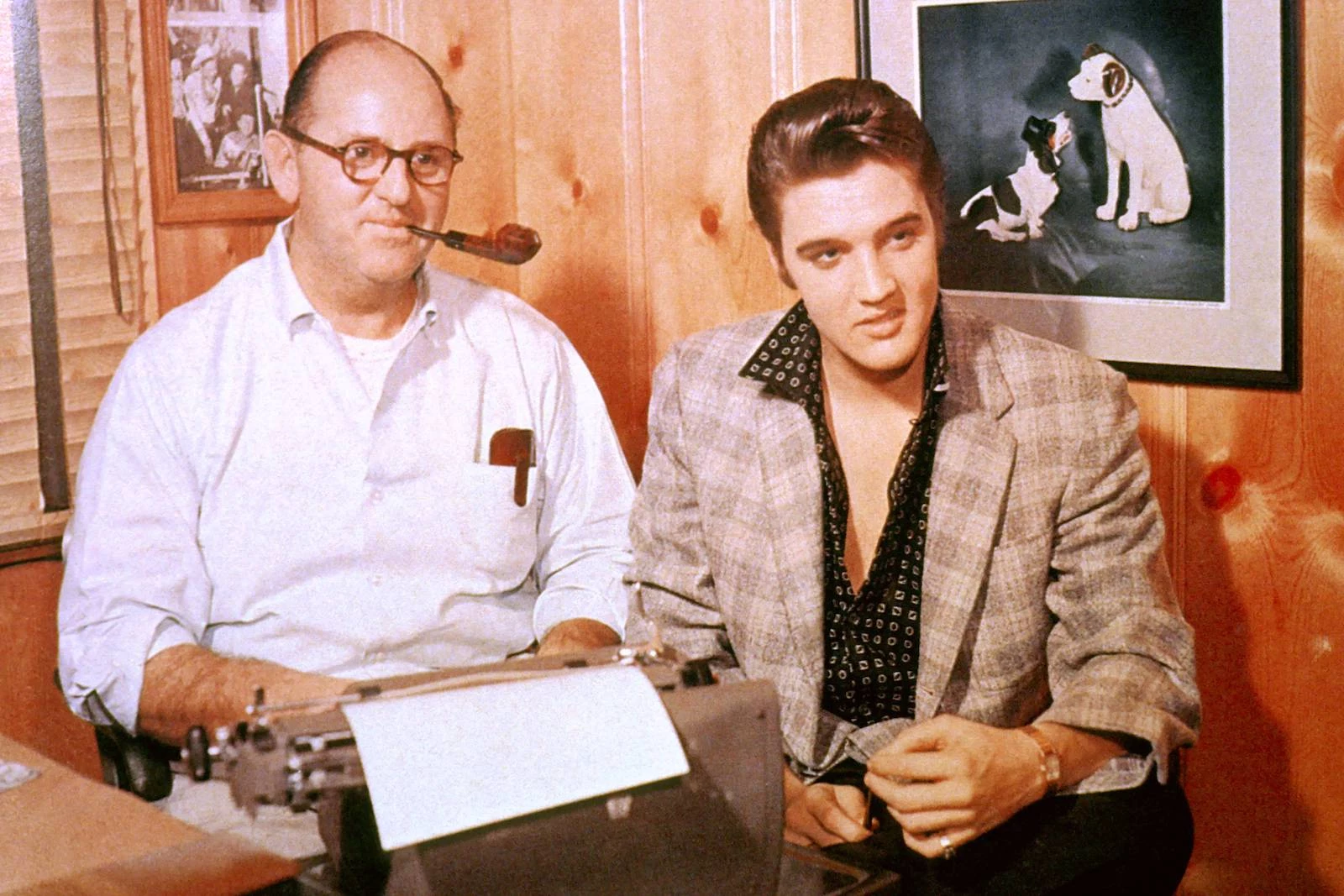
THE NIGHT ELVIS PRESLEY WAS TOLD TO PUT A PRICE ON HIS OWN VOICE
Early March, 1973. Los Angeles.
Imagine the weight of the decision facing Elvis as major agreements concerning his recording royalties were being negotiated while one question refuses to leave his mind:
How much is a lifetime of music worth?
Not the rhinestone jumpsuits.
Not the cars.
Not the mansion.
Not the private planes.
The music.
The voice that had turned a poor boy from Tupelo into the most recognizable entertainer on Earth.
The voice behind That’s All Right. Heartbreak Hotel. Hound Dog. Don’t Be Cruel. Can’t Help Falling in Love. Suspicious Minds.
Imagine being asked to put a number on all of it.
That is the emotional heart of the story surrounding Elvis, Colonel Tom Parker, RCA, and the enormous financial pressures surrounding Presley in the early 1970s.
But there is something important to understand before the legend gets bigger than the facts.
The documented history of Elvis’s recording rights is complicated.
RCA acquired Elvis’s Sun contract in November 1955 in a landmark deal widely reported at around $35,000–$40,000, along with the rights to his Sun recordings. That deal helped move the 21-year-old Presley from a regional sensation into the national spotlight.
By 1973, Elvis was living inside a very different world.
He had just completed the extraordinary Aloha from Hawaii project. The January 1973 satellite concert became one of the defining television events of his career, presenting Elvis to an international audience at a moment when his fame was still enormous.
From the outside, it looked like absolute victory.
Inside, however, the picture was far more complicated.
Elvis had a massive estate to maintain.
Graceland was no ordinary house. There were employees, horses, vehicles, security, household expenses, travel, musicians, associates and an enormous entourage. Presley had also developed a reputation for generosity that could be financially difficult to sustain.
He had spent much of his life giving things away.
Cars.
Money.
Gifts.
Help for friends.
Help for family.
The boy who had grown up knowing what it meant to have very little had become a man who often found it difficult to tell people around him, “No.”
And there was another enormous weight on his shoulders.
His marriage to Priscilla Presley had broken down.
Their separation and eventual divorce transformed private heartbreak into legal and financial reality. By 1973, Presley was no longer simply dealing with the emotional consequences of a failed marriage. There were lawyers, property questions, settlements and the future of his daughter, Lisa Marie.
For Elvis, money was never just money.
It was security.
It was family.
It was fear.
And sometimes, it was guilt.
That is what makes the legend of a $5.4 million deal so powerful.
The story says that Elvis was presented with an extraordinary offer: a huge lump sum in exchange for the rights to his existing masters.
If true, the emotional symbolism is enormous.
Because Elvis had spent nearly two decades creating those recordings.
But there is a crucial distinction between owning a recording and being the person who performed the recording.
Elvis could never sell the sound of his voice in the literal sense.
Nobody could erase That’s All Right from history.
Nobody could take away the moment when Scotty Moore and Bill Black helped create that early sound at Sun.
Nobody could undo the cultural explosion that followed.
And nobody could take Elvis Presley out of his own recordings.
But ownership of recordings, royalties, contracts and master rights is a different matter entirely.
That distinction is essential when telling Elvis’s story.
Because the most heartbreaking version of this tale is also the one that requires the most caution.
The idea that Elvis sat in a hotel room and literally signed away every record he had ever made — including Heartbreak Hotel, Hound Dog, Suspicious Minds and every other recording forever — makes for an unforgettable story.
But the historical record does not support treating that scene as an authenticated Elvis confession.
What is unquestionably real is the enormous commercial machinery surrounding Elvis’s music.
RCA had purchased his Sun contract in 1955, including his early masters.
And by the early 1970s, Elvis had become an institution whose recordings were already part of American culture.
That creates a fascinating irony.
The young Elvis had once walked into Sun Records with almost nothing.
He didn’t have the wealth.
He didn’t have the mansion.
He didn’t have the fleet of cars.
He didn’t have the army of employees.
He had a voice.
And that voice changed everything.
Twenty years later, the same voice was generating an enormous commercial empire.
Yet the larger Elvis became, the more complicated the business surrounding him became.
That is where Colonel Tom Parker enters the story.
Parker had been central to Elvis’s career for years. He helped transform Presley from a young Southern performer into an international superstar.
But their business relationship remains one of the most debated subjects in Elvis history.
To fans, Parker was sometimes portrayed as the brilliant architect behind Elvis’s success.
To critics, the business arrangements surrounding Presley raised serious questions about how much control Elvis actually exercised over his own career.
The truth is more complicated than either extreme.
And that complexity is precisely what makes 1973 so fascinating.
Elvis had reached the summit.
But the summit was expensive.
Aloha from Hawaii had demonstrated that his star power remained extraordinary. RCA continued to release and market his music. His concerts remained major attractions.
Yet behind the spectacle were contracts, expenses, taxes, lawyers, managers and obligations.
The King could fill a room with thousands of people.
But he could not simply escape the mathematics of being Elvis Presley.
And perhaps that is the real story hidden inside the dramatic hotel-room legend.
Not that Elvis literally woke up one morning and discovered he owned nothing.
But that the entertainment business had transformed something deeply personal — his music — into an enormous financial asset.
A song that began as a young man’s voice in a Memphis studio could eventually become part of a corporate catalog.
A recording could outlive the person who made it.
A performance could keep generating money decades after the singer had left the stage.
And that is where the story becomes haunting.
Because Elvis would eventually die in 1977.
His voice did not.
His recordings did not.
His name did not.
His music continued.
Long after the hotel rooms were empty.
Long after the lights at Las Vegas had gone dark.
Long after Graceland became a place of pilgrimage.
Long after the man himself was gone.
The most powerful part of Elvis’s legacy is therefore not whether one particular hotel-room conversation happened exactly as the legend describes.
It is the undeniable paradox behind it:
Elvis Presley spent his entire life creating a voice that the world could own emotionally — while the business world fought over who could own it financially.
That is the uncomfortable truth behind the myth.
The boy from Tupelo created something nobody could have predicted.
And decades later, millions of people were still listening.
Maybe that is why the image of Elvis sitting alone with a pen in his hand remains so powerful.
Because whether that exact scene happened or not, the question behind it was real:
When an artist becomes an institution, who owns the work — the artist, the company, the audience, or history itself?
Elvis could never control the answer completely.
But he could control one thing.
The voice.
The voice was still his.
And no contract could change the fact that when the needle dropped, the world still knew exactly who was singing.