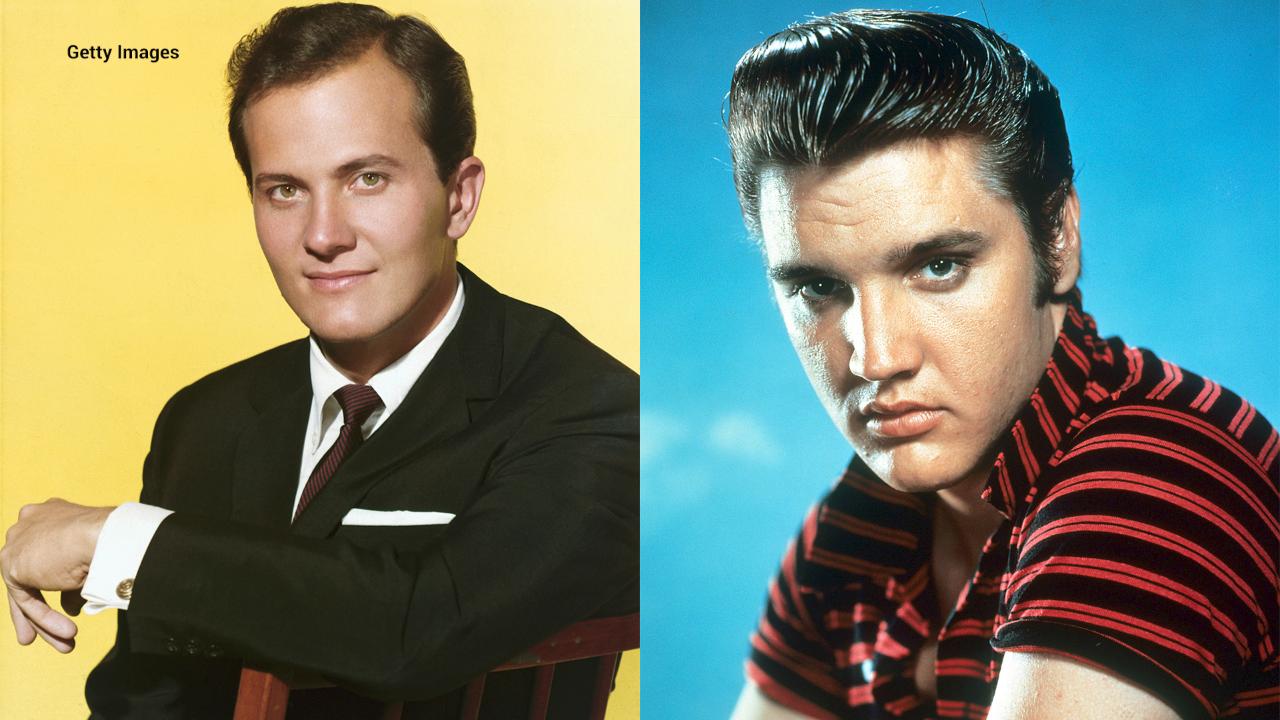
Before Elvis Presley became the King of Rock ’n’ Roll, he was simply a young man walking into rooms where almost nobody knew what to make of him.
In the mid-1950s, Elvis was still trying to establish himself. He did not look like the polished young singers audiences were accustomed to seeing. His hair was styled into a large pompadour. His clothes were flashy and unconventional, with loose or sharply tapered pants that stood out immediately. And then there was the way he moved onstage—something that seemed completely foreign to many performers of the era.
One person who initially had serious doubts about Elvis was Pat Boone.
At the time, Boone was already a much more established young entertainer. He had the clean-cut, “boy next door” image that parents and mainstream audiences found reassuring. His appearance was conservative, his performances were polished, and his songs fit comfortably within the popular music world of the day.
Then came Elvis.
The contrast could hardly have been greater.
Behind the scenes at one of the shows where they were appearing on the same bill, Boone reportedly met Elvis before the performance. His first impression was not exactly enthusiastic. Elvis seemed strange to him—different, unpredictable, and difficult to understand. Boone reportedly wondered what people saw in this young singer and whether Elvis could really go anywhere in the entertainment business.
After all, Elvis didn’t look like the other performers.
Boone represented the neatly dressed young star. Elvis walked in looking like something from another world: pompadour hair, distinctive clothes, and an attitude that seemed impossible to fit into the established mold.
But then Elvis walked onto the stage.
And everything began to change.
During Elvis’s performance, Boone heard him singing and watched the audience reaction. Whether it was “That’s All Right,” “Blue Moon of Kentucky,” or another number from that period, something about Elvis’s performance finally began to make sense.
Boone’s skepticism reportedly started to disappear.
His foot began tapping.
The rigid, polished image softened.
Instead of standing back and wondering what this unusual young man was doing, Boone began getting caught up in the music.
That moment was significant because Elvis wasn’t simply singing songs differently. He was demonstrating the very quality that would soon make him impossible for the traditional entertainment industry to ignore: he connected with an audience in a completely different way.
And Boone’s eventual attitude toward Elvis showed just how dramatically perceptions could change.
The two entertainers would later become friendly, and Boone spoke positively about Elvis. His early doubts were replaced by genuine admiration for what Elvis had accomplished. The young man who initially seemed too unusual to succeed was rapidly becoming one of the most talked-about performers in America.
But Elvis’s journey was only beginning.
Around this same period, another important chapter was unfolding in the American South: Louisiana Hayride.
The radio program, launched in Shreveport in 1948, became one of the most important platforms for country, blues, and emerging forms of popular music. By the mid-1950s, it was also being broadcast on television, giving performers an opportunity to reach audiences far beyond Louisiana.
Elvis became a regular performer on the Hayride and signed a one-year contract to appear on the program every Saturday night.
For Elvis, this was a major opportunity.
He was still working hard wherever he could—performing in clubs, traveling to different venues, and even selling appliances at one point to make ends meet. The Saturday-night Hayride appearances gave him something increasingly valuable: exposure.
Week after week, audiences heard Elvis.
And week after week, more people started paying attention.
His popularity grew rapidly.
The Hayride helped provide Elvis with a regular stage, but eventually his momentum became too large for the program to contain. His career was expanding beyond the regional circuit, and his management situation was changing as well.
Colonel Tom Parker increasingly saw enormous commercial potential in Elvis.
Parker understood that Elvis was not simply another young country performer. There was something about him that could potentially reach a national audience. The question was no longer whether Elvis could attract attention in the South.
The question was how far that attention could go.
And soon, Elvis would leave the world of small regional stages behind.
The skeptical looks, the strange clothes, the unusual movements, and the doubts from established performers were becoming part of a much bigger story.
Pat Boone had initially looked at Elvis and wondered what anyone saw in him.
But after watching him perform, he started tapping his foot.
That tiny reaction captured something enormous.
Elvis didn’t need everyone to understand him before he succeeded. He only needed them to hear him perform.
And once audiences heard him, the world of popular entertainment would never be quite the same again.
Video
https://youtu.be/BoWR3B15hKo?si=qZ71IOFgulR38a_b