When people talk about Elvis Presley, they often remember the voice first. Then the stage presence. Then, almost inevitably, the jumpsuits.
By the 1970s, Elvis had transformed the stage costume into something far beyond ordinary performance clothing. His jumpsuits became part of his identity—bold, extravagant, unmistakable, and sometimes so distinctive that fans could almost identify the year simply by looking at what he was wearing.
Among the many legendary designs, two continue to attract attention for very different reasons: the 1974 Peacock jumpsuit and the 1972 Powder Blue Wheat suit.
And according to fans discussing their personal favorites, both deserve a place among Elvis’s most memorable stage outfits.
THE 1974 PEACOCK: A $10,000 STATEMENT
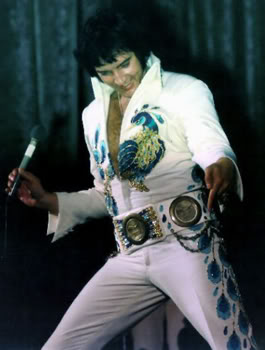
Coming in at number four on the list is the spectacular 1974 Peacock jumpsuit.
The first thing that catches the eye is the color. Deep blues and teal tones create a dramatic combination, while the intricate peacock design spreads across the suit in a way that makes the entire costume feel almost alive.
But it is not simply the colors that make this jumpsuit memorable.
The detail is what really stands out.
The peacock motif wraps around Elvis’s lower body before flowing downward, continuing toward the leg and creating the impression of a giant decorative fan. Every section appears carefully designed to move with Elvis rather than simply sit on the fabric.
And there is another remarkable detail: the reported price.
The suit is often associated with a cost of around $10,000, making it one of the most expensive and elaborate costumes connected with Elvis’s stage wardrobe.
There is also an interesting connection to Graceland.
Peacocks were part of the grounds around Elvis’s home, particularly near the living room and piano room area. Because of that, fans have long noticed the visual connection between the peacock motif on the jumpsuit and the peacocks associated with Graceland.
Whether that connection was intentional in the exact design is another question—but the similarity is certainly striking.
And perhaps that is part of why the Peacock suit remains so memorable. It does not merely look extravagant. It feels unmistakably Elvis.
THEN CAME THE POWDER BLUE WHEAT
On the other side of the discussion is the Powder Blue Wheat jumpsuit, associated with Elvis’s historic June 10, 1972 Madison Square Garden performances.
This costume has a completely different character.
Instead of the dramatic peacock imagery, the Powder Blue Wheat relies on a cleaner combination of color, design, and contrast.
The blue tone immediately draws attention, but the real magic comes from the accessories.
Elvis paired the suit with a white belt, which created a sharp visual break against the blue. He also wore a gold scarf, adding another layer of contrast and making the costume stand out even more under the stage lights.
Then came the white boots.
Together, the white belt and boots framed the blue jumpsuit and gave the entire outfit a polished, highly recognizable appearance.
For fans who have watched footage from the Madison Square Garden concerts, the costume is particularly memorable because it is so strongly associated with that specific period of Elvis’s career.
And that is one of the fascinating things about Elvis’s jumpsuits.
Some designs became so closely connected to a particular year, concert, or era that they almost function like visual timestamps.
See one of them, and you immediately begin thinking about a specific Elvis.
WHY CHOOSING A TOP FIVE WAS SO DIFFICULT
The discussion also reveals just how difficult it is to rank Elvis’s jumpsuits.
There were simply too many unforgettable designs.
A fan can choose a favorite one today, watch another concert tomorrow, discover another costume, and suddenly question the entire list.
That is exactly what happened during this conversation. The Powder Blue Wheat suit was initially placed at number four, but there was an admission that it could easily have been ranked even higher.
And that may be the real story behind Elvis’s stage wardrobe.
There was no single formula.
He changed colors. He changed patterns. He experimented with animals, metallic details, embroidery, belts, scarves, and increasingly elaborate designs.
The result was a collection of costumes that became inseparable from the man wearing them.
The 1974 Peacock represented extravagance, color, and elaborate symbolism.
The 1972 Powder Blue Wheat represented elegance, contrast, and a distinctive connection to one of Elvis’s most important concert periods.
Different styles. Different eras. Different visual identities.
But both prove the same thing:
Elvis Presley did not simply wear a jumpsuit onstage. He turned the jumpsuit into part of the performance itself.
Video
https://youtu.be/qz9l9EG_lp4?si=hvVivg7YlbwXEiRQ