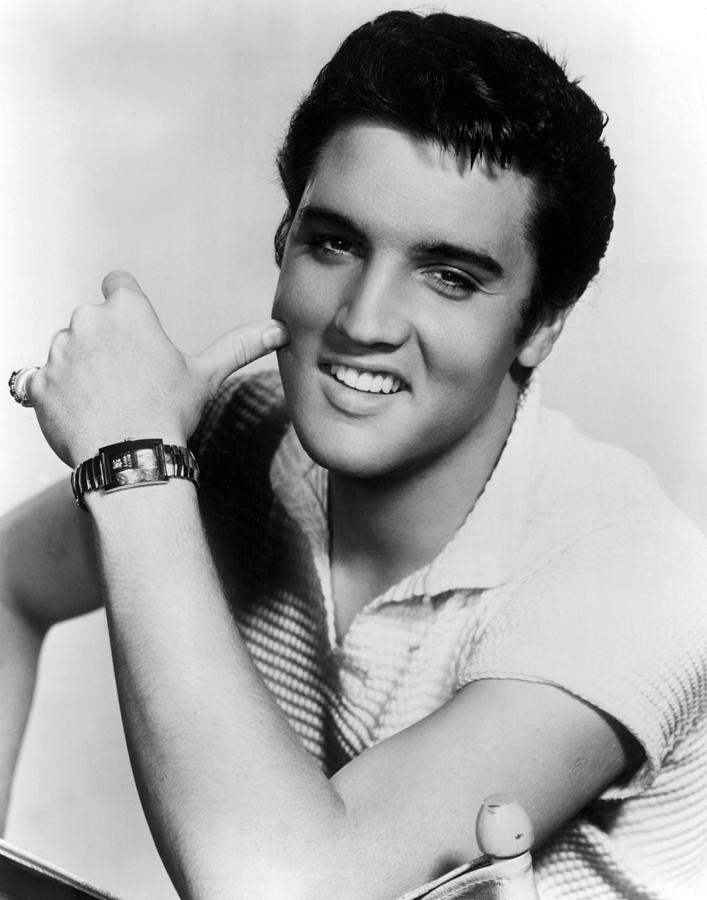
The Shocking Truth About Why Elvis Presley Never Learned to Read Music
Here is one of the most surprising facts about Elvis Presley: the man who changed the sound of popular music never learned to read music in the traditional sense.
No conservatory training. No years of studying musical notation. No sitting at a piano with pages of sheet music in front of him, learning scales and theory the way many formally trained musicians did.
And yet, Elvis became one of the most influential performers in music history.
So how was that possible?
The answer begins long before the fame, the sold-out concerts, the television appearances, and the screaming crowds. It begins in Tupelo, Mississippi, where Elvis grew up in a modest family without the money or access for extensive formal music lessons.
There was no expensive music education waiting for him.
But there was something else: church.
As a child, Elvis was deeply exposed to the music of the First Assembly of God. Gospel wasn’t simply something he listened to. It was something he experienced physically. People sang together, clapped, swayed, repeated melodies, and responded emotionally to the music.
Elvis learned by listening.
He absorbed voices, harmonies, rhythms and phrasing until they became part of his instinct. He didn’t necessarily need a sheet of paper to tell him where a melody was supposed to go. He heard it, remembered it, and eventually learned how to reshape it with his own voice.
Then came Memphis.
When the Presley family moved there, Elvis found himself surrounded by an extraordinary mixture of musical traditions. Gospel, country, blues, rhythm and blues, and popular music were all within his reach.
He listened constantly.
He became fascinated by sounds coming from Black musicians and performers on Beale Street. He wasn’t studying written transcriptions of blues songs. He was hearing musicians perform them live, watching how they bent notes, changed rhythms, emphasized certain words, and created emotion through timing.
That became Elvis’s musical education.
And then, in 1954, everything changed.
When Elvis entered Sun Records and began working with guitarist Scotty Moore and bassist Bill Black, he didn’t arrive with elaborate written arrangements. Instead, the musicians experimented in the studio.
During one famous session, Elvis began playing around with Arthur “Big Boy” Crudup’s “That’s All Right.” What emerged was loose, energetic and unlike the polished pop sound dominating much of the era.
Sam Phillips heard it.
He wanted them to record it.
The rest became history.
What makes this story remarkable isn’t simply that Elvis couldn’t read music. It’s how completely unnecessary that skill became to the way he created music.
Elvis could communicate musical ideas through his voice, his rhythm, his phrasing and his instincts. He could demonstrate a part, sing a harmony, hum a melody or show musicians what he wanted them to feel.
That was particularly important during recording sessions.
Instead of treating a song as something permanently fixed on paper, Elvis often approached it as something that could be discovered inside the studio. Musicians listened to one another. They experimented. They repeated sections. They changed tempos and phrasing until the performance felt right.
That approach could take time—but it also left room for something impossible to completely write down:
spontaneity.
A vocal crack. A different emphasis on a lyric. A sudden change in rhythm. An unexpected ad-lib.
Those small moments could transform a technically ordinary performance into something unforgettable.
And this is where the biggest misconception about Elvis needs to be corrected.
Not reading music did not mean Elvis didn’t understand music.
Those are two completely different things.
Music literacy means understanding written notation. Musical instinct means understanding sound, rhythm, harmony, phrasing and emotion.
Elvis possessed an extraordinary amount of the second.
He could move from a soft, intimate delivery to a powerful vocal attack. He could hold a note, bend it, delay it or push it forward for emotional effect. He could take elements from gospel, blues, country and pop and combine them naturally.
He didn’t need to study a textbook explaining how those genres could be blended.
He had already heard them.
He had lived with them.
They were inside his musical memory.
That may help explain why the early Elvis sound was so difficult to categorize. It wasn’t simply country. It wasn’t simply blues. It wasn’t simply gospel. It wasn’t traditional pop.
It was a mixture of sounds that Elvis had absorbed throughout his life and then filtered through his own voice and personality.
And the same instinct followed him into the recording studio and onto the stage.
Whether he was performing in the 1950s or years later in Las Vegas, Elvis could respond to the musicians around him and to the audience in real time. A phrase could change. An ending could stretch. A joke or spontaneous remark could appear between lyrics.
His performances were not always about reproducing a song exactly as it existed on paper.
They were about feeling the song in the moment.
That also demanded a special relationship between Elvis and his musicians. Players such as Scotty Moore, Bill Black and later D. J. Fontana had to listen closely to him. They weren’t simply executing instructions from a written score. They were responding to cues, timing and changes coming directly from the performer.
In that sense, Elvis’s lack of formal musical literacy became part of a larger tradition in American popular music, particularly among blues, gospel, country and early rock-and-roll musicians who often learned by ear.
Of course, this doesn’t mean that learning to read music is a disadvantage. Many extraordinary musicians have been highly trained and fluent in notation.
Elvis’s story simply demonstrates something different:
formal musical education is not the only path to profound musical understanding.
For Elvis, the classroom was the church.
The radio was a teacher.
Beale Street was a lesson.
Records were textbooks.
And repetition was practice.
By the time he reached Sun Records, he had already spent years training the most important instrument he possessed—not just his voice, but his ear.
That may be the real reason the absence of sheet music never stopped him.
Elvis didn’t need a page to tell him what music was supposed to feel like.
He had been learning that since childhood.
And perhaps that is one of the most fascinating contradictions of his entire career: one of the most important musicians of the 20th century was never formally trained to read the language of music on paper, yet he became extraordinarily fluent in the language of sound.
He didn’t change music because he mastered every rule.
He changed it because he knew what he heard—and, more importantly, he knew what he wanted people to feel when they heard him.
That was Elvis Presley’s real musical education.
And it started long before the world knew his name.