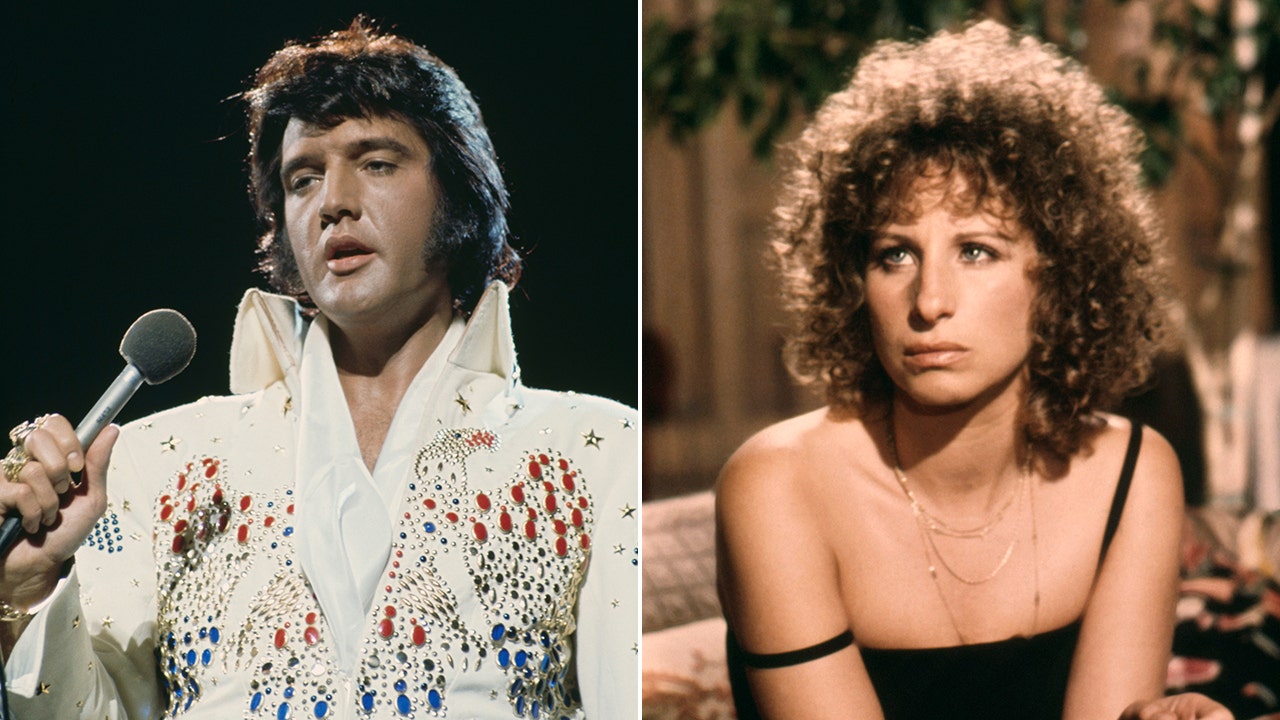
THE MOST EXPENSIVE WORD IN SHOW BUSINESS? ELVIS PRESLEY HEARD “NO” — AND IT MAY HAVE COST HIM THE ROLE THAT COULD HAVE CHANGED EVERYTHING
There is one question I want you to hold onto until the very end:
What was the most expensive word ever spoken in the history of show business?
Some believe that word may have been just two letters:
“No.”
And if the story surrounding Elvis Presley and A Star Is Born is even partly true, that single word may have cost Elvis far more than money.
It may have cost him the last serious escape route from the career machine that had trapped him for years.
By the summer of 1974, Elvis Presley was already one of the biggest entertainers on Earth. But behind the fame was a painful reality. The movie career that once seemed capable of becoming something extraordinary had largely turned into a cycle of predictable musical films, formulaic scripts, and songs Elvis himself reportedly had little enthusiasm for.
It had not always been that way.
In 1958, Elvis starred in King Creole, directed by Michael Curtiz, the legendary filmmaker behind Casablanca. At only 23 years old, Elvis received serious recognition for his acting. Critics who had previously dismissed him began acknowledging that there was genuine ability beneath the image of the rock-and-roll sensation.
Elvis had a future in acting.
Then something changed.
From 1960 through the end of the decade, he appeared in a long succession of commercially successful but increasingly formulaic movies. The familiar pattern became almost mechanical: Elvis played a charismatic young man, there was a location, a romantic interest, a story built around his music—and, inevitably, a collection of songs.
Financially, the movies made sense.
Artistically, they became another story.
And Elvis was not simply denied serious roles. Over the years, his name was associated with projects that could have taken him in completely different directions, including West Side Story, Thunder Road, and the role that eventually became one of the most painful “what ifs” of his career: Joe Buck in Midnight Cowboy.
That film went on to win Best Picture.
Imagine Elvis in that role.
Not the smiling movie-star Elvis.
Not the carefully packaged Hollywood Elvis.
But a character built around loneliness, fantasy, vulnerability, and the brutal discovery that fame and image cannot protect a man from reality.
Then came A Star Is Born.
In 1974, Barbra Streisand was developing the film that would eventually become her major musical drama. According to accounts from the period, Elvis was considered for the male lead, John Norman Howard. Streisand even met Elvis in Las Vegas and reportedly discussed the possibility with him.
This is where the story becomes controversial.
Elvis reportedly wanted the role.
But the negotiations never reached a successful agreement.
Accounts differ over exactly what happened next, particularly concerning the financial demands and billing arrangements. Some versions describe demands involving a substantial fee, prominent billing, profit participation, and other contractual conditions.
What is clear is that Elvis did not end up in the movie.
The role eventually went to Kris Kristofferson.
And A Star Is Born became a major success.
That creates the haunting question: Was Elvis kept out of the movie because of money—or because someone believed it was protecting him?
Colonel Tom Parker has often been placed at the center of the story.
One interpretation is simple: control.
Parker had built an extraordinary business structure around Elvis. Vegas engagements, recording contracts, merchandising, touring, movies—the Colonel was deeply involved in the machinery surrounding his client.
A serious dramatic film created a different environment.
There would be another producer.
Another star.
Another director.
Another studio.
Another set of people making decisions.
And Elvis would have been operating outside the familiar system.
The second interpretation is more complicated.
By the mid-1970s, Elvis’s personal circumstances had become increasingly difficult, and questions about his health and reliability were becoming impossible to ignore. A major film production required long schedules, early mornings, intense preparation, and months of commitment.
Could Parker have believed that Elvis was not capable of handling it?
Could he have thought he was protecting his client from the possibility of failing publicly?
That possibility should not simply be dismissed—but neither should it be presented as proven fact.
Because there is another heartbreaking part of this story.
Elvis never got to play the aging rock star in A Star Is Born.
Instead, within only a few years, audiences were watching the real Elvis struggle with the enormous weight of his own fame.
In 1976, he recorded “Hurt,” delivering a performance that many listeners have interpreted as deeply personal and emotionally revealing.
In 1977, his deteriorating condition became increasingly visible to the public.
He continued performing.
He continued walking onto stages.
He continued receiving applause.
And eventually, on August 16, 1977, Elvis Presley died at just 42 years old.
Meanwhile, A Star Is Born had been released in December 1976—with Kris Kristofferson in the role Elvis had once been considered for.
That coincidence makes the story almost impossible to forget.
The film was about a famous performer whose extraordinary talent remained while his personal life and career began collapsing around him.
Elvis never played that character on screen.
But in the final years of his life, some people saw uncomfortable parallels between the fictional story and the reality unfolding before them.
So what was the most expensive word in show business?
Maybe it was “no.”
Maybe Parker believed the deal was financially impossible.
Maybe he wanted to protect his control over Elvis.
Maybe he believed he was protecting Elvis himself.
Or perhaps the truth was some combination of all three.
And there is one fact nobody can change:
Elvis Presley never made A Star Is Born.
We will never know what would have happened if he had.
Maybe it would have revived his acting career.
Maybe it would have become his greatest dramatic performance.
Maybe it would have changed nothing.
But for a man who had spent years wanting something more meaningful from Hollywood, losing that opportunity remains one of the most fascinating “what ifs” in Elvis Presley history.
So now the question belongs to you:
Was it about money, control, or protection?
And if Elvis Presley had actually played that role, how different might his final years have looked?