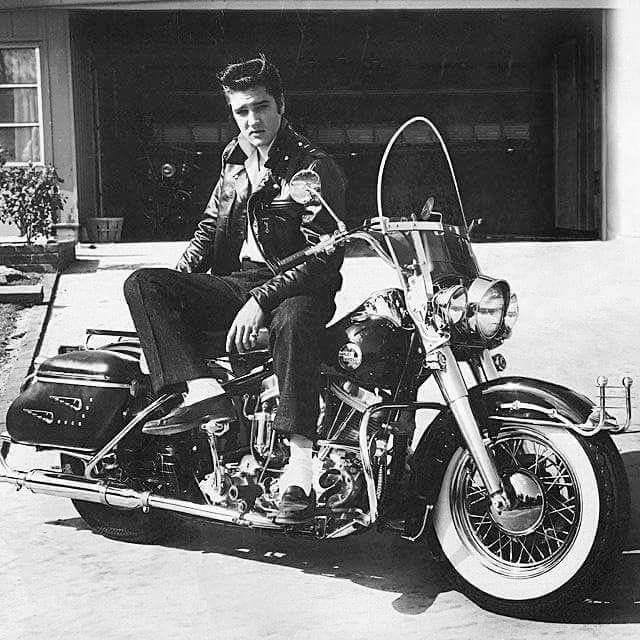
THE HIDDEN MOTORCYCLE STORY OF ELVIS PRESLEY: 22 YEARS, COUNTLESS BIKES, AND ONE FINAL HARLEY
Memphis, 1955. Elvis Presley was only 20 years old, still a regional singer with no idea how enormous his future would become. With some of his first money from Sun Records in his pocket, he walked into a Harley-Davidson dealership and bought a motorcycle.
It was a modest beginning: a Harley-Davidson Model 165, powered by a single-cylinder, two-stroke engine. Small, light, and relatively easy to handle, it was the kind of motorcycle a new rider might choose to learn on.
But that seemingly ordinary purchase became the beginning of a 22-year relationship between Elvis and motorcycles.
Over the years, Elvis would buy motorcycles, trade them, give them to friends, ride them with people he loved, and sometimes buy several at once. He once arranged for nine Triumph motorcycles to be purchased for members of his circle. He owned different Harley-Davidsons, Hondas, Triumphs, and even three-wheeled machines powered by Volkswagen engines.
And then, just one year and five days before his death, Elvis bought what sources identify as his final motorcycle: a customized Harley-Davidson FLH Bicentennial in California.
The story of that final Harley is fascinating. But before getting there, the story begins with that little Model 165 in Memphis.
In January 1956, only days after recording “Heartbreak Hotel” and shortly after turning 21, Elvis returned to Memphis Harley-Davidson. This time, he traded in the Model 165 and bought a much larger pepper-red Harley-Davidson KH.
The price was $1,143, with his old motorcycle credited at just under $440. Elvis financed the remainder.
The KH was dramatically different from his first bike. It had an 883cc flathead V-twin engine and represented the end of Harley-Davidson’s K-model era. The following year, the Sportster would arrive and replace it.
In an almost unbelievable coincidence, Elvis was buying the end of one motorcycle line at precisely the moment his own career was beginning to explode.
By May 1956, Elvis appeared on the cover of The Enthusiast, Harley-Davidson’s own magazine. The young singer who had only recently been a regional performer was suddenly becoming a national sensation—and he was photographed sitting on his Harley.
The motorcycle also became part of his social life. Elvis and his friend Fleming Horn reportedly went riding together late at night. By November 1956, the KH had passed into Horn’s hands.
Normally, that might have been the end of the story.
But the paperwork survived.
The bill of sale, registration documents, and insurance paperwork remained with the motorcycle. Even more remarkably, those documents were signed by Elvis himself. On the insurance application, his occupation was listed simply as “self-employed vocalist.”
Decades later, the motorcycle and documents were sold to Harley-Davidson, and the KH eventually became an important part of the Harley-Davidson Museum’s pop-culture collection.
That motorcycle tells us something important about Elvis’s relationship with bikes: there wasn’t necessarily one single “Elvis motorcycle.” He kept changing them.
In November 1956, he bought a brand-new 1957 Harley-Davidson Hydraglide with a touring package that included a windshield, crash guards, and saddlebags. One account describes Natalie Wood riding behind Elvis as they traveled around Memphis.
Years later, the same pattern appeared on a much larger scale.
In 1965, Elvis was living in Bel Air when his friend Jerry Schilling bought a Triumph Bonneville. Elvis tried it.
Apparently, he liked it.
According to Schilling, Elvis essentially told his transportation manager to get motorcycles for the guys—and get them that night.
The result was extraordinary: nine Triumph 650s, including TR6s and Bonnevilles, were acquired for friends and employees.
The reason was surprisingly simple.
Elvis wanted everyone to be able to ride together.
The purchase was not merely a celebrity indulgence. It was part of how Elvis created experiences with the people around him. Yet the motorcycles caused enough noise that neighbors reportedly complained, and the group eventually used trailers to transport the bikes through the gates.
Today, however, the whereabouts of those nine Triumphs remain unknown.
Then there was Priscilla.
Elvis owned a black Honda CA77 Dream, and in 1965 a white Honda was shipped to Memphis for Priscilla. According to biographer Peter Guralnick, Elvis bought it so she could ride with him.
Once again, the motorcycle wasn’t simply about the machine.
It was about having someone beside him.
That same impulse appeared again in 1976, when Elvis bought three Harley-Davidson Electra Glides. One account says he again gave motorcycles to members of his crew so they could ride together.
But by then, the Elvis motorcycle legend had already become much larger than the documented record.
One of the most famous stories claims that a Harley Elvis gave away eventually ended up abandoned in a junkyard, where Jay Leno supposedly discovered it, restored it, and sold it for millions.
Versions of the story vary wildly.
Some claim Priscilla had given Elvis seven Harleys. Others say Leno discovered five. Another version involves a farmer finding an old motorcycle with a note beneath the seat.
The supposed note changes too.
Sometimes it reportedly says something to Priscilla. Other versions connect the motorcycle to James Dean.
The supposed sale price has also changed over the years.
But the problem is simple: the story isn’t supported by the people and institutions connected to Elvis’s motorcycles.
Jay Leno has said his connection to the story is essentially that people keep asking him about it. Harley-Davidson has also rejected the story, and a Graceland representative stated that the famous lost-Harley tale was not genuine.
The legend became particularly persistent after a newspaper published a sensational story about an alleged Elvis motorcycle supposedly discovered in a junkyard and sold for millions.
The irony is that there really are missing Elvis motorcycles.
The nine Triumphs from the 1965 purchase remain unaccounted for.
Reality, it turns out, was already interesting enough without the legend.
By 1975, Elvis’s taste in motorcycles had become even more unusual. He purchased a three-wheeled Stinger from a Memphis shop called Supercycle. Soon afterward, he returned for another machine, the Stallion.
These weren’t ordinary motorcycles. They were three-wheelers powered by Volkswagen engines, and the Stallion’s design had connections to the work of custom-car legend Ed “Big Daddy” Roth.
Elvis even had one customized with TCB painted across the front.
Photographs from the period show people around Elvis and the machines, including Linda Thompson, Lisa Marie, and Ginger Alden.
And then came the final Harley.
On August 11, 1976, Elvis bought a Harley-Davidson FLH Bicentennial in California.
The motorcycle featured custom blue-and-black paint that had been ordered according to Elvis’s preferences. It was registered to his Palm Springs home and later shipped to Graceland.
According to the surviving record, this was the last motorcycle Elvis purchased.
Exactly what happened afterward is less certain.
Some accounts say Elvis sold the motorcycle back to a Harley-Davidson dealer in California several months before his death. Other accounts place the sale after his death.
Eventually, however, the motorcycle reached a hotel owner in New Jersey, who used it as a promotional attraction. It later became part of the collection at the Pioneer Auto Museum in Murdo, South Dakota.
For decades, visitors could see Elvis’s motorcycle behind glass.
The odometer reportedly showed approximately 1,260 miles, and the motorcycle retained its original California title bearing Elvis’s signature.
In 2019, the Harley sold at auction for $800,000. It was offered again at a Mecum auction in 2023 but did not reach its reserve.
And that brings the story back to where it started.
A 20-year-old Elvis Presley spending his first Sun Records money on a small Harley.
A young singer trading that motorcycle for a bigger one just as “Heartbreak Hotel” was about to change everything.
A superstar buying motorcycles for friends because he wanted them riding beside him.
A husband buying one for Priscilla.
A celebrity collecting different machines as his life changed.
And finally, a 41-year-old Elvis walking into a California dealership and buying one last Harley for himself.
The motorcycles changed. The brands changed. The people around him changed.
But one thing remained remarkably consistent.
Elvis loved the feeling of being on a motorcycle.
The famous quote sometimes attributed to him about discovering the freedom of “going into the wind” lacks a reliable original source, so it should be treated as a later legend rather than established fact.
Yet the documented purchases tell their own story.
For more than two decades, Elvis Presley didn’t simply collect motorcycles.
He used them to escape, to explore, to share time with friends, and sometimes simply to feel the road beneath him.
From that first little Harley in Memphis to the final Bicentennial FLH in California, the machines became part of the story of Elvis Presley.
And perhaps that is the most fascinating part.
Behind the rhinestones, sold-out shows, movie sets, private jets, mansions, and unimaginable fame was still the same man who once took his first hard-earned money and bought a motorcycle.
The King became a legend. But somewhere underneath it all, he was still chasing the wind.