THE ELVIS SIGNATURES THAT SURVIVED DECADES — AND THE STORIES HIDDEN BEHIND THEM
What if a single handwritten name could tell the story of an entire career?
Long before Elvis Presley became the global superstar remembered today, his signature was simply the name of a young man trying to make his mark. Decades later, those handwritten signatures have become historical artifacts — tiny pieces of paper, photographs, yearbooks, notes, and personal items that capture different moments in Elvis’s extraordinary life.
That is what makes Yours, Elvis Presley so fascinating.
Rather than being another general biography filled with familiar photographs and stories, the book takes a remarkably focused approach: it follows Elvis Presley through the evolution of his autograph.
The collection, associated with author and Elvis memorabilia expert Stephen M. Shutts and contributions from collectors including Lindell Morris, brings together examples of Elvis’s signatures from the early 1950s through the 1970s. What might appear to be nothing more than a name written in ink becomes something much more interesting when viewed across an entire career.
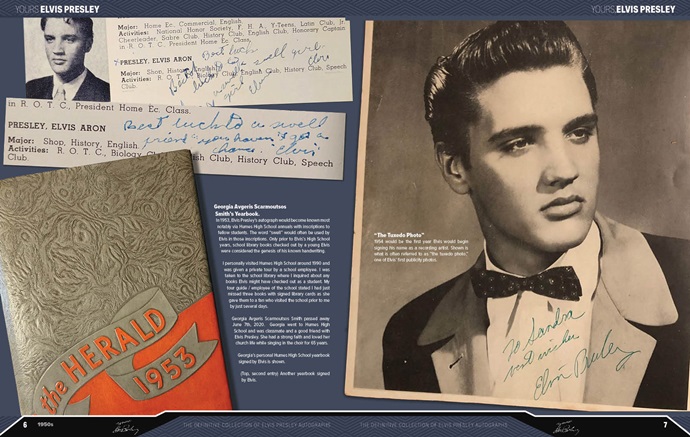
One of the earliest examples discussed is connected to Elvis’s high-school years, including a 1953 Humes High School yearbook. Then comes the period when Elvis was beginning to establish himself professionally. Some early signatures even included wording identifying him as a singer at Sun — a fascinating reminder that the man who would eventually become one of the most recognizable names on Earth was once virtually unknown.
And then something remarkable happens.
The signature begins to change.
As Elvis’s career develops, his handwriting evolves along with him. The simple autograph of the young performer gradually becomes a more recognizable and distinctive signature associated with an international celebrity. The book allows readers to follow that transformation year by year, through his recording career, Hollywood years, and later concert era.
The final documented examples in the book reach into 1976, including a signature associated with a Cadillac dealership in Beverly Hills.
But the signatures themselves are only half the story.
What makes this collection especially compelling is the material surrounding them. The book does not simply display autograph after autograph. It provides context about where signatures came from, who received them, and the circumstances surrounding their acquisition.
Some were obtained by fans who happened to encounter Elvis during an extraordinary moment. Others were written on ordinary pieces of paper — items someone happened to have in a pocket, purse, notebook, or nearby.
And that is where Elvis history suddenly feels incredibly personal.
Imagine being a fan in Las Vegas during Elvis’s performing years. You have saved your money, traveled to see him, and bought a ticket for one show. You know Elvis is staying in a highly controlled environment, moving between the stage, hotel areas, elevators, and private spaces.
Then, somehow, you encounter him.
You have only seconds.
You reach into your pocket and pull out whatever piece of paper you have.
Elvis signs it.
That ordinary scrap of paper instantly becomes something you may preserve for the rest of your life.
One particularly memorable example described in the collection involves a woman who reportedly removed her shoe and had Elvis sign the bottom. Stories like that demonstrate why autograph collecting can be so much more than simply owning a famous person’s handwriting. Each object can carry a personal story about the moment when a fan and an extraordinary cultural figure crossed paths.
The book also includes a study guide designed to help readers understand the differences between authentic Elvis signatures and possible forgeries. That is particularly important because the Elvis memorabilia market contains items that require careful examination.
The guide examines changes in Elvis’s signature over time and provides examples intended to help collectors recognize characteristics associated with authentic examples. It also discusses the use of signature stamps by Elvis’s staff — an important detail that casual collectors might not realize.
A stamped signature and a handwritten autograph are obviously not the same thing.
Yet without understanding the history behind Elvis’s paperwork and correspondence, it could be easy for an inexperienced collector to misunderstand what they are looking at.
That is one of the strengths of Yours, Elvis Presley: it treats the autograph not simply as a souvenir, but as a historical subject.
And perhaps the most surprising part is how much these signatures reveal without saying a single word.
Elvis’s career lasted more than two decades. During that time, he transformed from a young Memphis performer into a recording phenomenon, movie star, cultural icon, and Las Vegas headliner.
His name remained the same.
His signature did not.
Seen together, these autographs create a visual timeline of that transformation.
For Elvis collectors, that makes the book particularly intriguing. For casual fans, it offers something different: a chance to see the evolution of one of the most recognizable names in popular culture through something extremely simple — handwriting.
The physical presentation also appears to have been an important part of the project. The book comes with a protective case and a separate study guide, giving it the feel of a serious collector’s reference rather than an ordinary coffee-table publication.
And that matters because the subject itself demands careful preservation.
Elvis left behind countless recordings, photographs, films, costumes, documents, and personal artifacts. But an autograph is different. It represents a moment when Elvis physically put pen to paper.
The ink may be decades old.
The paper may be ordinary.
The handwriting may be only a few inches across.
But together, they preserve a direct physical connection to a particular moment in Elvis’s life.
That is why a book like this can be so meaningful to the Elvis community.
Not everyone is an autograph collector. Some fans prefer photographs. Others collect records, books, clothing, concert memorabilia, or historical documents. Some simply want to learn more about Elvis’s life.
But for those fascinated by the smallest surviving details of his career, these signatures offer something uniquely personal.
They show Elvis not as an untouchable legend, but as a man sitting down for a moment and writing his name for another human being.
And perhaps that is the real story hidden inside Yours, Elvis Presley.
The book is not merely about signatures.
It is about moments.
A high-school student signing a yearbook before anyone could know what his future would become.
A young performer identifying himself as a singer at Sun.
A rising star developing a distinctive autograph.
A movie star and international celebrity leaving his name for fans.
And finally, an older Elvis in the 1970s whose signature had become recognizable around the world.
Every autograph marks a moment in time.
Every piece of paper has a story.
And together, they create something far more powerful than a collection of names: a handwritten timeline of Elvis Presley’s journey from an unknown young singer to a legend whose name is still recognized more than half a century later.
That may be the most fascinating thing about Elvis’s signature.
The man is gone.
The performances have ended.
The crowds have disappeared.
But in museums, collections, archives, and carefully preserved personal memorabilia, his handwriting remains.
And sometimes, history survives in something as small as a signature.