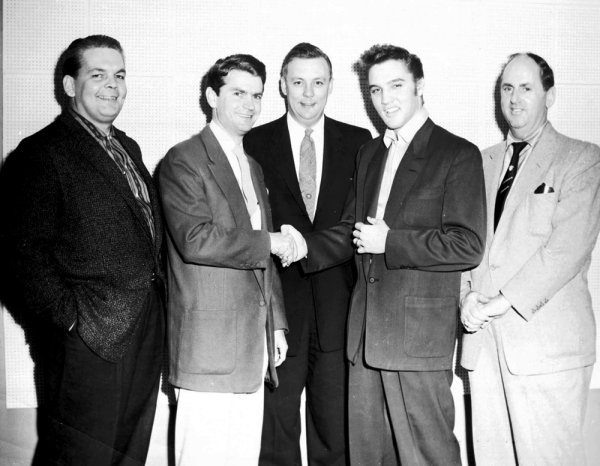
THE DARK SIDE OF ELVIS PRESLEY’S $40,000 DEAL: DID COLONEL TOM PARKER MAKE THE KING OF ROCK AND ROLL A PRISONER OF HIS OWN SUCCESS?
He helped turn a young truck driver from Memphis into the biggest rock-and-roll superstar on Earth. But decades later, shocking financial controversies, missed opportunities, and bitter legal battles would raise a disturbing question: Did Colonel Tom Parker build Elvis Presley’s empire only to gain extraordinary control over the man behind it?
On November 21, 1955, a $40,000 deal changed music history forever.
RCA Victor purchased Elvis Presley’s recording contract from Sun Records for $35,000, plus another $5,000 in royalties owed to the young singer. Elvis was just 20 years old. He had the voice, the looks, the rebellious energy, and the magnetic personality that would soon transform popular music.
Behind him stood a man who claimed he could turn that extraordinary talent into an international empire.
His name was Colonel Tom Parker.
To millions of fans, Parker was the brilliant businessman who recognized Elvis’s potential and helped make him a legend. But behind the spectacular success was a relationship that would eventually become one of the most controversial partnerships in entertainment history.
And the deeper historians examined the business arrangements, the more uncomfortable the questions became.
THE MYSTERIOUS MAN BEHIND THE KING
The first shocking detail about Parker was that his famous American identity concealed a very different past.
He was born Andreas Cornelis van Kuijk in Breda, the Netherlands, on June 26, 1909. He later entered the United States and built a career in American entertainment. Although he used the title Colonel, he had never been a commissioned military colonel. Louisiana Governor Jimmie Davis awarded him an honorary colonel title in 1948.
Parker transformed that honorary designation into a powerful professional identity.
But there was another mystery that would have enormous consequences for Elvis’s career.
Despite becoming one of the most internationally recognizable entertainers on the planet, Elvis never embarked on major concert tours across Europe or Asia. He performed in Canada in 1957, but his international touring career remained remarkably limited.
One widely discussed explanation involved Parker’s immigration circumstances. Biographers have suggested that he feared international travel could expose his past and create problems with American immigration authorities.
Whatever the complete explanation, the result was extraordinary.
The King of Rock and Roll conquered the world through records, movies, television, and radio, yet millions of international fans never had the opportunity to see him perform live.
Was this simply a business decision, or did Parker’s personal circumstances restrict opportunities that could have transformed Elvis’s career even further?
THE MONEY BEHIND THE MUSIC
As Elvis’s popularity exploded, the financial machinery surrounding his career became increasingly complicated.
Parker was not simply arranging performances. He was involved in recording agreements, movie contracts, merchandising, publishing arrangements, and other commercial opportunities connected to Elvis’s name.
One particularly controversial area involved songwriting and publishing rights.
Legendary songwriters Jerry Leiber and Mike Stoller, responsible for classics such as Hound Dog and Jailhouse Rock, later discussed the complicated business arrangements surrounding Elvis’s recordings.
Songwriting credits, publishing income, and recording royalties were separate financial interests, and the arrangements could have enormous consequences for everyone involved.
The issue was not merely who created the songs. It was who received money whenever those songs were sold, played, licensed, or performed.
And the controversy extended beyond the songwriters.
Scotty Moore and Bill Black had helped create the raw, electrifying sound that introduced Elvis to the world. They were there during the early Sun Records sessions, long before Elvis became a global phenomenon.
But in September 1957, both musicians left the group following disagreements over their compensation.
Contemporary newspaper reports described their dissatisfaction with their weekly earnings, particularly considering Elvis’s rapidly increasing popularity.
Imagine helping create the sound that defines an entire generation, only to feel that your financial rewards are not keeping pace with the success you helped make possible.
Their departure revealed an uncomfortable reality: the business surrounding Elvis was becoming enormously successful, but not everyone who helped build that success felt fairly rewarded.
THE SHOCKING 50 PERCENT COMMISSION
Perhaps the most controversial financial arrangement involved Parker’s management commission.
Under their business relationship, Parker received 50 percent of certain earnings. This was an extraordinary share compared with the commissions commonly received by entertainment managers.
Why did Elvis accept such an arrangement?
The answer may have involved years of loyalty, personal trust, professional dependence, and the fact that Parker had been involved in his career from its earliest explosive days.
Elvis had entered the entertainment industry as a teenager. Parker became a constant presence in his professional world.
But the financial relationship would eventually attract serious scrutiny.
In August 1981, Memphis Probate Judge Joseph Evans described Parker’s compensation as excessive and said it shocked the conscience of the court.
The judge ordered the Presley estate to pursue legal action concerning Parker’s business dealings with Elvis.
Investigations conducted on behalf of Elvis’s daughter, Lisa Marie Presley, raised questions about possible conflicts of interest, management commissions, and financial arrangements involving RCA.
Parker disputed the accusations and defended the agreements, maintaining that Elvis had participated in major business decisions.
The controversy was no longer just gossip about a powerful manager.
It had become a serious legal and financial battle involving one of the most valuable entertainment legacies in history.
THE 1968 COMEBACK THAT REMINDED THE WORLD WHO ELVIS REALLY WAS
In December 1968, Elvis delivered one of the most important performances of his career.
After years of appearing in Hollywood movies, many following repetitive formulas, he returned to television for the NBC special that became known as the ’68 Comeback Special.
Director Steve Binder wanted something authentic. He wanted the world to see the real Elvis again: the musician, the performer, and the revolutionary artist who had changed popular music.
Parker reportedly favored a safer Christmas-themed production.
But Elvis embraced Binder’s vision.
Wearing his famous black leather outfit, he delivered powerful performances that reminded audiences why he had once electrified an entire generation.
The special reignited public interest in Elvis as a live performer and helped prepare the way for his successful return to concert stages.
It also demonstrated something important.
Elvis still had his own artistic instincts. He was not simply a product of someone else’s business strategy.
And yet, despite this remarkable artistic comeback, Parker remained his manager.
THE $5.4 MILLION DEAL THAT CHANGED EVERYTHING
Then came March 1973.
In a controversial agreement with RCA, Elvis relinquished his future recording royalty income from more than 700 master recordings made before March 1973.
The total buyout was approximately $5.4 million.
The money was divided between Elvis and Parker, with the arrangements later becoming a major subject of legal controversy.
On paper, the deal offered an enormous immediate financial payment.
But consider what Elvis was giving up.
His recordings were not ordinary products with a short commercial lifespan. They were becoming timeless classics, and they would continue selling long after their original release dates.
By accepting a lump-sum payment, Elvis surrendered future artist royalties from those earlier recordings.
In the years that followed, investigators questioned whether the arrangement had been in Elvis’s best interests and whether Parker had received financial advantages that created a conflict with his responsibilities as manager.
Parker defended the transaction, arguing that Elvis and his father, Vernon Presley, had supported the decision.
The disagreement would become one of the central issues in the later legal dispute.
It was a deal worth millions, but its long-term financial consequences would remain controversial for decades.
THE HOLLYWOOD OPPORTUNITY ELVIS NEVER GOT
Another painful chapter emerged in the mid-1970s.
Barbra Streisand considered Elvis for the male lead in A Star Is Born, a major Hollywood project that could have offered him a different kind of acting career.
Elvis had spent years appearing in commercially successful movies, but many of those productions followed similar musical-comedy formulas.
He wanted more challenging opportunities.
The role in A Star Is Born could have been a chance to demonstrate his dramatic abilities and reinvent himself as an actor.
However, negotiations reportedly broke down amid disagreements involving financial demands, contractual arrangements, and billing.
Parker’s position became a significant part of the controversy.
The role eventually went to Kris Kristofferson.
For Elvis, it was another opportunity that disappeared before it could become reality.
And for fans who believed he possessed far greater acting potential than Hollywood had allowed him to demonstrate, the missed opportunity remains particularly frustrating.
THE BODYGUARDS WHO BROKE THEIR SILENCE
In 1976, three men who had been close to Elvis for years were dismissed: Red West, Sonny West, and Dave Hebler.
The following year, they published the controversial book Elvis: What Happened?
Their book described their concerns about Elvis’s health, lifestyle, and the people surrounding him.
Because they had worked so closely with the singer, their accounts attracted enormous attention.
However, their allegations were disputed, and their book should be understood as the testimony of former associates rather than an independently verified account of every event.
Still, their departure added another disturbing chapter to the story of a superstar whose private life was becoming increasingly complicated.
AUGUST 16, 1977: THE KING IS GONE
On August 16, 1977, Elvis Presley died at Graceland at just 42 years old.
The world was devastated.
Millions mourned the man whose music had changed popular culture forever.
But behind the grief, another struggle was beginning.
Elvis’s daughter, Lisa Marie Presley, was only nine years old. His estate now faced the enormous responsibility of protecting his assets, his music, and the commercial empire built around his name.
Parker’s business arrangements soon became the subject of intense legal scrutiny.
In 1981, Judge Joseph Evans ordered action concerning Parker’s compensation and financial dealings with Elvis.
The resulting dispute eventually led to a major settlement involving Parker, RCA, and the Presley estate.
In June 1983, an out-of-court agreement was announced. RCA agreed to pay Parker $1 million for his collection of Elvis master recordings, while the estate was to receive $1.1 million over ten years to settle its claims concerning Presley earnings.
The estate also agreed to drop its lawsuit against Parker in exchange for financial and contractual arrangements.
It was a complicated settlement, not a criminal conviction.
But it marked the end of Parker’s central involvement in the business affairs of the Presley estate.
The man who had once stood at the center of Elvis’s professional world was no longer controlling the empire in the same way.
SO, DID COLONEL TOM PARKER MAKE ELVIS PRESLEY — OR HOLD HIM BACK?
Parker’s legacy cannot be reduced to a simple story of villainy.
He recognized Elvis’s extraordinary potential, helped secure the RCA deal, negotiated opportunities, and played a major role in transforming a young Southern singer into an international superstar.
Without Parker, Elvis’s rise might have followed a very different path.
But that does not erase the financial controversies, the international touring limitations, the disputed business arrangements, or the questions raised by the Presley estate after his death.
Perhaps the most unsettling part of the story is that both things can be true.
Colonel Tom Parker helped build one of the greatest entertainment careers in history. At the same time, his management decisions and financial arrangements became the subject of serious criticism and legal scrutiny.
Elvis Presley gave the world music that will never disappear.
Yet the story behind his success reminds us that fame does not necessarily mean freedom, and enormous wealth does not always mean complete control over one’s own destiny.
The $40,000 deal of 1955 created the foundation of an empire. But the relationship that followed would raise questions that survived long after the King himself was gone.
And perhaps the most haunting question remains:
If Elvis Presley had been free to make every major career decision without the limitations of his manager, how much more could the King of Rock and Roll have achieved?
Was Colonel Tom Parker the genius who made Elvis Presley immortal, or did his management ultimately prevent Elvis from reaching his full artistic potential?
The truth behind the King deserves to be discussed.