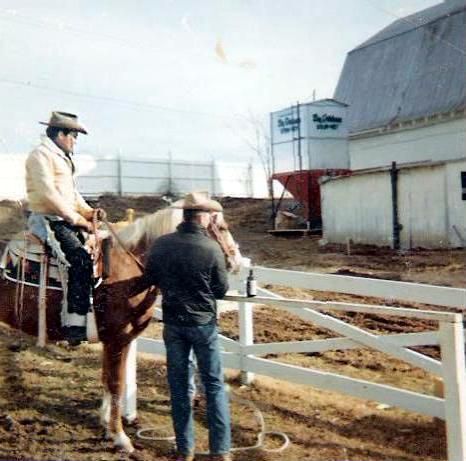
ELVIS SPENT $437,000 ON THIS RANCH — THEN HIS DREAM BEGAN TO FALL APART
Just before dawn in February 1967, Elvis Presley was driving down a quiet back road south of Memphis with Priscilla and several of the men closest to him. They had spent the night doing something surprisingly ordinary for Elvis: buying a Tennessee Walking Horse for his father, Vernon.
Nothing about that drive suggested they were about to stumble into a chapter of Elvis Presley’s life that would begin almost like a dream—and disappear before the year was over.
Then Elvis looked out the window.
On a hill overlooking a lake stood a white cross.
He told Allan to pull the truck over.
That single moment would soon lead Elvis to purchase 163 acres of land in Horn Lake, Mississippi, roughly 18 miles south of Graceland. He called the property Circle G, and what followed became one of the most extraordinary—and shortest-lived—experiments in Elvis’s life.
At the time, Elvis had already developed a fascination with horses. He had begun keeping them at Graceland, converting an old barn for the animals. But the number of horses kept growing. Elvis had a habit that people around him repeatedly noticed: when something made him happy, he wanted the people he cared about to experience it too.
Soon, horses weren’t just for Elvis.
They were for Priscilla. They were for Vernon. They were for members of Elvis’s inner circle.
And before long, Graceland simply wasn’t large enough for what Elvis had created.
Circle G seemed to offer the perfect answer.
The ranch came with a cottage, cattle, tractors, and plenty of open land. Elvis reportedly paid around $437,000 for the property—a huge investment for 1967.
But buying the ranch was only the beginning.
Elvis didn’t simply want somewhere to ride horses.
He wanted to create a place where the people closest to him could live alongside him.
Horses were purchased. Riding equipment followed. More cattle and ranch equipment were brought in. On February 8, Elvis purchased three new GMC pickup trucks in Senatobia, Mississippi—one red, one blue, and one green.
Eventually, the ranch had a fleet of trucks.
Then came something even more extraordinary.
Nine house trailers were brought onto the property near the lake.
The goal was essentially to give members of Elvis’s inner circle their own places to stay. Electricity, water, and sewage had to be arranged.
In a matter of weeks, a cattle ranch had begun transforming into something resembling a tiny private community.
And Elvis was at the center of it.
By some accounts, the total spending connected to Circle G—including the land, animals, vehicles, trailers, and improvements—approached one million dollars.
For 1967, that was an astonishing amount of money.
And it reportedly worried the person who had perhaps the strongest reason to worry: Elvis’s father, Vernon.
Vernon was involved in overseeing Elvis’s finances, and the rapid spending reportedly concerned him enough that he raised the issue with Colonel Tom Parker.
Yet for Elvis, Circle G wasn’t simply another expensive possession.
For a brief period, it appeared to be a place where he could escape the pressures of celebrity.
He rode horses.
He spent time with his friends.
He shot targets on the property.
He picnicked near the lake.
For a man whose entire adult life had been lived under an enormous spotlight, Circle G offered something that money could rarely buy:
privacy.
And then the ranch became even more significant.
On May 1, 1967, Elvis married Priscilla in Las Vegas.
Circle G also became an important private retreat for Elvis and Priscilla around the beginning of their married life.
Priscilla later described the cottage as small and beautifully decorated—far removed from the grandeur associated with Graceland.
That detail makes the story even more fascinating.
The ranch had begun as a place for Elvis and his friends, a massive project built around horses, friendship, and his instinct to share his success.
But for a few days, it became something far more intimate.
It became part of the beginning of Elvis and Priscilla’s married life.
And yet, only months later, the entire experiment was effectively over.
By November 4, 1967, an auction was held at Circle G to dispose of equipment that was no longer needed. But the ranch itself was not sold until May 1969.
The trailers disappeared.
The trucks were sold.
The horses were moved or sold, with some returning to Graceland.
The small private community Elvis had created simply came apart.
And perhaps the strangest part is how quickly it happened.
Less than a year earlier, Elvis had seen a cross at dawn and seemingly felt drawn to the land.
Within months, he had transformed it into his own private world.
Then, before the year ended, he let it go.
There was no dramatic public farewell.
No great announcement.
No famous final night.
Just an auction.
Vehicles changed hands. Equipment disappeared. The people who had briefly lived beside the lake moved on.
And Circle G became another forgotten chapter in Elvis Presley’s extraordinary life.
It’s tempting to say the ranch failed because of money, or because Elvis became tired of it, or because his career was changing.
But the historical record doesn’t give us a simple, definitive answer.
What we do know is that Elvis’s life was entering a major transition. His movie career was nearing its breaking point, and his return to live performance was approaching. Soon would come the 1968 television special that helped reshape his career.
Whether Circle G directly influenced those changes is difficult to prove.
But the timing is striking.
One chapter was closing.
Another was beginning.
And Circle G disappeared somewhere in between.
Perhaps that is what makes the story so compelling.
Elvis didn’t simply buy 163 acres.
For a few months, he tried to build an entire private world around himself and the people he loved.
He took something that made him happy—horses—and expanded it until it became a community.
He saw a piece of land beneath a cross at sunrise and acted.
He spent enormously.
He gave generously.
He built quickly.
And then, just as quickly, he walked away.
Today, the most haunting image may not be the expensive trucks or the horses or the trailers.
It’s that original white cross on the hill.
Because everything Elvis built around it eventually disappeared.
The ranch changed hands.
The vehicles were gone.
The trailers were gone.
The temporary community was gone.
But the story remained.
A quiet morning.
A white cross.
A sudden decision.
A million-dollar dream.
Nine months of extraordinary generosity.
And then—nothing.
Circle G may have been one of the shortest-lived dreams Elvis Presley ever created.
But for those few months in 1967, it offered him something that Graceland, Hollywood, and the world of celebrity could never completely provide:
a place where Elvis could simply ride a horse, sit beside a lake, and be surrounded by the people he trusted.
And perhaps that’s why the story still feels almost impossible.
He built an entire world.
And then, before most people even realized it was there, he let it disappear.