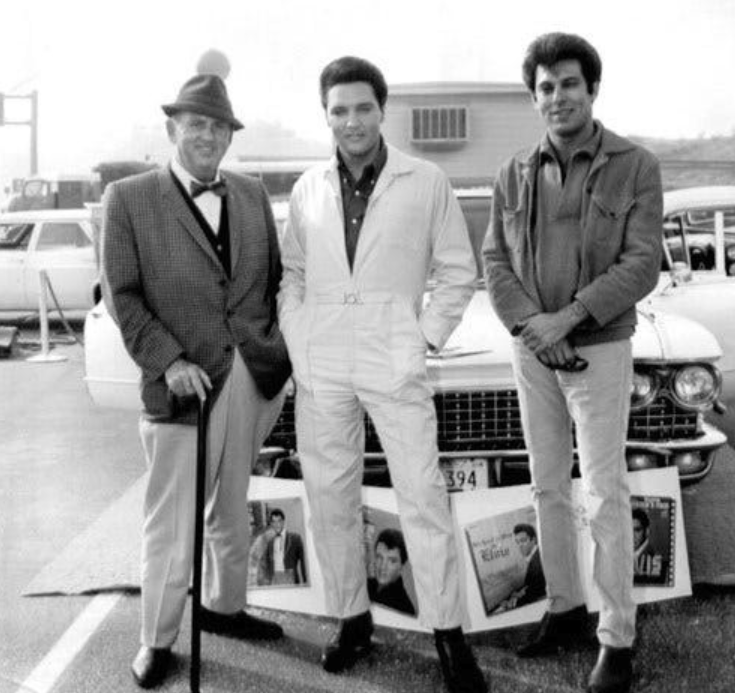
ELVIS PRESLEY’S SECRET SPIRITUAL SEARCH — THE QUESTIONS HE COULDN’T ESCAPE
Los Angeles, April 30, 1964.
Elvis Presley was 29 years old, already one of the most famous entertainers on Earth, and yet that afternoon he revealed something that had almost nothing to do with fame, money, movies, or music.
On April 30, 1964, Elvis Presley was at his rented Bel-Air home in Los Angeles when a young hairstylist named Larry Geller arrived to style his hair. Geller was not a celebrity. He was not a powerful executive. He was simply someone who happened to be there.
But Elvis opened up.
According to Geller’s later accounts, Elvis spoke about a lifelong feeling that something was missing. He had achieved almost everything a young man could dream of, yet he was still searching for an answer he could barely put into words.
What happened next would become one of the most unusual relationships in Elvis Presley’s life.
Instead of immediately leaving for his next appointment, Elvis reportedly stayed and talked with Geller for hours.
Behind the image of the dazzling entertainer was another Elvis — deeply curious, intensely spiritual, and constantly questioning the meaning of his own life.
And this side of Elvis is often overshadowed by the jumpsuits, screaming crowds, Hollywood films, and legendary performances.
But it may have been the side that mattered most to him.
THE BOY FROM TUPELO NEVER LEFT THE CHURCH BEHIND
Before Elvis became “The King,” he was a boy growing up in Tupelo, Mississippi.
Religion and gospel music were woven into his childhood.
His family attended church, and gospel singing was not simply entertainment. It was emotional, communal, and deeply personal.
Elvis absorbed that atmosphere at an early age.
He saw people sing, pray, cry, and respond emotionally to music. Long before he understood the commercial power of a song, he understood its emotional power.
That connection never completely disappeared.
Even after Elvis became a global superstar, gospel music remained one of the most important musical languages in his life.
His career would eventually produce countless rock-and-roll classics, but his only three Grammy Awards were all connected to gospel recordings.
That fact is astonishing.
The Recording Academy never gave Elvis a Grammy for “Hound Dog,” “Jailhouse Rock,” or “Suspicious Minds.”
His Grammy victories came for gospel performances, including “How Great Thou Art” and “He Touched Me.”
For a man who changed popular music forever, the industry’s most prestigious recognition of his recording artistry came through sacred music.
That tells us something important about where Elvis’s heart may have been.
THE BIBLE THAT REVEALED ANOTHER ELVIS
Elvis did not merely sing gospel.
Those who knew him well described a man who read the Bible and explored spiritual ideas throughout his life.
His Bible, preserved at Graceland, contains markings and annotations that provide a glimpse into his private thinking.
There were passages that mattered enough for him to underline and return to.
This was not the carefully constructed public image of Elvis Presley.
These annotations offer a rare glimpse into Elvis’s private interests and thoughts.
And then Larry Geller entered his world.
Geller introduced Elvis to books and ideas that extended far beyond traditional Christian teaching.
Their conversations reportedly touched on philosophy, mysticism, numerology, Eastern thought, and spiritual writings.
Elvis became fascinated by ideas that might help explain consciousness, destiny, and the purpose of human existence.
He wanted answers.
But the deeper he searched, the more complicated the questions became.
THE BOOKS THAT ANGERED COLONEL PARKER
Eventually, Elvis’s spiritual exploration became a source of tension.
Colonel Tom Parker, the manager who controlled much of Elvis’s professional career, reportedly viewed Geller and his influence with suspicion.
Geller was derisively referred to as ‘the Swami’ by people around Elvis, and Parker reportedly viewed his influence with suspicion.
To Parker, Elvis was a valuable entertainment property whose career depended on discipline, schedules, movies, records, and appearances.
Spiritual philosophy was a distraction.
For Elvis, however, it was something much more personal.
The conflict represented a much larger struggle inside Elvis’s life.
One part of him belonged to the entertainment machine.
Another part desperately wanted to understand why he had been given the extraordinary life he was living.
And those two worlds increasingly collided.
THE MYSTERY OF JESSE GARON PRESLEY
Perhaps nothing affected Elvis more deeply than the death of his identical twin brother, Jesse Garon Presley.
Jesse was stillborn on January 8, 1935 — the same day Elvis was born.
Elvis grew up carrying the knowledge that his twin had existed, but had never lived outside the womb.
That loss became part of his personal mythology.
Elvis reportedly believed that his own life somehow carried a responsibility beyond himself.
The fame.
The music.
The millions of people who adored him.
The extraordinary opportunities.
At times, he seemed to connect his own existence with the life Jesse never had.
Whether viewed spiritually or psychologically, the presence of his twin remained significant throughout Elvis’s life.
The superstar who appeared larger than life to millions may privately have felt that he was living with an absence that could never be filled.
THE DESERT VISION
One of the most extraordinary stories associated with Elvis’s spiritual search allegedly occurred while he and Geller were traveling through the Mojave Desert.
According to Geller’s later recollections, Elvis looked toward the sky and became convinced that he saw a face forming in the clouds.
He reportedly described the image as changing before appearing to resemble Jesus.
Whatever actually happened that night, the story illustrates how seriously Elvis approached his spiritual experiences.
He was not simply collecting unusual books or talking about abstract philosophy.
He was trying to interpret his own existence.
He wanted to know whether his life had a larger purpose.
And that question would follow him for years.
ELVIS WAS LOOKING FOR SOMETHING MONEY COULDN’T BUY
By the late 1960s, Elvis had achieved almost unimaginable success.
But success did not necessarily bring peace.
Hollywood had consumed years of his career.
He had spent much of the 1960s making movies and recording material that did not always reflect the artistic ambition he had once possessed.
He had not performed a full live concert for years.
Then came the 1968 television special.
Then the return to the stage.
Then Las Vegas.
Elvis was back.
But the spiritual questions remained.
His greatest comeback could not answer them.
Neither could the money.
Neither could the women, cars, mansions, jewelry, fame, or adoration.
THE QUESTION THAT NEVER DISAPPEARED
By the final years of Elvis’s life, his physical health was deteriorating.
Yet accounts from people around him continue to describe someone who remained interested in spiritual questions.
The search had never really stopped.
That is what makes the story so fascinating.
The public saw Elvis Presley as a larger-than-life figure.
But behind closed doors, he could be vulnerable, confused, curious, frightened, and deeply thoughtful.
He had spent his entire life searching for something he could not clearly define.
Perhaps that is why gospel music remained so powerful to him.
When Elvis sang gospel, he did not need to explain everything.
He could simply sing.
And sometimes his voice seemed to reveal emotions that words could not contain.
The three Grammy Awards preserved at Graceland tell a remarkable story.
The greatest rock-and-roll superstar of his generation was honored by the Recording Academy not for the songs that made him a cultural revolution, but for songs connected to his faith.
That contrast is almost impossible to ignore.
The Elvis of the stage wore spectacular clothes.
The Elvis of Hollywood lived inside an enormous celebrity machine.
But another Elvis sat quietly with books, marked his Bible, asked questions, remembered his lost twin, and searched for meaning.
He had conquered the world.
Yet he still felt as though something was missing.
And perhaps that is the greatest mystery of Elvis Presley.
He spent his entire adult life surrounded by millions of people — but the question he carried inside was profoundly personal.
What was he really searching for?
Maybe it was God.
Maybe it was purpose.
Maybe it was peace.
Maybe it was an explanation for why a poor boy from Tupelo had been given a voice that could move millions.
Or perhaps it was something even he could never name.
The answer may be hidden not in the gold records or the famous photographs, but in the quiet moments — in the Bible pages he marked, the gospel songs he loved, the questions he asked, and the spiritual journey he never completely abandoned.
That was the Elvis most people never saw.
And perhaps, behind all the fame, that was the real Elvis Presley.