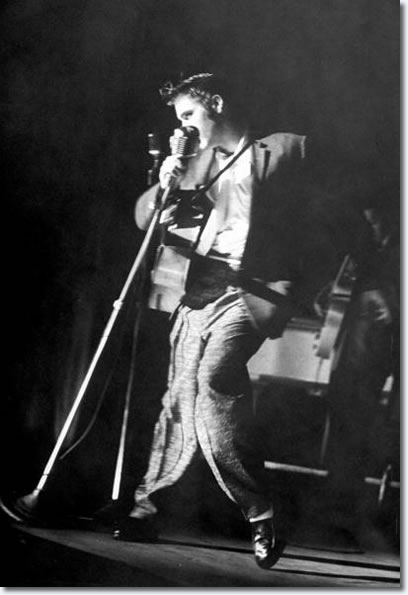
ELVIS PRESLEY’S FLORIDA SECRET REVEALED: THE STATE THAT IGNITED THE KING’S METEORIC RISE TO FAME
For decades, fans have associated Elvis Presley’s rise to superstardom with Memphis, Sun Records, Las Vegas, and Hollywood. But a fascinating new presentation by award-winning journalist and author Bob Kealing reveals a powerful—and often overlooked—chapter of the King’s story: Florida may have been one of the most important places in the making of Elvis Presley.
Seventy years after Elvis first stormed across the Sunshine State, the memories of those extraordinary performances remain astonishing. According to Kealing, Elvis performed 59 live shows in Florida in just 15 months between May 1955 and August 1956—more appearances than he made in Tennessee and Texas combined.
That statistic alone changes the way we understand Elvis’s early career.
When he first arrived in Florida in 1955, Elvis was still an unknown young performer, often buried near the bottom of a concert bill. Yet something extraordinary happened wherever he appeared. Audiences reacted with an intensity that shocked promoters, fellow performers, journalists, police officers—and even Elvis himself.
By the summer of 1956, everything had changed.
The unknown young man had become the hottest recording artist in America.
And Florida had been there for the transformation.
FROM UNKNOWN TEENAGER TO THE KING OF ROCK ’N’ ROLL
Kealing’s presentation, based on his book Elvis Ignited, takes audiences back to the chaotic Florida tours that helped establish Elvis’s reputation.
During his first Florida appearances, Elvis could still be treated as a supporting act. But the crowds quickly became impossible to ignore. Established country stars reportedly found themselves frustrated because audiences were becoming obsessed with the young newcomer.
Girls screamed.
Teenagers pushed forward.
Police struggled to control crowds.
And Elvis simply kept performing.
Within months, the atmosphere surrounding him had transformed completely.
By August 1956, Elvis was no longer an opening act hoping to be noticed. He was a national phenomenon capable of creating near-hysteria wherever he appeared.
One of the clearest examples came on August 7, 1956, at the Florida Theatre in St. Petersburg.
Elvis performed three shows that day.
Attendance was estimated at roughly 6,500 people.
And the crowd response was extraordinary.
Six girls reportedly required treatment for heat exhaustion and fainting. Police also dealt with hysterical teenagers around the theater. Most remarkably, officers stopped 14 teenagers who attempted to climb the fire escape toward Elvis’s dressing room.
That detail captures the atmosphere better than almost anything else.
The madness surrounding Elvis had become part of the spectacle.
And perhaps most remarkable of all was the fact that Elvis was only 21 years old.
THE EXHAUSTED YOUNG MAN BEHIND THE HYSTERIA
Behind the screaming crowds was a very different Elvis.
During one Florida interview, Elvis reportedly admitted that the relentless schedule could mean performing three or even four shows in a single day and getting only a few hours of sleep each night.
Photographs from the period reveal a young man who looked exhausted despite his extraordinary success.
He had gone from being a virtually unknown performer in 1955 to being called the King of Rock ’n’ Roll in 1956.
The transformation was breathtaking.
But Florida wasn’t simply a place where Elvis happened to perform.
According to Kealing, Florida was his breakout state.
THE SONG THAT CHANGED EVERYTHING—AND THE FLORIDA CONNECTION
One of the most explosive revelations from Kealing’s research involves the story behind “Heartbreak Hotel,” Elvis’s first million-selling record.
The song’s connection to Florida runs surprisingly deep.
Mae Axton, a Jacksonville teacher and aspiring songwriter, was hired as a publicist to accompany Elvis during his Florida touring days. She boldly told the young singer that she intended to write his first million-selling hit.
She eventually helped create it.
A newspaper story about a mysterious death inspired the idea of a lonely street and became the foundation for “Heartbreak Hotel.” Axton and musician Tommy Durden developed the song together, and an early demonstration was recorded in Axton’s Jacksonville living room.
Then came the moment that changed Elvis’s career.
When Elvis heard the demo, he reportedly agreed to record it.
The song became a sensation.
And today, the Jacksonville house where the song was written and first demonstrated stands as a remarkable piece of hidden Elvis history.
Think about that for a moment:
One of the most important songs in Elvis Presley’s career was born inside an ordinary Florida home.
THE JUDGE WHO THREATENED TO ARREST ELVIS
But Florida also exposed Elvis to something far more complicated than adoration.
By 1956, his provocative stage style had become a national controversy.
Some adults considered his movements dangerous or obscene. In Jacksonville, a judge reportedly warned Elvis that if he performed certain movements onstage, he could be arrested.
So what did Elvis do?
During “Hound Dog,” instead of giving the authorities exactly what they feared, he reportedly reduced his movement to a tiny gesture involving his pinky.
It became a remarkable moment of resistance.
Elvis was not simply entertaining anymore.
He had become a cultural battleground.
Adults were debating him.
Teenagers were defending him.
Newspapers were attacking him.
And millions of young people were watching.
THE WOMEN JOURNALISTS WHO SAW WHAT OTHERS MISSED
Kealing also highlighted the Florida women journalists who refused to dismiss Elvis as a passing sensation.
While some male reporters mocked Elvis and ridiculed his teenage fans, journalists such as Ann Roe and Elvalee Donaldson approached him differently.
They looked beyond the screaming crowds.
They saw a young artist who could be humble, respectful, hardworking, and surprisingly shy.
One account described Elvis picking up a broom and cleaning his dressing room while being interviewed.
That image is striking because it contradicts the exaggerated caricature that some newspapers were creating.
The supposedly dangerous young rebel could also be a polite Southern boy simply trying to make his way through an overwhelming new world.
COLONEL PARKER’S DARK FLORIDA HISTORY
Another fascinating part of the story involves the man who would become one of the most powerful—and controversial—figures in Elvis’s career: Colonel Tom Parker.
Before managing Elvis, Parker had already built a strange and complicated history in Florida.
His connection to the state went back to his military years and later his work promoting entertainment in the Tampa area.
According to the presentation, Parker’s career included an astonishing series of twists before he eventually became associated with Elvis.
The story becomes even more fascinating because Parker was reportedly already involved in promoting major shows at Tampa’s Homer Hesterly Armory before Elvis became a superstar.
And that same venue would become historically important to Elvis.
It was the only Florida venue Elvis performed at on all four of his early Florida tours.
ELVIS AND THE YOUNG TOM PETTY
Perhaps one of the most beautiful stories from this forgotten Florida history involves another future music legend: Tom Petty.
In 1961, Elvis was filming Follow That Dream in Florida.
A young Tom Petty was given the opportunity to meet him.
Petty later remembered seeing Elvis arrive in a white limousine surrounded by screaming fans and police trying to control the scene.
For the young Petty, the encounter was transformative.
He saw Elvis not simply as a singer, but as something almost larger than life.
Soon, Petty was trading childhood toys and interests for Elvis records.
Years later, he would become one of Florida’s greatest musical exports himself—and eventually a member of the Rock & Roll Hall of Fame.
That makes the connection almost poetic:
Elvis helped ignite Florida’s rock ’n’ roll story, and a young Florida boy who witnessed Elvis firsthand would later help carry that musical legacy forward.
ELVIS WANTED A HOME IN FLORIDA
And there was another surprising revelation.
Elvis apparently considered buying a home in St. Cloud in the mid-1970s.
He reportedly wanted to establish a Florida residence and even envisioned building a theater on the property.
The plan ultimately failed because local zoning authorities would not approve the changes he wanted.
Florida therefore came remarkably close to becoming Elvis’s permanent home.
But it never happened.
THE LASTING LEGACY OF ELVIS IN FLORIDA
Perhaps the most emotional part of Kealing’s presentation was the testimony of people who witnessed Elvis during those explosive early years.
Some fans who saw him in 1956 are still alive today.
One woman reportedly became emotional when she realized that she was sitting in a historical presentation exactly 70 years after seeing Elvis perform as a teenager.
Another remarkable witness, Artist Bell, saw Elvis during his early Florida years—and later saw his final Jacksonville performance in 1977.
Her memories captured both sides of Elvis’s extraordinary journey.
The young Elvis had once raced through Florida as an energetic 20-year-old beginning his climb toward fame.
Two decades later, audiences were seeing a very different man.
Yet according to her recollection, one thing had never disappeared:
his voice.
And that may be the most powerful lesson from this forgotten chapter of Elvis Presley history.
Florida was not merely another stop on his touring schedule.
It was where crowds first exploded around him.
It was where journalists documented his transformation.
It was where “Heartbreak Hotel” was born.
It was where Colonel Parker’s entertainment empire had roots.
It was where young Tom Petty encountered Elvis and found inspiration.
And it was where the world began to understand that this young man from Memphis was becoming something much bigger than a recording artist.
He was becoming Elvis Presley.
The King.
And 70 years later, the echoes of those Florida screams still haven’t completely disappeared.