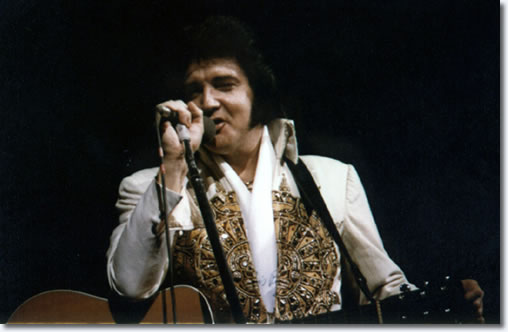
ELVIS PRESLEY’S FINAL CONCERT: THE NIGHT NOBODY KNEW WAS GOODBYE
June 26, 1977. Market Square Arena. Indianapolis, Indiana.
The lights went down.
Nearly 18,000 people rose to their feet, screaming the name of the man who had defined American music, celebrity, and rock ’n’ roll for more than two decades.
Elvis Presley walked onto the stage one final time.
Nobody in that arena knew it.
Not the fans.
Not the musicians.
Not the people working backstage.
And perhaps not even Elvis himself.
There was no farewell speech. No dramatic final bow. No announcement that history was about to close one of the most extraordinary chapters in popular music.
It was simply another Elvis Presley concert.
Or at least, that is what everyone believed.
Just 51 days later, Elvis Presley would be dead.
He was only 42 years old.
And suddenly, that ordinary Sunday night in Indianapolis would become something entirely different: the final live performance of the King of Rock ’n’ Roll.
THE KING WAS STILL ON STAGE — BUT SOMETHING HAD CHANGED
By the summer of 1977, Elvis had been living inside an exhausting cycle of concerts, travel, hotels, rehearsals, airplanes, and performances for years.
The machine surrounding Elvis Presley never seemed to stop.
There was always another city.
Another audience.
Another paycheck.
Another show.
Colonel Tom Parker had built an enormous business around Elvis, and keeping the King working was central to that machine.
But Elvis was no longer the explosive young performer who had shocked television audiences in the 1950s.
He was no longer the lean, dangerous figure who had electrified America during the 1968 comeback.
The man walking onto stages in 1977 was a profoundly different Elvis.
Years of health problems, prescription-drug dependence, poor eating habits, lack of sleep, and the relentless pressures of fame had taken an enormous toll.
Photographs from the final months are difficult to look at today.
The face is familiar.
The jumpsuit is familiar.
The voice is familiar.
But the physical decline is impossible to ignore.
Elvis often appeared swollen and exhausted. His movements could be slow. His energy could fluctuate dramatically.
And sometimes, he struggled with songs he had performed countless times before.
Yet something extraordinary happened when the music began.
Elvis could still become Elvis.
For brief moments, the old magic returned.
The voice could suddenly explode with power.
A familiar phrase could carry the emotional weight that had made millions of people fall in love with him.
The audience could forget everything else.
For a few minutes, they weren’t watching a sick 42-year-old man struggling under the weight of fame.
They were watching Elvis Presley.
The King.
THE SIGNS WERE THERE
This is perhaps the most painful part of the story.
The warning signs weren’t invisible.
People close to Elvis could see that something was wrong.
Musicians saw it.
Friends saw it.
Family members saw it.
People working around him saw it.
But Elvis was Elvis.
And there was an enormous psychological barrier surrounding him.
How do you tell the King that he needs to stop?
How do you tell the man who has spent his entire adult life performing that he cannot keep performing?
How do you tell someone whose entire world depends upon the next concert that there should be no next concert?
The people around Elvis were caught between love, loyalty, fear, money, responsibility, and denial.
Some may have believed they could still help him.
Some may have been afraid of confronting him.
Some may have depended upon him financially.
And some may simply have hoped that tomorrow would be better.
But tomorrow kept becoming another show.
Another city.
Another performance.
Another attempt to keep the machine moving.
INDIANAPOLIS: THE FINAL NIGHT
On June 26, Elvis arrived at Market Square Arena.
For the people inside, this wasn’t history.
It was entertainment.
It was Elvis.
Fans had traveled to see him from different parts of the country.
Some had loved him since the 1950s.
Others were teenagers seeing him for the first time.
They weren’t thinking about death.
They weren’t thinking about Graceland.
They weren’t thinking about August 16.
They certainly weren’t thinking about the possibility that this would be the last time they would ever see Elvis Presley perform live.
They were simply waiting for the King.
And when he appeared, the reaction was enormous.
The screams came exactly as they had for years.
For those few moments, the mythology was still alive.
Elvis was still capable of commanding thousands of people simply by walking onto a stage.
But beneath the spectacle, the physical strain was becoming increasingly apparent.
He sat during portions of the performance.
His voice showed fatigue.
Some songs were abbreviated.
There were moments of extended talking between songs.
To an ordinary audience member, these things might not have seemed particularly important.
But viewed through the lens of history, they become haunting.
Every pause feels longer.
Every movement feels heavier.
Every smile carries a strange finality.
And every word sounds like something we should have been listening to more carefully.
THE MOST HAUNTING THING ABOUT THE FINAL CONCERT
There was no disaster.
No collapse.
No dramatic announcement.
No moment when Elvis looked at the audience and said goodbye.
That is what makes the night so disturbing.
Nothing happened.
The show ended.
The lights came up.
The audience went home.
The musicians packed their equipment.
The crew continued doing their jobs.
Everyone assumed there would be another Elvis concert.
Of course there would.
There had always been another one.
That’s how Elvis’s life had worked for years.
He would go home.
Rest.
Return to the stage.
And the cycle would continue.
But this time, it didn’t.
That ordinary ending became the final ending.
Elvis walked off the stage.
And he never walked onto another one.
51 DAYS LATER
After Indianapolis, Elvis returned to his world at Graceland.
The next tour was supposed to continue.
Life appeared to move forward.
But behind the gates, the problems surrounding Elvis had not disappeared.
His dependence on prescription medications had become increasingly serious.
His health continued to deteriorate.
His personal world had become increasingly isolated.
And the enormous protective bubble around him made it difficult for the outside world to understand just how serious the situation had become.
Then came August 16, 1977.
Elvis was found unresponsive at Graceland.
He was rushed to Baptist Memorial Hospital in Memphis.
He was pronounced dead that afternoon.
Elvis Presley was 42 years old.
The world stopped.
Fans cried.
Radio stations played his music.
Newspapers printed enormous headlines.
People gathered outside Graceland.
The King was gone.
And suddenly, that concert in Indianapolis became something nobody had understood it to be while they were actually living through it.
A goodbye.
A farewell without a farewell.
THE PHOTOGRAPHS BECAME HAUNTING
Before August 16, photographs from Indianapolis were simply photographs.
Elvis on stage.
Elvis in his jumpsuit.
Elvis performing.
Elvis smiling.
Elvis surrounded by musicians and fans.
After August 16, every photograph changed.
The meaning changed.
The context changed.
The audience changed.
People began looking at those images differently.
They began searching for clues.
Was he tired?
Did he look ill?
Was something in his expression different?
Did anyone realize?
Could anyone have known?
Could anyone have stopped what was coming?
These questions have haunted Elvis fans for generations.
And perhaps there is no satisfying answer.
Because history is cruel that way.
We know the ending.
The people inside the story did not.
DID ELVIS KNOW?
This is one of the most fascinating questions surrounding that final night.
Did Elvis understand that his health was deteriorating?
Did he know how serious things had become?
Did he believe he could recover?
Did he simply assume he would continue performing because that was what Elvis Presley had always done?
There are stories and recollections about Elvis appearing tired, reflective, or emotionally distant during his final weeks.
But we have to be careful.
Memory is not a perfect recording.
People remembering events after a tragedy often reinterpret ordinary moments through the knowledge of what happened later.
A quiet conversation that seemed meaningless in June can feel prophetic after August.
A tired expression can suddenly look like a warning.
A pause can feel like a farewell.
That doesn’t make those memories false.
But it reminds us that hindsight can be powerful.
And sometimes dangerous.
THE TRAGEDY WAS BIGGER THAN ONE NIGHT
The real story of Elvis’s final concert isn’t simply that he performed on June 26 and died 51 days later.
The deeper tragedy is the system surrounding him.
Elvis had become too valuable to stop.
Too famous to appear vulnerable.
Too important to disappoint audiences.
Too central to an enormous financial operation.
The world wanted Elvis Presley to remain the King forever.
The business surrounding him needed him to remain the King.
And perhaps Elvis himself didn’t know how to be anything else.
That combination created a dangerous illusion.
As long as Elvis could walk onto the stage, everything must be okay.
As long as thousands of people were still screaming, the machine could continue.
As long as there was another concert on the schedule, tomorrow would take care of itself.
But fame cannot make a human body immortal.
Money cannot make illness disappear.
And applause cannot save someone who is falling apart behind the curtain.
NO FINAL BOW
That’s why June 26, 1977 remains so haunting.
Elvis Presley did not get the grand farewell that a figure of his magnitude might have deserved.
There was no final speech.
No goodbye to his fans.
No dramatic closing number designed to become his last.
There was simply a man walking onto a stage and doing what he had done thousands of times before.
Performing.
And when the show ended, everyone assumed there would be another.
There wasn’t.
That is perhaps the most heartbreaking truth of all.
The final moment of Elvis Presley as a live performer did not feel historic.
It felt ordinary.
And sometimes history doesn’t announce itself.
Sometimes it looks like a normal Sunday night.
Sometimes the final photograph doesn’t look like a final photograph.
Sometimes the last song doesn’t sound like a last song.
Sometimes the last wave isn’t a goodbye.
You only discover the meaning afterward.
ELVIS WAS STILL THE KING
Whatever his physical condition, whatever mistakes surrounded him, whatever failures occurred behind the scenes, one thing remained undeniable:
Elvis Presley still had the ability to move people.
For more than two decades, he had transformed music.
He changed the relationship between performers and audiences.
He changed fashion.
He changed television.
He changed celebrity.
He became one of the first truly global entertainment superstars.
And on June 26, 1977, even while his body was failing him, thousands of people still stood and screamed his name.
That is the paradox of Elvis’s final performance.
A man was visibly struggling.
Yet the legend remained enormous.
The body was weakening.
The King was still there.
THE QUESTION THAT NEVER GOES AWAY
Nearly half a century later, the Indianapolis concert still forces us to ask uncomfortable questions.
Could the people around Elvis have done more?
Could someone have stopped the touring?
Could someone have confronted him more forcefully?
Could his doctors have acted differently?
Could his inner circle have broken through the walls surrounding him?
Or had the situation become too complicated, too deeply rooted, and too difficult to reverse?
We may never know.
But perhaps the most important lesson isn’t about blaming one person.
It’s about what happens when an entire world becomes invested in pretending that everything is okay.
Elvis Presley wasn’t surrounded by strangers.
He was surrounded by people.
And yet, in the final years of his life, he could still become profoundly isolated.
That may be the darkest irony of his story.
The most famous man in the room could still be the loneliest person in it.
THE LAST TIME
On June 26, 1977, nearly 18,000 people watched Elvis Presley perform.
They thought they were watching another concert.
They were actually witnessing the closing chapter of an era.
Fifty-one days later, Elvis Presley would be gone.
The fans would never hear that voice live again.
The musicians would never share another stage with him.
The lights would go down again and again in arenas around the world.
But Elvis would never walk back out.
There was no final bow.
There was no goodbye.
There was only a Sunday night concert in Indianapolis.
And then silence.
That is what makes Elvis Presley’s final performance so heartbreaking.
It wasn’t spectacular because it was his last.
It became spectacular because we discovered afterward that it was.
And perhaps that is the greatest lesson hidden inside the final night of the King:
The most historic moments in our lives rarely tell us that they are historic while they are happening.
Sometimes they simply pass by.
And only later, when everything has changed, do we realize what we were watching.
June 26, 1977 wasn’t supposed to be goodbye.
But it was.
What do you think? Could the people around Elvis have done more to save him, or had his tragedy become almost impossible to stop by the summer of 1977?
Share your thoughts in the comments—and share this story with someone who still remembers why Elvis Presley was called The King.