ELVIS PRESLEY NEVER TOURED THE WORLD — AND THAT MAY BE THE MOST SHOCKING PART OF HIS LEGACY
Imagine becoming one of the most famous people on Earth without ever performing a concert in Europe, Asia, South America, or Australia.
That was Elvis Presley.
During a career that transformed popular music, Elvis performed thousands of times, appeared on television, starred in movies, sold millions of records, and became an international cultural icon. Yet unlike almost every modern superstar, he never embarked on a conventional world tour. His live performances outside the United States were limited to Canada in 1957.
And somehow, the entire world still knew his name.
That is what makes Elvis’s fame so difficult to compare with anyone today.
Before he became “The King,” Elvis Aaron Presley was a poor young man from Tupelo, Mississippi. Born on January 8, 1935, Elvis grew up in a family that struggled financially. His twin brother, Jesse Garon, was stillborn, leaving Elvis as the only surviving child.
For his 11th birthday, Elvis reportedly wanted a bicycle or a rifle. Instead, his mother Gladys helped him buy a guitar.
That inexpensive guitar would eventually become part of music history.
Elvis had no formal musical training. He learned by listening, absorbing gospel music from church, blues from Memphis, and country music from the radio and local performers. At first, however, very few people saw him as a future superstar.
He was even told that he should forget about becoming a singer.
Then came Sam Phillips and Sun Records.
During a recording session with guitarist Scotty Moore and bassist Bill Black, Elvis suddenly began performing “That’s All Right,” transforming the song with a sound that seemed to sit between country and rhythm and blues.
It was different.
Almost impossible to categorize.
When Memphis DJ Dewey Phillips played the recording on the radio, listeners immediately wanted to know who the mysterious singer was. Elvis was invited onto the show, and the response helped launch him toward national attention.
By 1956, everything changed.
“Heartbreak Hotel” became a massive hit. Elvis appeared on television, and his combination of voice, charisma, clothing, movement, and stage presence created a cultural explosion unlike anything America had experienced before.
His appearance on The Ed Sullivan Show became one of the defining television moments of the decade. Millions watched.
Suddenly, Elvis wasn’t simply a successful singer.
He was a national phenomenon.
Then came the Army.
In 1958, Elvis was drafted into the United States Army. His famous hair was cut, his career was temporarily interrupted, and many people wondered whether America would simply move on without him.
It didn’t.
After serving in Germany, Elvis returned in 1960 and immediately reclaimed his place at the top of popular entertainment.
But there was one enormous limitation to his career: Elvis never became a true global touring performer.
The explanation most commonly associated with this is his manager, Colonel Tom Parker. Parker’s complicated immigration history and lack of American citizenship have long been cited as one major reason he was unwilling to take Elvis on an international tour.
Whatever the full combination of reasons, the result was extraordinary.
Elvis remained largely in North America while his fame spread around the world.
And then came Las Vegas.
In 1969, Elvis returned to the stage at the International Hotel in Las Vegas after years away from regular live performances. The engagement became a spectacular success and helped establish the modern Las Vegas superstar residency model.
But Elvis’s biggest global television moment came in 1973.
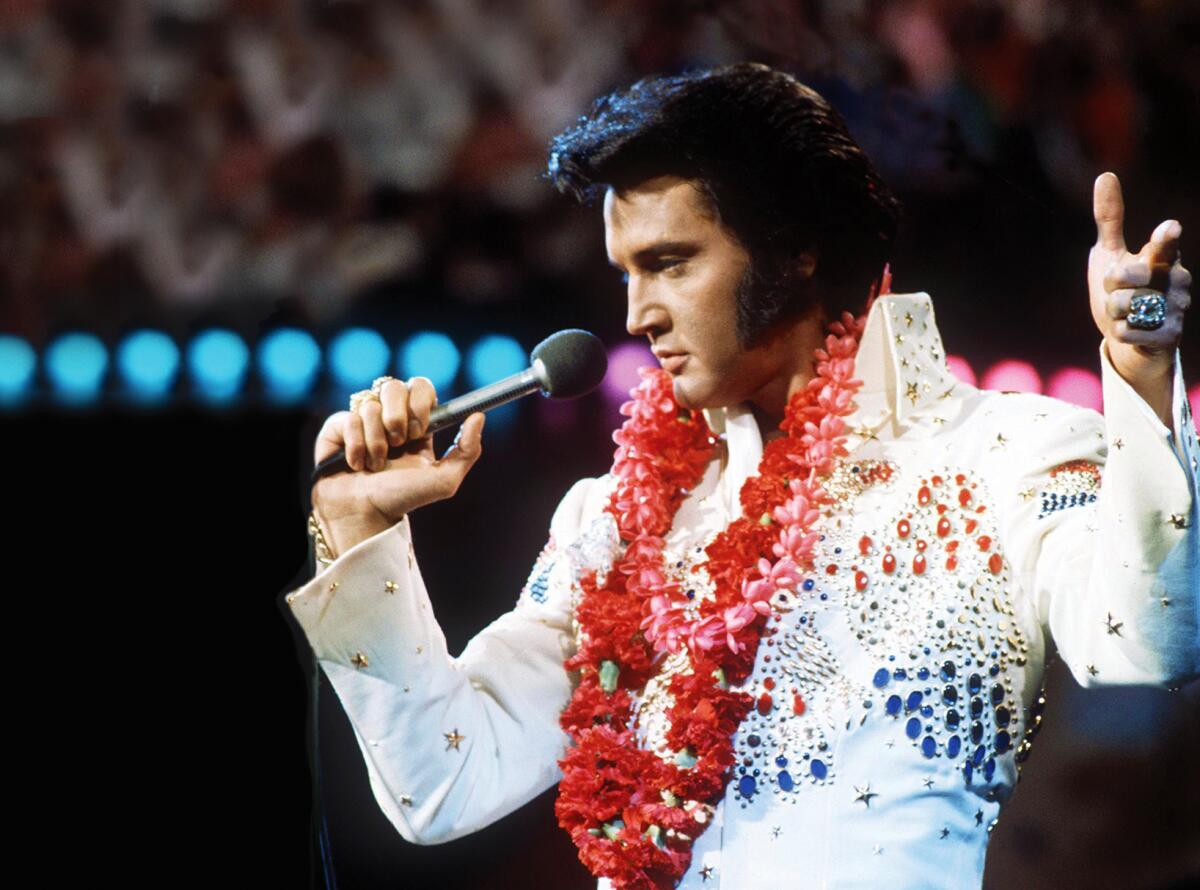
Aloha from Hawaii was transmitted by satellite to audiences across Asia, the Pacific and other international markets, with delayed broadcasts reaching Europe and the United States. It was a technological milestone and another reminder of just how enormous his audience had become.
Then there were the numbers.
Dozens of chart records. Dozens of films. Millions of records sold. Television audiences that would be almost impossible to recreate today.
And perhaps the strangest example of all was the Elvis postage stamp.
When the U.S. Postal Service allowed Americans to vote on the design of an Elvis commemorative stamp, more than a million ballots were reportedly cast.
Think about that.
People were voting on what Elvis should look like on a postage stamp.
His popularity had become part of everyday American life.
Then, on August 16, 1977, everything stopped.
Elvis was found at Graceland and later pronounced dead at Baptist Memorial Hospital. He was only 42 years old.
The reaction was immediate and enormous.
Crowds gathered outside Graceland. Thousands came to Memphis to pay their respects. His death became one of the defining celebrity tragedies of the twentieth century.
But the most astonishing part of the Elvis story may be what happened afterward.
He did not disappear.
Decades after his death, Graceland remains a major destination for Elvis fans. Every year, visitors from around the world travel to Memphis to walk through the home where he lived. Each August, fans gather for Elvis Week and the candlelight vigil at his grave.
There are Elvis tribute artists across the globe. His songs continue to be recorded, performed, streamed, and rediscovered by new generations.
And here is the question that makes his story so fascinating:
How famous was Elvis Presley actually?
He became a worldwide icon without social media.
Without YouTube.
Without Spotify.
Without Instagram.
Without TikTok.
Without a global stadium tour.
He had radio, television, records, movies, photographs, and an extraordinary ability to command people’s attention.
That may be the real secret of Elvis Presley.
He didn’t need to travel the entire world to become a global superstar.
The world came to him.
And perhaps that is why Elvis remains so difficult to compare with anyone else.
Today’s biggest stars can reach billions of people instantly. But Elvis belonged to a different era—one in which an entire country could stop and watch the same television program at the same time.
For a brief moment in history, one man could dominate music, television, movies, fashion, headlines, and popular culture simultaneously.