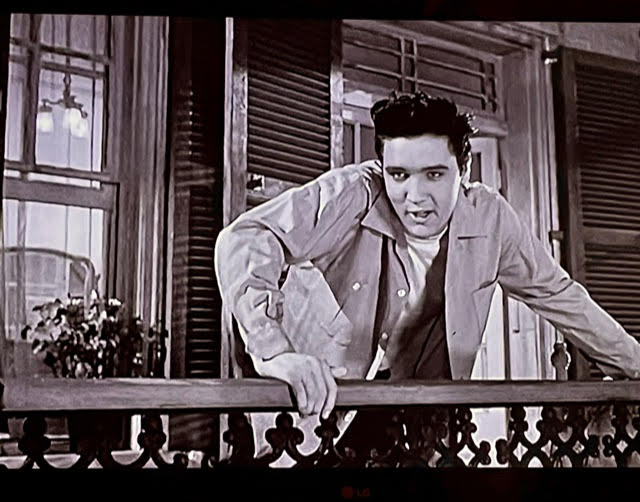
He had the voice of a generation, the charisma of a superstar, and a natural screen presence that could have made him one of Hollywood’s greatest dramatic actors. But instead of becoming the next James Dean or Marlon Brando, Elvis Presley found himself trapped in a Hollywood machine that seemed more interested in selling movie tickets and soundtrack albums than developing his extraordinary talent. Was the King of Rock and Roll one of cinema’s greatest wasted opportunities?
When Elvis Presley stepped in front of the cameras for his first major motion picture, Love Me Tender, in 1956, Hollywood saw something special. The young singer was already taking the music world by storm, but his arrival on the silver screen revealed another side of his personality.
He wasn’t simply a famous musician trying to become a movie star.
He could actually act.
Although Elvis had no formal acting training, his natural charisma, emotional intensity, and remarkable screen presence quickly attracted attention. His early performances suggested that he might become much more than another celebrity appearing in musical films.
Then came Loving You (1957), Jailhouse Rock (1957), and, most importantly, King Creole (1958).
And this is where the story becomes fascinating.
Directed by legendary filmmaker Michael Curtiz, King Creole remains one of the strongest examples of Elvis’s dramatic potential. His performance was more mature, emotionally convincing, and dramatically powerful than many people expected. For audiences who had only known him as the electrifying rock-and-roll sensation, this was a revelation.
Elvis himself reportedly wanted to become a respected motion picture actor.
He had ambitions beyond singing a few songs, charming a leading lady, and collecting a paycheck.
But Hollywood had other plans.
In 1958, Elvis was drafted into the United States Army. After completing his military service in 1960, he returned to an entertainment industry that was ready to turn his popularity into an enormous commercial machine.
His first major post-Army film, G.I. Blues, established a formula that would dominate much of the decade.
The stories became increasingly predictable. Elvis would play a handsome young man, usually surrounded by beautiful women, romantic complications, and plenty of opportunities to sing. The films were colorful, entertaining, and commercially successful, but the dramatic ambition that had made King Creole so memorable was increasingly difficult to find.
And the frustrating part?
Elvis had already shown Hollywood what he could do.
There were still attempts to give him more serious material. Flaming Star (1960) and Wild in the Country (1961) demonstrated that his dramatic ambitions had not disappeared. Unfortunately, these films did not achieve the same commercial returns as the lighter musical comedies.
Hollywood noticed the numbers.
The musical formula was profitable, so the studios kept repeating it.
As the years passed, Elvis appeared in increasingly formulaic productions, often making several movies in a single year. His films became closely connected to soundtrack albums, promotional singles, and commercial opportunities.
The business model was simple: release a movie, sell the soundtrack, promote the songs, and move on to the next production.
But what happened to the actor?
According to accounts of Elvis’s Hollywood years, he became increasingly frustrated with repetitive scripts and musical material that did not reflect his artistic ambitions. One particularly revealing example came during the production of Double Trouble in 1967, when he reportedly walked out of a recording session after being asked to perform a version of “Old MacDonald.”
Imagine that.
The man who had revolutionized popular music was now being asked to record material that seemed completely disconnected from the artistic fire that had made him famous.
Colonel Tom Parker remains at the center of this controversial chapter.
Parker helped transform Elvis into a worldwide superstar. He secured important opportunities, negotiated lucrative contracts, and understood the commercial power of his client’s name better than almost anyone.
But his management decisions also raise difficult questions.
Critics have argued that Parker prioritized profitable movie contracts and soundtrack opportunities over Elvis’s desire to pursue challenging dramatic roles. He also had considerable influence over the projects Elvis could accept.
However, Parker was not the only force shaping this story. Hollywood studios, producers, audience expectations, and the enormous financial success of the musical formula all played important roles.
The tragedy was not simply that one manager made questionable decisions.
It was that an entire industry discovered a profitable formula and became reluctant to let its biggest star escape it.
Yet Elvis never completely abandoned his dream of doing something different.
In 1969, Charro! offered a fascinating glimpse of another possible career. Unlike his traditional musical comedies, the film contained virtually no singing from Elvis, allowing him to concentrate on a more conventional Western performance.
He also appeared in Change of Habit that same year, demonstrating his willingness to explore different characters and stories.
But by then, the opportunity to rebuild his Hollywood career was becoming increasingly limited.
And then came the moment that changed everything.
On December 3, 1968, NBC broadcast the legendary television special now known as the ’68 Comeback Special.
Dressed in black leather, holding his guitar, and performing with the raw energy that had originally made him a global phenomenon, Elvis reminded the world exactly who he was.
This was not the predictable movie star audiences had been watching for years.
This was Elvis Presley.
The special reignited his musical career and helped lead to the extraordinary Memphis recording sessions of 1969, producing classics such as “Suspicious Minds” and “In the Ghetto.”
Hollywood’s grip on his creative life was finally weakening.
But there was one more heartbreaking possibility.
In 1976, Barbra Streisand reportedly offered Elvis the leading male role in A Star Is Born. The opportunity could have provided the serious cinematic comeback he had wanted for so long. However, negotiations involving Parker ultimately fell apart, and the role went to Kris Kristofferson.
Priscilla Presley later said that Elvis regretted not taking the opportunity.
Was this his final missed chance to prove himself as a serious actor?
We will never know.
What we do know is that Elvis Presley appeared in 31 narrative feature films, and several of his earliest performances demonstrated a level of natural talent that Hollywood never fully explored.
Perhaps the greatest tragedy of his film career is not that he failed to become a great actor.
It is that we never truly discovered how great he might have become.
Did Colonel Tom Parker protect Elvis’s financial success while sacrificing his artistic ambitions? Or was Hollywood itself responsible for turning a potentially extraordinary dramatic actor into a predictable musical-comedy star?
Was King Creole proof that Elvis could have become one of Hollywood’s greatest actors?
And most importantly, what might have happened if he had been given the freedom to choose his own films?
Because behind the legend of the King of Rock and Roll lies a Hollywood story that may be one of the greatest “WHAT IF?” mysteries in entertainment history.
Video
https://youtu.be/9MhzzxMVKCw?si=e7EOU_WOm1gzWu-F