
Introduction:
A Spark Before the Crown: How Baby, Let’s Play House Revealed the Fire of a Young King
When we revisit the early recordings of Elvis Presley, we are not merely listening to songs—we are witnessing the formation of a cultural force that would soon reshape the landscape of popular music. Among these formative works, Elvis Presley – Baby, Let’s Play House stands as a vibrant and revealing moment, capturing the restless energy of a young artist on the brink of legend.
Recorded in the mid-1950s, this track belongs to a period when Elvis was still carving out his identity, blending the raw emotional depth of blues with the rhythmic vitality of country and the rebellious spark that would later define rock and roll. What makes Elvis Presley – Baby, Let’s Play House particularly compelling is not just its sound, but its attitude. From the very first note, there is a sense of urgency—a playful defiance that feels both intimate and electrifying.

The song itself, originally written and recorded by Arthur Gunter, finds new life in Elvis’s interpretation. Where earlier versions carried a smoother, more restrained tone, Elvis injects a sense of youthful impatience and emotional immediacy. His vocal delivery is sharp yet fluid, moving effortlessly between tenderness and insistence. It is this duality that gives the performance its lasting appeal. He is not simply singing the lyrics; he is inhabiting them.
Instrumentally, the track is deceptively simple. The guitar work is crisp and driving, while the rhythm section provides a steady backbone that allows Elvis’s voice to take center stage. Yet within this simplicity lies a powerful sense of innovation. This was music that felt alive—unpolished in the best possible way, and full of character. It hinted at a new direction for popular music, one that valued feeling and individuality over perfection.
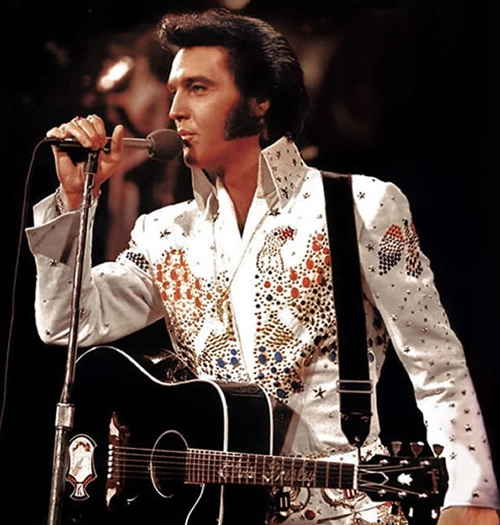
What also deserves attention is how Elvis Presley – Baby, Let’s Play House contributed to Elvis’s growing reputation at the time. It became his first song to enter the Billboard country chart, marking an important milestone in his career. For audiences of that era, this was more than just another recording—it was a signal that something new had arrived. A voice that did not fit neatly into existing categories, yet somehow resonated across them all.
Listening to the song today, one can still feel that sense of discovery. It carries the excitement of possibility, the sound of an artist testing boundaries and finding his voice in real time. For seasoned listeners and newcomers alike, it offers a glimpse into the early stages of a journey that would soon captivate the world.
In the end, Elvis Presley – Baby, Let’s Play House is more than a song—it is a moment. A moment when talent met opportunity, when tradition met transformation, and when a young man from Memphis began to step into the role history would remember him for.