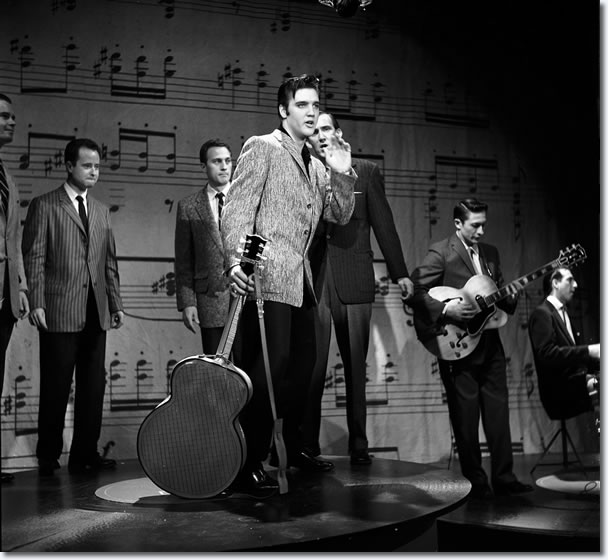
Elvis on Ed Sullivan: The Night Ed Wasn’t There — And the Famous Myth That Isn’t True
September 9, 1956. It became one of the most unforgettable nights in television history.
Millions of Americans sat down in front of their television sets expecting to watch The Ed Sullivan Show. Instead, they witnessed something nobody could have predicted: Ed Sullivan wasn’t there. Elvis Presley wasn’t even in New York. And yet, somehow, this became the night Elvis Presley entered millions of American homes at once.
There is also a famous story about what television supposedly did to Elvis that night — a story repeated for decades.
But there is one problem.
It isn’t true.
By September 1956, Elvis Presley was already a national sensation. He had appeared on several television programs, including Stage Show, The Milton Berle Show, and The Steve Allen Show. His records were selling, teenagers were screaming, and adults were arguing about whether his performance style was destroying American culture.
Then came an important television showdown.
In July 1956, Elvis appeared on The Steve Allen Show, which aired opposite The Ed Sullivan Show. Elvis helped Allen defeat Sullivan in the ratings that evening. Suddenly, the singer Sullivan had been reluctant to feature became impossible for television executives to ignore.
Ratings changed everything.
Colonel Tom Parker negotiated a reported $50,000 deal for three Elvis appearances on The Ed Sullivan Show. At the time, that was an enormous television fee.
But Elvis was worth it.
Then came the first appearance.
There was just one major problem: Ed Sullivan himself was absent.
Sullivan was recovering from serious injuries after an automobile accident, so actor Charles Laughton stepped in as guest host.
And Elvis?
He wasn’t in New York.
He was in California, working on his first movie, Love Me Tender. Instead of appearing on the Sullivan stage, Elvis performed remotely from CBS Television City in Hollywood.
Think about how strange that sounds today.
The show was called The Ed Sullivan Show — but Ed Sullivan wasn’t hosting.
Elvis Presley was the star — but Elvis wasn’t even in the building.
And despite all of that, television history was about to be made.
When Elvis appeared, millions of viewers saw him perform “Don’t Be Cruel” and “Love Me Tender.” The latter was particularly significant because Love Me Tender had not yet been released as a movie. Television was helping introduce the song — and Elvis’s new screen persona — to an enormous national audience.
Later, Elvis returned with “Ready Teddy” and “Hound Dog.”
And Hound Dog was the moment that truly exploded.
The voice.
The attitude.
The movement.
The screaming crowd.
And, of course, the Elvis hips.
Television transformed Elvis from a singer people could hear into a performer millions could actually see.
Then comes the myth.
You’ve probably heard it before: television executives were supposedly so terrified of Elvis’s provocative movements that they ordered the cameras to film him only from the waist up.
Sounds believable.
But here’s the twist.
That did NOT happen during Elvis’s first Sullivan appearance on September 9, 1956.
The famous waist-up restriction is most closely associated with Elvis’s third and final Sullivan appearance on January 6, 1957. During his first appearance on September 9, 1956, however, the broadcast did include shots of Elvis’s full body, although official Sullivan material also notes that he was filmed from the waist up whenever he was in motion.
So the story that Elvis was already restricted to waist-up shots during his first Sullivan performance is one of those legends that became so familiar that people stopped questioning it.
The first appearance was different.
And the audience reaction was enormous.
Approximately 60 million viewers reportedly watched Elvis that night, with commonly cited estimates putting the audience at roughly 82% of the television audience.
In an era before streaming, YouTube, TikTok, Netflix, and hundreds of television channels, that number was extraordinary.
For one Sunday evening, Elvis Presley was everywhere.
But did The Ed Sullivan Show make Elvis famous?
Not exactly.
Elvis was already famous.
He had hit records. He had already appeared on national television. He had already built an enormous teenage following.
What Sullivan did was something even more powerful.
It amplified Elvis’s fame to an unprecedented national scale.
Parents who didn’t own his records saw him.
People who had never attended one of his concerts saw him.
Americans who had only heard stories about the controversial young singer suddenly had Elvis Presley standing in their living rooms.
And that changed everything.
Elvis returned to the program on October 28, 1956, and again on January 6, 1957. By that final appearance, the famous waist-up camera strategy had become part of the Elvis-Sullivan story.
The irony is almost perfect.
The performer who had once seemed too controversial for Sullivan’s program had become so valuable that television couldn’t afford to ignore him.
And Ed Sullivan eventually made his own position clear. During Elvis’s final appearance, Sullivan publicly praised him as a fine young man.
What a transformation.
Only months earlier, Elvis represented controversy to many television viewers.
Now he was being welcomed into America’s living rooms on one of the biggest programs on television.
So perhaps the real mystery of September 9, 1956 isn’t why Elvis became famous.
It is why this particular appearance became so important.
Because Elvis didn’t suddenly become talented that night.
He didn’t suddenly become successful.
And he didn’t even become famous for the first time.
Instead, something much bigger happened.
America saw Elvis Presley — all at once.
For one extraordinary Sunday evening, a young singer performing from Hollywood reached an audience of roughly 60 million people.
Ed Sullivan wasn’t there.
Elvis wasn’t in New York.
And the famous waist-up censorship story didn’t happen that night.
Yet somehow, everything came together to create one of the defining television moments of the 1950s.
The cameras rolled.
The teenagers screamed.
America watched.
And Elvis Presley walked straight into history.
Seventy years later, we’re still talking about that night.
Maybe that’s the most remarkable part of all.
Because Elvis didn’t need Ed Sullivan to be there.