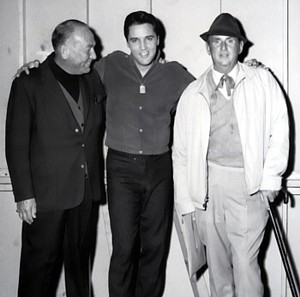
ELVIS MAKES PITCHES: THE SHOCKING CHAPTER THAT REVEALS HOW COLONEL PARKER TURNED ELVIS PRESLEY INTO HOLLYWOOD’S MOST POWERFUL — AND CONTROLLED — STAR
What if Elvis Presley’s Hollywood career was never really about making Elvis a great actor?
What if, from the very beginning, the movies were designed primarily as another machine to sell records, concert tickets, merchandise—and, ultimately, to strengthen Colonel Tom Parker’s control over Elvis?
That is the explosive story behind Chapter 11 of Alanna Nash’s The Colonel, titled “Elvis Makes Pitches.”
This chapter takes us back to 1956, when Elvis Presley was suddenly becoming the most controversial and electrifying young entertainer in America. Hollywood was watching. Producers were watching. Record executives were watching.
And Colonel Parker was watching them right back.
One Saturday night, Joseph Hazen received a phone call from his neighbor, Harriet Ames, urging him to watch a young singer named Elvis Presley on television. Hazen immediately recognized something extraordinary. Elvis wasn’t simply another performer. There was something different about him.
Hazen quickly contacted producer allHal B. Wis, and Wallis became fascinated by Elvis’s screen potential.
Wallis later remembered the young singer’s eyes, expressive face, and mysterious presence. He believed Elvis possessed the kind of natural screen quality that could make him a movie star.
But while Hollywood was trying to get Elvis’s attention, Parker was playing a completely different game.
He deliberately remained difficult to reach.
Wallis called.
Parker didn’t answer.
He telegraphed.
Still, Parker kept his distance.
According to Nash, Parker had actually been fascinated by Wallis for years. He had watched Wallis’s rise through Hollywood and dreamed of the day he could arrive in California with an act so powerful that a Hollywood heavyweight would have no choice but to deal with him.
That act was Elvis Presley.
And Parker intended to use Elvis not only to make money—but to build his own power.
THE SCREEN TEST THAT SHOCKED HOLLYWOOD
Eventually, Elvis arrived in California for a Paramount screen test.
What happened next surprised people.
Elvis was given dramatic scenes from The Rainmaker, along with a musical performance of “Blue Suede Shoes.” Even though he had very little preparation, the results impressed people who had expected little more than a singing sensation.
RCA executives Steve Sholes and Chick Crumpacker saw something they hadn’t expected.
Elvis could act.
His performance was natural, emotionally direct, and intense.
People compared his screen presence to young stars such as James Dean and Marlon Brando.
For a brief moment, it appeared Elvis might have the opportunity to become something much bigger than a rock-and-roll singer.
He could become a serious actor.
But there was one enormous obstacle.
Colonel Parker.
Parker didn’t necessarily believe Elvis needed to become a great dramatic actor.
He saw movies differently.
To Parker, movies were another way to sell Elvis.
And that distinction would shape the next two decades of Elvis Presley’s career.
THE $15,000 DEAL THAT PARKER NEVER FORGOT
In April 1956, Elvis and Parker signed a contract with Hal Wallis.
On paper, it sounded enormous: one movie with options for six more.
But Nash points out that the deal was nowhere near as powerful as it appeared.
The first movie paid Elvis only $15,000, with subsequent salaries increasing gradually.
There was no guaranteed billing.
No script approval.
No special protections.
And Elvis was being paid far less than some of his co-stars.
Parker was furious.
But rather than simply accept the deal, he learned something.
He learned exactly how Hollywood negotiations worked.
And he also learned how much leverage Elvis’s rapidly growing popularity gave him.
That lesson would become extremely important.
Because Parker was about to discover one of his favorite weapons:
Threaten to walk away.
LOVE ME TENDER CHANGED EVERYTHING
Elvis’s first movie, Love Me Tender, became a critical turning point.
Elvis reportedly wanted to prove that he could be taken seriously as an actor. He wanted a dramatic career that would last.
But Parker and RCA had other priorities.
Songs were added to the movie.
Why?
Because songs could sell records.
The movie could promote the music.
And the music could promote the movie.
The three industries—Hollywood, RCA, and Elvis’s live career—could feed each other.
Parker understood this perfectly.
Elvis, meanwhile, was overwhelmed.
He was learning how to act, dealing with intense public criticism, barely sleeping, and trying to understand a business that was suddenly moving at incredible speed.
At one point, Parker reportedly reduced the decision to brutally simple terms:
“We do it this way, we make money.”
Elvis eventually surrendered.
“Okay, let’s make money.”
That sentence says almost everything about the conflict that would define Elvis’s movie career.
Elvis wanted artistic development.
Parker wanted commercial results.
And commercial results usually won.
THE COLONEL’S MOST BIZARRE HOLLYWOOD POWER PLAY
Then came one of the strangest stories in the entire chapter.
Parker established an office at Fox that he jokingly called the “Elvis Exploitation Office.”
It was filled with Elvis merchandise, balloons, stuffed animals, strange props, and theatrical distractions.
But Parker wasn’t simply being eccentric.
He was performing.
When studio executives Buddy Adler and Lou Schreiber came to meet him, Parker staged one of the most outrageous psychological games imaginable.
He placed a sign reading “Colonel Parker’s West Coast Office” above the men’s restroom.
Then he ordered his staff to pretend they were conducting serious business.
He even placed Elvis’s enormous friend Arthur Hooton in the shower with a notepad, pretending to take dictation.
And then Parker hid in the bathroom.
When the executives arrived, they were directed into the restroom.
There sat Parker—on the toilet—conducting business as if nothing were unusual.
The situation became even more bizarre when the executives discovered that Parker had smeared something unpleasant on the doorknobs.
They were trapped in an absurd situation, while Parker calmly continued talking business.
Afterward, everyone around Parker reportedly burst into laughter.
And then came the final move.
Parker arranged for expensive television sets to be sent to the embarrassed executives as gifts from Elvis and the Colonel.
It was funny.
It was outrageous.
But it was also a demonstration of power.
Parker wanted Hollywood executives to understand one thing:
He could humiliate them—and they still needed Elvis.
PARKER WASN’T JUST MANAGING ELVIS. HE WAS CONTROLLING ACCESS TO ELVIS.
This is where the chapter becomes much darker.
Parker increasingly controlled who could speak to Elvis.
Agents couldn’t simply call him.
Executives couldn’t casually approach him.
Visitors were restricted.
Even people who officially represented Elvis had difficulty reaching him.
Leonard “Lanny” Hershan of William Morris became a particular target.
Parker feared that agents might develop their own relationship with Elvis and eventually influence him.
So he made sure Elvis remained surrounded by people Parker trusted.
The future “Memphis Mafia” became part of this protective—and controlling—environment.
Hazen began to recognize what was happening.
Parker wasn’t merely protecting Elvis from exploitation.
He was controlling access to Elvis.
And that distinction is crucial.
Because once a manager controls who can speak to the star, what information reaches the star, and which opportunities the star sees, the manager possesses enormous power.
THE MONEY MACHINE WAS GETTING BIGGER
Then Parker found another way to make Elvis’s movie career profitable.
Song publishing.
Through Hill & Range and associated arrangements, Elvis’s recordings could generate additional publishing revenue.
The system became increasingly favorable to Parker and his associates.
Songwriters who wanted Elvis to record their songs could be encouraged to surrender portions of their publishing.
From Parker’s perspective, this wasn’t simply about music.
It was business architecture.
Every Elvis movie could sell records.
Every record could generate publishing income.
Every movie could promote Elvis’s concerts.
Every concert could increase Elvis’s popularity.
And every increase in Elvis’s popularity gave Parker more leverage.
The machine was becoming self-reinforcing.
ELVIS HAD MAGNETISM. PARKER CLAIMED THE CREDIT.
Perhaps one of the most revealing moments comes when Trude Forsher reportedly told Parker that Elvis had magnetism.
Parker’s response was brutally dismissive.
He essentially argued that if he hadn’t discovered Elvis, the young singer would still be driving a truck.
That statement reveals Parker’s enormous sense of ownership.
Elvis had the talent.
Elvis had the voice.
Elvis had the looks.
Elvis had the charisma.
But Parker increasingly portrayed himself as the man responsible for turning all of that into money.
And he believed that made him indispensable.
LOVE ME TENDER BECOMES A PHENOMENON
Commercially, Parker’s strategy worked.
Love Me Tender recovered its production cost in less than three weeks.
When the movie opened in New York in November 1956, enormous crowds gathered.
A giant Elvis cutout towered over the theater.
Thousands of fans lined the streets.
Traffic was disrupted.
News cameras captured the frenzy.
And Parker understood exactly how to turn that excitement into publicity.
He staged crowds.
He distributed promotional materials.
He encouraged theaters to clear audiences after each showing so every new group would have to purchase another ticket.
The movie wasn’t simply entertainment.
It was an Elvis event.
And Parker knew how to sell an event.
THEN CAME THE MILLION-DOLLAR DEMAND
Parker’s confidence exploded.
When Fox negotiated Elvis’s next film opportunities, Parker reportedly demanded an astonishing $1 million.
At the time, virtually nobody was receiving that kind of money for a single movie.
The demand wasn’t realistic.
But perhaps realism wasn’t the point.
Parker wanted Hollywood to understand that Elvis Presley was different.
Eventually, Elvis received $100,000 plus co-star billing and additional incentives.
Parker also secured options for future films.
And more importantly, Parker secured something else:
a larger role for himself.
He increasingly negotiated deals in which he and Elvis appeared almost like equal partners.
That wasn’t just branding.
It was a declaration of power.
Elvis was the star.
But if Hollywood wanted Elvis, they had to deal with Parker.
“ELVIS MAKES PICTURES”
Nash describes Parker developing an almost obsessive belief in the commercial power of Elvis’s movies.
He began repeating a simple idea:
“Elvis makes pictures.”
That became his mantra.
But there was a hidden cost.
The more profitable Elvis became, the more Parker’s interests became intertwined with Elvis’s career.
And the more Parker controlled the business, the harder it became for Elvis to make independent decisions.
Elvis wanted to become a serious actor.
Parker wanted Elvis to remain a commercially unstoppable Elvis Presley.
Those two visions were not necessarily compatible.
THE BEGINNING OF A CAREER-LONG PATTERN
Looking back, Chapter 11 is disturbing because it shows the pattern forming in real time.
Elvis wanted to grow.
Parker wanted to monetize.
Elvis wanted serious acting opportunities.
Parker wanted movies that sold records and promoted concerts.
Elvis wanted creative control.
Parker wanted business control.
And Hollywood quickly learned that the easiest way to reach Elvis was through Parker.
The Colonel had turned himself into the gatekeeper.
And once he became the gatekeeper, his influence became enormous.
The tragedy is that Elvis’s first screen test suggested he might genuinely have had dramatic potential.
Hollywood saw it.
People around him saw it.
Even Elvis himself believed in it.
But Parker had other priorities.
And those priorities would eventually help transform Elvis’s movie career from a promising opportunity into a highly commercial formula.
Chapter 11 isn’t simply about Elvis making movies.
It’s about the moment Colonel Tom Parker realized that Hollywood could become another kingdom—and Elvis Presley could be the product that gave him the power to rule it.
And once Parker discovered how profitable that kingdom could be, there was almost no chance he would willingly give up control.
Elvis had the talent.
Parker had the strategy.
And Hollywood had just discovered that the two came as a package.
Stay tuned for Chapter 12, “Directional Snowing,” where the story of Colonel Parker, Elvis Presley, and the extraordinary machinery surrounding the King continues.