Before He Was King: The Arkansas Years That Helped Create Elvis Presley
Before Elvis Presley became the King of Rock ’n’ Roll, he was just a young man driving through Arkansas with a few musicians, a car full of instruments, and something to prove. Then one night, the crowd became so wild that a gymnasium floor reportedly began to give way beneath them.
Long before the Las Vegas lights, the white jumpsuits, the Hollywood movies, and the screaming crowds that followed him everywhere, Elvis Presley was still learning how to command a stage.
And some of the most important lessons happened in Arkansas.
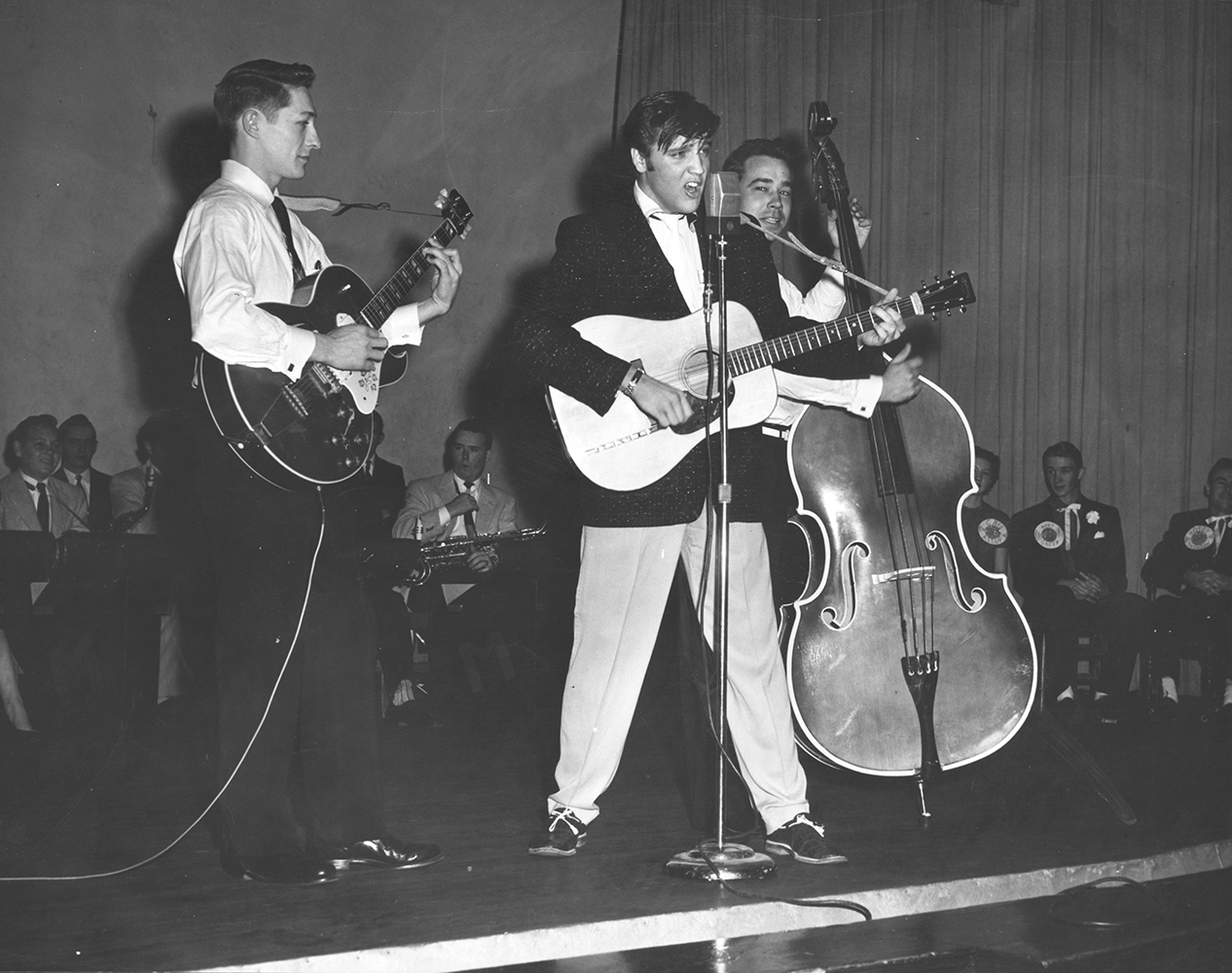
Between 1954 and 1956, Elvis, Scotty Moore, Bill Black, and later D.J. Fontana traveled repeatedly through Arkansas, appearing in school gyms, auditoriums, fairgrounds, clubs, armories, and small-town venues. They traveled the roads that would eventually become known as the Rock ’n’ Roll Highway, playing town after town and building an audience one performance at a time.
There were no massive security teams.
No private jets.
No luxurious backstage rooms.
No guarantee that anyone would even like what they heard.
There was simply a young Elvis Presley, standing in front of audiences who had never seen anything quite like him.
One of his early documented Arkansas appearances came on November 24, 1954, in Texarkana, only months after “That’s All Right” had introduced his name to a growing regional audience.
He was still incredibly young.
But something was already changing.
As Elvis returned to Arkansas throughout 1955, the reactions became increasingly intense. Teenagers were fascinated by his voice, his clothes, his movements, and the sheer unpredictability of his performances. Older members of the audience sometimes had a completely different reaction.
To some, Elvis represented the future.
To others, he represented a disturbing new kind of entertainment.
And then came Dermott.
On March 25, 1955, Elvis performed at Dermott High School. The response was reportedly so intense that school officials became concerned about the reaction surrounding the performance. According to accounts of the event, the following morning the superintendent addressed the students and refunded their admission money.
Whether every detail of the story has been repeated accurately over the decades or not, the episode illustrates something important: Elvis was already becoming more than a singer.
He was becoming an event.
And one remarkable photograph from that Arkansas stop captures just how different Elvis’s world still was.
At a truck stop in Dermott, Elvis was photographed with Scotty Moore and Bill Black, alongside a local radio personality. Elvis can also be seen holding an Arkansas State Trooper’s revolver.
Today, the image looks almost unbelievable.
There were no layers of security separating Elvis from ordinary people. He could walk into a local establishment, meet people, pose for photographs, and seemingly become part of the community for a few minutes.
He wasn’t yet the untouchable superstar the world would soon know.
He was simply Elvis.
But not every Arkansas appearance went smoothly.
At the White River Water Carnival in Batesville on August 6, 1955, Elvis reportedly encountered a much less enthusiastic reception. A later complaint from promoter Ed Lyon to Colonel Tom Parker accused Elvis of inappropriate behavior and leaving the stage early.
Some details surrounding the incident have been debated and expanded through later retellings, so the safest conclusion is not that every dramatic version is true.
The important point is that Elvis was still performing for audiences who were not automatically converted.
He could win a room.
He could confuse a room.
And sometimes, he could shock a room.
Then came Bono, Arkansas.
On September 6, 1955, Elvis performed at the Bono High School gymnasium. The crowd reportedly became so excited that the floor was placed under tremendous pressure, with accounts describing sections of the flooring giving way.
Fortunately, there were no reports of serious injuries.
But imagine what that must have looked like.
Teenagers screaming.
People pushing toward the stage.
A young Elvis Presley in the middle of it all.
And beneath the audience, the building itself struggling to contain the excitement.
It became one of those stories that perfectly symbolizes Elvis’s rise in the mid-1950s.
He wasn’t simply singing to teenagers.
Something bigger was happening around him.
Arkansas also provided Elvis with smaller venues where he could develop the stage presence that would later become legendary.
Clubs such as the Silver Moon Club in Newport and B&I Club in Swifton were part of that early circuit. These were not glamorous venues. They were places where Elvis had to learn how to deal with unpredictable crowds and hold people’s attention.
And on December 9, 1955, shortly after signing with RCA Victor, Elvis reportedly performed a new song in Swifton called “Heartbreak Hotel.”
According to later recollections, Elvis confidently suggested that the song would become his first major hit.
Whether the exact wording has survived perfectly is difficult to establish, but the timing is extraordinary.
The young performer who had spent months driving through small Arkansas towns was beginning to understand that something much bigger was coming.
Then came Little Rock.
When Elvis first appeared at Robinson Auditorium in February 1955, he wasn’t yet the headliner everyone had come to see. He was still an added attraction on a larger country-music package.
But when he returned to the same auditorium on May 16, 1956, everything had changed.
Elvis was no longer an obscure regional performer.
He was becoming a national sensation.
Fans reportedly gathered in large numbers, and the atmosphere inside the auditorium became increasingly difficult to control. Elvis eventually appeared wearing a striking purple jacket with black trousers, and the audience erupted.
The most remarkable part is that the performance was recorded.
The recording preserves songs including “Heartbreak Hotel,” “Blue Suede Shoes,” “Long Tall Sally,” and “Money Honey.”
But one performance stands out historically.
“Hound Dog.”
The Little Rock recording is often discussed because it captures an extremely early live version of the song, recorded before Elvis’s famous televised performance on the Milton Berle Show and before his RCA studio recording.
Listening to that recording today is like opening a time capsule.
You can hear the audience reacting in real time.
You can hear the excitement.
You can hear an artist standing on the edge of something enormous without knowing exactly how far it would take him.
And Arkansas wasn’t finished with Elvis.
In March 1958, another unforgettable chapter took place at Fort Chaffee near Fort Smith.
This time there was no screaming concert.
No provocative stage performance.
No teenage hysteria.
Instead, Elvis was an Army recruit.
And one of the most recognizable images of his entire life was created there.
Inside the Fort Chaffee barber shop, Elvis sat down for the haircut required as he entered military service. His famous pompadour and sideburns were cut away as photographers captured the moment.
The hairstyle that had become closely associated with youthful rebellion was suddenly gone.
Elvis reportedly joked, “Hair today, gone tomorrow.”
The photograph traveled around the world.
For a moment, the rebellious young performer looked like an ordinary soldier.
But even after Elvis returned from Germany and became an even bigger star, Arkansas remained part of his story.
In 1960, Elvis met students in Arkansas and received recognition connected with his charitable work. During that period, he reportedly spoke about something surprisingly personal: the fact that he had once wanted to attend college but his family had not been able to afford it.
That detail is easy to overlook when remembering the millionaire superstar.
Before the fame, before the mansion, before the Cadillacs, there had been a young man from a working-class family who understood what it meant to have limited opportunities.
And perhaps that is why the Arkansas story matters.
Because Arkansas did not meet Elvis as the finished product.
It met him while he was still becoming Elvis Presley.
Years later, the contrast was astonishing.
In 1972, Elvis returned to Little Rock to perform at Barton Coliseum during the Elvis On Tour era. By then, he was no longer struggling to convince people to listen.
He was one of the biggest entertainers on Earth.
The same performer who once drove through Arkansas in a crowded car was now appearing before enormous audiences wearing elaborate jumpsuits and delivering songs such as “Polk Salad Annie,” “Never Been to Spain,” and “An American Trilogy.”
He returned to Arkansas again in later years, including performances in 1975 and 1976.
Then, in early 1977, there was one final, much quieter connection.
Elvis traveled to Jasper, Arkansas, with Ginger Alden to attend the funeral of her grandfather.
There was no giant stage.
No screaming crowd.
No spotlight.
Just Elvis Presley attending a family funeral and offering support.
And strangely enough, that quiet moment may be the perfect ending to the Arkansas story.
Because Arkansas had seen almost every version of Elvis.
The nervous young singer.
The controversial performer.
The teenage sensation.
The Army recruit.
The national superstar.
And finally, the private man away from the stage.
When people remember Elvis Presley today, they often remember Memphis, Graceland, Las Vegas, Hollywood, or Tupelo.
But somewhere along those Arkansas highways, in those small gyms, clubs, auditoriums, and dusty roads, something important was happening.
Before he was called the King, Elvis was earning the crown one town at a time.
And Arkansas was one of the places where he learned how to wear it.