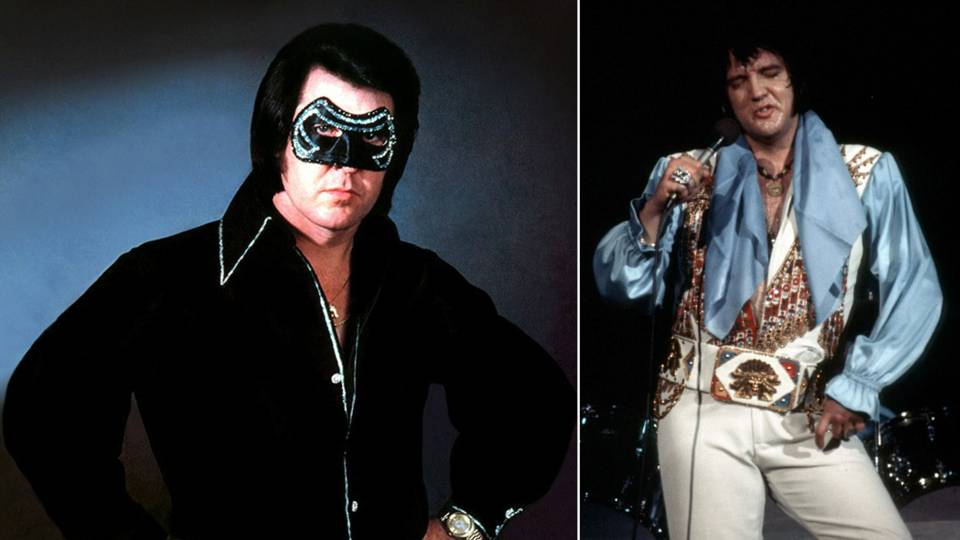
ELVIS PRESLEY’S MYSTERIOUS DOUBLE FINALLY EXPOSED: THE INCREDIBLE STORY OF ORION, THE MASKED SINGER WHO MADE THE WORLD QUESTION WHETHER THE KING WAS STILL ALIVE!
For decades, one of the most fascinating mysteries surrounding Elvis Presley has continued to capture the imagination of music fans around the world. What if the King of Rock and Roll had somehow returned after his death? What if the unmistakable voice of Elvis had suddenly appeared on new recordings, performed by a mysterious singer whose true identity nobody seemed able to confirm?
It sounds like the plot of an unbelievable conspiracy thriller. But in the late 1970s, something remarkably similar happened in the American music industry. A mysterious performer named Orion emerged, wearing a mask, singing with a voice astonishingly similar to Elvis Presley’s, and leaving audiences wondering whether they were hearing a tribute artist, an extraordinary impersonator, or something far more mysterious.
The truth, however, was even more complicated.
Behind the mask was a real man named Jimmy Ellis, a talented singer whose remarkable vocal resemblance to Elvis would eventually change his life forever.
THE VOICE THAT MADE PEOPLE THINK OF ELVIS
Born in 1945, Jimmy Ellis grew up in Alabama with a passion for music and a dream of making it as a professional singer. Long before the world knew him as Orion, he was developing a voice that would eventually become both his greatest opportunity and his greatest burden.
His vocal similarity to Elvis Presley was extraordinary. Listeners could hear the familiar richness, phrasing, and emotional intensity associated with the King of Rock and Roll. The resemblance was so striking that even experienced listeners could sometimes mistake his recordings for Elvis performances.
That unusual talent eventually attracted the attention of Shelby Singleton, the music businessman who acquired Sun Records in 1969.
Singleton understood the commercial value of Elvis’s legacy. Sun Records had played a crucial role in launching Elvis’s early career, and although Elvis’s master recordings had passed to RCA, the Sun name still carried enormous historical and emotional significance.
When Singleton encountered recordings featuring Jimmy Ellis in 1972, he recognized something potentially extraordinary.
Instead of immediately presenting Ellis as an ordinary new country singer, the recordings were released in a way that encouraged mystery and speculation. The singer’s identity was not always made clear, and the remarkable resemblance to Elvis became an increasingly powerful talking point.
Then came August 1977.
Elvis Presley died, and millions of fans around the world struggled to accept that the voice they had loved for so many years would never perform again.
Suddenly, the idea of hearing something that sounded like Elvis became more emotionally powerful than ever.
THE BIRTH OF ORION: A MASK, A NAME, AND A CONTROVERSIAL MYSTERY
As the Elvis mystery continued to attract attention, Jimmy Ellis was transformed into Orion.
The character was carefully constructed. He wore a distinctive mask, adopted an appearance reminiscent of Elvis, and performed music that deliberately encouraged comparisons with the legendary superstar.
The mask was not simply a costume. It became the defining symbol of the entire act.
In 1979, Orion released his album Reborn. Even the album’s original artwork seemed designed to provoke controversy. One version featured a masked figure standing above an open coffin containing a body resembling Elvis Presley.
The imagery was disturbing, provocative, and impossible to ignore. The original cover was eventually replaced.
Think about the message it seemed to communicate: a mysterious masked singer, a name associated with a fictional character who had supposedly faked his own death, and an album title suggesting resurrection.
Was this simply brilliant marketing, or had the music business gone too far by playing with the emotions of grieving Elvis fans?
Whatever the answer, the strategy succeeded in attracting attention.
Orion became a genuine recording and touring artist, releasing country, gospel, and rockabilly music. His career developed beyond the initial mystery, and his version of Queen’s Crazy Little Thing Called Love even reached the American country charts.
Yet behind the publicity, the costumes, and the speculation, Jimmy Ellis had a personal struggle that the public rarely saw.
THE MAN BEHIND THE MASK WANTED TO BE RECOGNIZED
Here was the contradiction at the heart of Orion’s story.
The mask had helped make Jimmy Ellis famous, but it also prevented audiences from seeing him as an individual artist.
He wanted recognition for his own name and musical abilities. He wanted people to appreciate Jimmy Ellis, not simply compare him with Elvis Presley.
The tension between Ellis and the image created around him eventually reached a turning point.
In 1981, Orion removed his mask during a live performance, revealing his real identity to the audience.
For a moment, the mystery was over.
But revealing the truth came at a cost. The illusion that had helped build Orion’s popularity was suddenly weakened. The fascination surrounding the masked singer began to change, and Ellis struggled to establish the independent career he had hoped to achieve.
He eventually returned to performing as Orion, but the relationship between the man and the character had become increasingly complicated.
The question was no longer simply who was singing behind the mask.
It was whether Jimmy Ellis could ever escape the identity that had made him famous.
A HORRIFIC TRAGEDY THAT ENDED THE STORY
The final chapter of Jimmy Ellis’s life was far more devastating than anything connected with the Elvis mystery.
In the 1990s, Ellis operated a pawn shop in Alabama. On December 12, 1998, an armed robbery at the business turned into a double murder.
Jimmy Ellis and Elaine Thompson, his former wife, were shot and killed. Another employee, Helen King, was also shot but survived.
The crime shocked those who knew Ellis and brought a tragic end to the life of the man behind Orion.
The perpetrator, Jeffery Lee, was eventually convicted and sentenced to death. After years of legal proceedings, Alabama authorities carried out his execution on September 17, 2026.
The official announcement from the Alabama Attorney General confirmed the execution and the details of the crime.
For a man whose public identity had been surrounded by mystery, speculation, and theatrical illusion, the ending was heartbreakingly real.
ORION WAS NOT ELVIS. BUT HIS STORY DESERVES TO BE REMEMBERED.
Today, Jimmy Ellis deserves to be remembered for much more than a mask or the extraordinary resemblance that made people think of Elvis Presley.
He was a talented singer who found himself at the center of one of the strangest and most controversial musical phenomena of the late twentieth century.
His story raises difficult questions about fame, identity, marketing, and the emotional connection between artists and their audiences.
Did Shelby Singleton create a brilliant character that gave a talented singer an opportunity to reach millions? Or did the Orion identity eventually become a prison from which Jimmy Ellis could never completely escape?
Perhaps the most haunting part of this story is not whether Elvis Presley secretly returned from the dead.
There is no credible evidence that he did.
The real mystery is what happened to the man whose voice sounded so much like the King’s.
Jimmy Ellis spent years performing behind a mask, allowing audiences to imagine that something impossible might be happening. Yet behind that mask was not a resurrected superstar, but a real human being with his own dreams, ambitions, disappointments, and tragedies.
Orion was not Elvis Presley.
But the story of Jimmy Ellis reminds us that sometimes the greatest mystery in the entertainment business is not the identity of the person behind the mask.