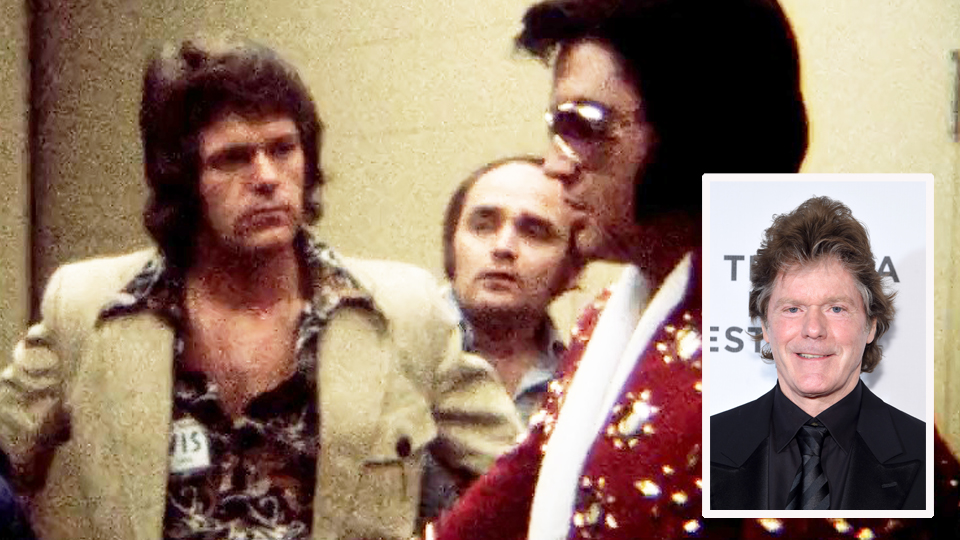
JERRY SCHILLING BREAKS HIS SILENCE: The Untold Truth About Elvis Presley, Their 23-Year Friendship, and the Painful Secrets Behind the King’s Final Years
For more than two decades, Jerry Schilling stood beside Elvis Presley through the extraordinary highs and devastating lows of his life. He wasn’t simply another member of Elvis’s inner circle. He was a trusted friend, a constant companion, and someone who witnessed the King of Rock and Roll far beyond the flashing cameras, screaming crowds, and glamorous world of fame. Now, in a revealing interview, Schilling takes listeners back to the beginning of their remarkable friendship, shares surprising memories of Elvis’s rise to stardom, and delivers an emotional account of the loss that changed his life forever.
But perhaps the most heartbreaking part of his story is what he believes ultimately happened to Elvis.
Their story began in an ordinary Memphis neighborhood in 1954, long before the world knew the name Elvis Presley.
Jerry Schilling grew up in North Memphis, living with his grandparents, aunts, and uncles after losing his mother when he was just one year old. Life was difficult, and opportunities were limited. Yet an unexpected afternoon at a neighborhood playground would change the direction of his entire life.
At the time, Elvis was an 18-year-old young man struggling to fit in. Despite what he would eventually become, he wasn’t particularly popular among the neighborhood boys. In fact, Schilling remembers that Elvis and four other teenagers couldn’t even find a sixth person to join their football game!
A young Jerry was invited to play because someone knew he had experience with school football. When he walked into the huddle, he came face-to-face with Elvis Presley.
And something clicked immediately.
Schilling remembers being fascinated by the older teenager. What began as a simple neighborhood encounter eventually developed into a friendship lasting 23 years. They shared laughter, arguments, difficult moments, tears, and experiences that few outsiders could ever fully understand.
But the young Elvis Schilling met was far from the confident superstar the world would later adore.
Elvis had moved from Mississippi to Memphis with his family when he was around 13 years old, hoping for better opportunities. Moving to a new city at that age was difficult. Surrounded by children who had already established their friendships, Elvis often found himself isolated.
According to Schilling, Elvis was particularly close to his parents and a few cousins. He was also an incredibly observant person, constantly absorbing inspiration from the world around him. Movies, music, performers, and even ordinary people walking down the street could influence his personality and style.
Schilling believes Elvis had something special even before he recorded his first major hit. He wasn’t simply someone who became a star because the records sold millions. In Jerry’s eyes, Elvis already possessed the qualities of a star when they first met.
One of the most fascinating revelations in the interview concerns the musical influences that helped shape Elvis Presley.
During the early 1950s, Memphis was a city deeply divided by racial segregation. Black and white communities were separated in many aspects of everyday life, and even something as basic as drinking fountains reflected the discrimination of the era.
Yet music was beginning to cross those boundaries.
Schilling recalls listening to Dewey Phillips’s radio program, Red Hot and Blue, which introduced young listeners to rhythm and blues artists who were largely absent from mainstream white radio programming.
Names like Chuck Berry, Little Richard, LaVern Baker, the Platters, and the Coasters became part of their musical world.
He also remembers listening to WDIA, the influential Black-owned radio station in Memphis, and trying to sneak into performances on Beale Street.
These experiences opened his eyes to a musical culture that profoundly influenced him and his generation.
Schilling believes that music accomplished something extraordinary during those years. It brought people together in ways that politics and traditional institutions often failed to achieve.
And Elvis was paying attention.
When Dewey Phillips played Elvis’s recording of “That’s All Right” in 1954, Schilling was listening. He remembers the excitement and the shock of hearing something unlike anything he had experienced before.
The combination of Elvis’s voice, Scotty Moore’s distinctive guitar, and Bill Black’s powerful bass created a sound that seemed completely new.
It wasn’t simply country music, rhythm and blues, or traditional pop. It was something explosive.
Something that would eventually change popular music forever.
Then came Scotty Moore, the guitarist Jerry Schilling believes helped create musical history.
Schilling speaks with enormous admiration about Moore’s contribution to Elvis’s early recordings. His echo-filled guitar sound was instantly recognizable, and his playing gave the music an identity that listeners had never quite heard before.
One song stands out particularly in Schilling’s memory: “Heartbreak Hotel.”
He describes Scotty’s guitar break as unforgettable, explaining that even today it gives him chills.
“Mystery Train” is another favorite, but for Schilling, “Heartbreak Hotel” remains the defining example of Moore’s extraordinary talent.
Interestingly, Moore wasn’t just Elvis’s guitarist. He also played an important managerial role during the earliest days of the singer’s career.
Before Colonel Tom Parker became the dominant figure in Elvis’s professional life, Scotty helped organize performances, handle practical arrangements, and guide the young singer through an increasingly complicated music business.
Schilling also recalls how Sam Phillips eventually brought Elvis together with Scotty Moore and Bill Black to explore what they could create in the studio.
That combination became musical magic.
But the interview takes an especially interesting turn when Schilling discusses Elvis’s legendary 1968 Comeback Special.
After years of making Hollywood movies, Elvis was increasingly frustrated with the direction of his career.
He had signed long-term movie contracts, and although some films were successful, he often felt creatively restricted. He wanted more control over his music and artistic decisions, but the business machinery surrounding him wasn’t always willing to listen.
Schilling explains that Elvis had matured. The young man who once moved through his career at breathtaking speed now wanted to make meaningful decisions about his future.
He wanted hit records. He wanted to perform live again. Most importantly, he wanted to reconnect with the music and musicians who had helped make him famous.
That is why the reunion with Scotty Moore and DJ Fontana during the 1968 special was so meaningful.
For Schilling, the intimate performances weren’t merely nostalgic entertainment. They represented Elvis reconnecting with the people who understood his musical instincts.
He remembers seeing Elvis genuinely happy in their company, joking with them and rediscovering the confidence that had once made him such a powerful performer.
It was as if the King had finally found his way home.
Schilling even believes those musicians should have returned to the stage with Elvis when he began performing live again. Their chemistry was something that money, contracts, and business arrangements could never easily replace.
Then comes the darkest and most emotional part of the interview: Elvis’s death on August 16, 1977.
When asked how he felt after losing his longtime friend, Schilling doesn’t offer a simple expression of sadness.
Instead, he describes feeling frightened and alone for the first time since he was a young teenager.
For years, Elvis had been a constant presence in his life. Their friendship had become such an important part of his existence that he had difficulty imagining a world without him.
He remembers Graceland as the safest place he had ever lived. Elvis had even helped him purchase his own home.
Losing him was devastating.
But there was something else beneath the grief: anger.
Schilling says he believed Elvis didn’t have to die when he did. He felt that certain people in positions of influence should have understood what Elvis needed, particularly when it came to his artistic ambitions and personal aspirations.
He recalls Elvis wanting to tour internationally and pursue new creative opportunities. Yet many of those dreams remained unfulfilled.
In Schilling’s view, Elvis endured years of professional disappointments and frustrations. He believed the singer gradually became discouraged because the people around him failed to understand what he was trying to accomplish artistically.
And that is perhaps the most haunting message of this interview.
Jerry Schilling doesn’t remember Elvis Presley simply as a legendary entertainer who conquered the world. He remembers a talented, sensitive, sometimes lonely young man who wanted to be accepted, loved, understood, and allowed to create something meaningful.
The superstar was only one part of the story.
Behind the fame was a friend, a dreamer, and a human being whose ambitions were sometimes overshadowed by the enormous machinery surrounding his career.
Even decades later, Schilling admits that his anger has not completely disappeared.
His words leave behind a difficult question: Could Elvis Presley have enjoyed a different final chapter if the people surrounding him had listened more carefully to what he wanted?
We may never know the answer.
But Jerry Schilling’s memories remind us that the story of Elvis Presley is much bigger than record sales, movie appearances, sold-out concerts, and worldwide fame.
It is also the story of a friendship that began on a Memphis playground in 1954 and lasted until the tragic day the world lost its King.
And for Jerry Schilling, that loss was never just the death of a superstar.
It was the loss of someone who had been like family for 23 unforgettable years.