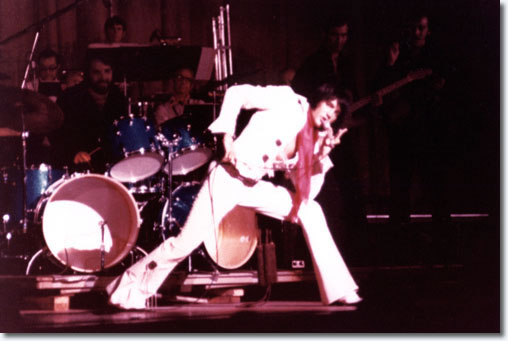
ELVIS PRESLEY SHOOK DETROIT TO ITS CORE! 17,000 FANS SCREAMED AS THE KING TOOK OVER OLYMPIA STADIUM IN A NIGHT NOBODY COULD FORGET!
September 11, 1970. Detroit, Michigan. One night. One legendary superstar. And nearly 17,000 fans who were about to witness something extraordinary.
Imagine standing outside Olympia Stadium in Detroit on that unforgettable Friday evening. Thousands of people are pouring toward the entrance. Excitement fills the streets. Cameras are ready, flashbulbs are exploding, and the anticipation is almost unbearable. Everyone has come for one reason: ELVIS PRESLEY.
On September 11, 1970, Elvis returned to Detroit and proved that the King of Rock and Roll still possessed a power that few performers in history could ever match. At approximately 9:35 p.m., he stepped onto the stage at Olympia Stadium. What happened next was nothing short of explosive.
According to a newspaper report published the following day, nearly 17,000 screaming fans transformed the stadium into an absolute madhouse. The moment Elvis appeared, the audience erupted. Flashbulbs illuminated the arena like lightning, while thousands of voices screamed his name. For approximately 45 minutes, Elvis sang, joked, moved, and entertained the crowd with the unmistakable charisma that had made him an international phenomenon.
But here’s the truly fascinating part: Elvis was already 35 years old. More than a decade had passed since the explosion of rock and roll in the 1950s. Yet when he appeared in Detroit, the reaction looked as though the world had traveled straight back to 1956.
One young woman reportedly struggled to contain her emotions after Elvis left the stage. Her words said everything: “He’s too much. He’s too much.”
And honestly, how could anyone argue with that?
THE KING’S ARRIVAL WAS ALMOST LIKE A TOP-SECRET PRESIDENTIAL VISIT!
Elvis’s arrival in Detroit was surrounded by extraordinary secrecy. His management team, led by the legendary Colonel Tom Parker, reportedly arranged an elaborate operation to protect the singer’s movements.
The Presley entourage had rented approximately 75 rooms at the Detroit Hilton Hotel. His people began arriving early Friday morning, with the first of five taxis carrying members of his group reaching the hotel around 10:30 a.m.
Even more fascinating, reservations had reportedly been made at several major Detroit hotels, apparently to keep Elvis’s actual resting location secret.
When Elvis finally emerged from his limousine at approximately 4:40 p.m., the excitement exploded.
He wore a black outfit with a blue shirt, his dark hair perfectly styled, and silver-rimmed blue sunglasses. Around 40 spectators, many of them young women, rushed toward him near the hotel’s service entrance.
There were screams, pushing, and frantic attempts to get closer to the biggest star in the world.
But Elvis did something that revealed why people adored him so much.
He stopped.
He signed autographs.
He smiled.
He didn’t need a long speech or an elaborate performance. Sometimes, a sleepy expression, a half-smile, and that unmistakable Elvis lip movement were enough to send his fans into complete hysterics.
Even at 35, he could still make an entire crowd lose its mind.
WHAT HAPPENED TO THE LEGENDARY OLYMPIA STADIUM?
Here’s where the story becomes even more emotional.
Today, many people driving through Detroit have absolutely no idea that they are passing a location where Elvis Presley once stood before thousands of screaming fans.
The historic Olympia Stadium once occupied the area around Grand River Avenue and McGraw Avenue. It was a legendary entertainment venue where Elvis had also performed in 1957.
But the building is gone.
In its place stands a Michigan National Guard Armory facility, leaving behind little physical evidence of the extraordinary musical history that once unfolded there.
By studying historical photographs, aerial views, street layouts, and the surrounding buildings, it is possible to identify the approximate location of the old arena.
The parking area visible in historic concert photographs can be compared with the modern streetscape. Even the nearby intersection helps establish where the crowds once gathered.
Think about that for a moment.
The same ground where thousands of fans once walked toward Olympia Stadium is now part of a completely different Detroit landscape.
The old Olympia sign is gone. The arena has disappeared. The screaming crowds have long since gone home.
But the memories remain.
A NIGHT THAT PROVES ELVIS WAS STILL THE KING!
There is something incredibly powerful about revisiting September 11, 1970.
This wasn’t simply another concert on a tour schedule. It was a reminder that Elvis Presley possessed something that couldn’t be manufactured, purchased, or easily explained.
His voice was extraordinary, but his impact went far beyond music. His presence could transform an ordinary hotel arrival into a major public spectacle. His appearance could turn a stadium filled with nearly 17,000 people into a sea of screaming excitement.
And perhaps the most remarkable detail is that this happened years after the first wave of Elvis mania had supposedly passed.
The King hadn’t disappeared. He hadn’t lost his ability to command an audience. Detroit witnessed firsthand that Elvis Presley remained one of the most electrifying entertainers on the planet.
Today, when we look at the surviving footage and photographs, we’re not just watching an old concert. We’re getting a glimpse into a world that no longer exists.
A world where a single appearance by Elvis could stop people in their tracks, fill an enormous stadium, and create memories that fans would carry for the rest of their lives.
September 11, 1970: 17,000 fans. One legendary stage. Forty-five minutes of pure Elvis magic.
The Olympia Stadium may be gone, but the King will never leave that history.
Long live Elvis Presley!
WHAT DO YOU THINK? If you could travel back in time and attend one Elvis Presley concert, would you choose this legendary Detroit performance in 1970 or one of his explosive appearances in the 1950s?