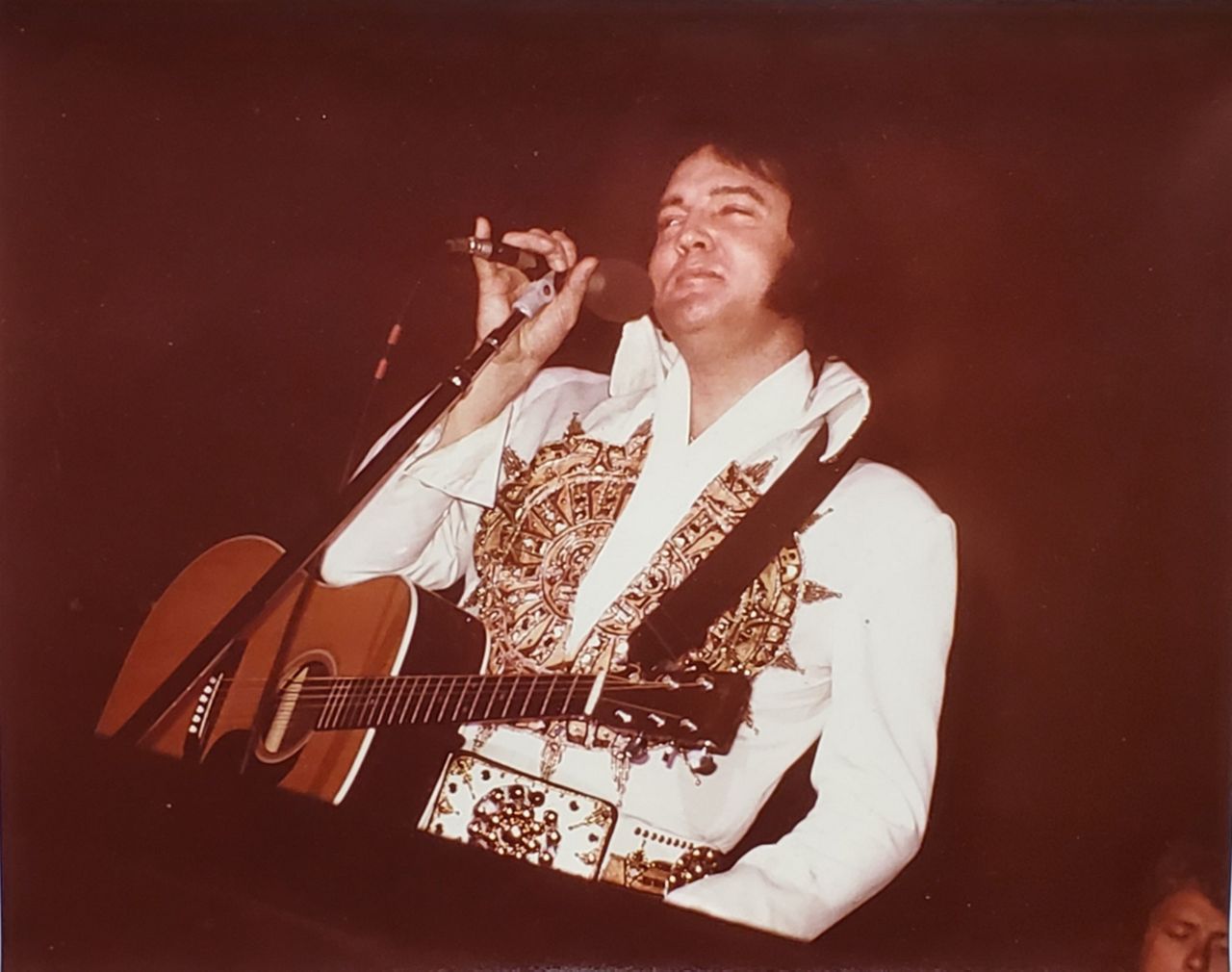
ELVIS PRESLEY IN MAINE, 1977: THE RARE 8MM FOOTAGE THAT BRINGS THE KING BACK TO LIFE — A NIGHT FANS WILL NEVER FORGET!
May 24, 1977. Augusta, Maine. One legendary performer. One unforgettable night. And a rare piece of film history that allows the world to witness Elvis Presley onstage just months before his untimely death.
What if a few precious moments captured on an old film reel could transport you back to a night when the King of Rock ’n’ Roll stood before thousands of devoted fans? What if those grainy images could make you feel, even decades later, as though you were standing inside the arena, watching one of music’s greatest icons perform before your very eyes?
That is the extraordinary appeal of Elvis Presley in Maine — Rare 8mm Footage from May 24, 1977 (Augusta Live). This remarkable archival footage offers fans a glimpse into a chapter of Elvis’s career that has become increasingly emotional with the passage of time.
And the story behind that night is even more fascinating than many people realize.
THE NIGHT ELVIS PRESLEY MADE HISTORY IN MAINE
On May 24, 1977, Elvis Presley performed at the Augusta Civic Center in Augusta, Maine. This was not just another stop on a concert tour. According to historical accounts of his performances, it was his first and only concert appearance in Maine.
Thousands of fans gathered to see the man whose voice, charisma, and revolutionary influence had transformed popular music. For those fortunate enough to be there, the evening represented an opportunity to experience something extraordinary: Elvis Presley, live and in person.
Imagine the anticipation inside the venue. Fans waiting for the lights to change. Conversations growing quieter as the moment approached. Then the unmistakable excitement as the concert began and the legendary performer appeared before the audience.
For many people in attendance, this was more than entertainment. It was a memory they would carry for the rest of their lives.
And thanks to the survival of rare film footage, that moment has not disappeared into history.
WHY THIS OLD 8MM FILM IS SO SPECIAL
Today, we live in a world of high-definition cameras, smartphones, and instant video uploads. Almost every major performance can be recorded from multiple angles and shared around the globe within seconds.
But in 1977, capturing a live concert on film was a very different experience.
An 8mm camera offered limited recording time, and every moment captured was precious. The resulting images might be grainy, imperfect, or distant compared with modern concert footage. Yet those very imperfections give archival film a unique emotional power.
There is something deeply moving about seeing a legendary performer through the lens of an ordinary camera carried by someone who wanted to preserve a special moment.
The footage becomes more than a record of a concert. It becomes a surviving fragment of someone’s experience.
Every frame invites us to imagine the atmosphere of the arena, the excitement of the crowd, and the extraordinary presence of an artist who had already become a worldwide phenomenon.
This is not simply about technical image quality. It is about history, memory, and the irreplaceable value of seeing the past with our own eyes.
ELVIS IN 1977: THE LEGEND BEHIND THE SPOTLIGHT
By 1977, Elvis Presley had already achieved a level of fame few performers could ever hope to reach.
He had changed the course of popular music, conquered the recording charts, starred in Hollywood films, and built a reputation as one of the most recognizable entertainers on Earth.
Yet the Elvis who toured in the final year of his life was also a more complicated figure than the young sensation who had electrified audiences in the 1950s.
His later performances took place against the backdrop of personal struggles and declining health. Looking back today, knowing that he would die on August 16, 1977, gives surviving footage from this period an emotional weight that no one watching in Augusta could fully anticipate.
But it is important to remember that the significance of this concert is not limited to tragedy.
Elvis was still a performer with a remarkable musical legacy, a powerful catalog of songs, and an audience that remained deeply devoted to him. His live repertoire could move from rock ’n’ roll energy to gospel-inspired passion and emotionally charged ballads.
That contrast was one of the defining qualities of Elvis Presley.
He could make an audience cheer with a familiar rock classic and then create a completely different atmosphere with a heartfelt song.
THE SONGS THAT MADE THE AUGUSTA CONCERT MEMORABLE
Historical setlists for the May 24 performance include a remarkable collection of songs spanning different eras of Elvis’s career.
Among them were See See Rider, Jailhouse Rock, It’s Now or Never, Heartbreak Hotel, My Way, Hurt, Hound Dog, and Can’t Help Falling in Love.
Each title tells part of the story.
Heartbreak Hotel recalls the breakthrough that helped establish Elvis as a defining force in 1950s rock ’n’ roll. Jailhouse Rock represents the explosive energy that made him a cultural phenomenon. It’s Now or Never showcases the romantic side of his repertoire, while My Way and Hurt bring a more reflective dimension to his later performances.
And then there is Can’t Help Falling in Love, the beloved song that became one of the most enduring emotional signatures of his concert career.
For fans revisiting this period, these songs are more than entries on a setlist. They are reminders of how one performer could connect with listeners through excitement, tenderness, nostalgia, and raw emotion.
The surviving 8mm footage offers a visual connection to this particular night, while historical recordings and concert documentation help preserve the broader story of what happened onstage.
A GLIMPSE INTO HISTORY THAT FEELS ALMOST IMPOSSIBLE
Perhaps the most powerful thing about watching rare Elvis footage is realizing how easily these moments could have been lost forever.
An old film reel could have been damaged, misplaced, or forgotten in a drawer. A camera operator’s brief recording could have disappeared without anyone outside the original audience ever knowing it existed.
Instead, surviving footage allows new generations to encounter Elvis in a way that photographs and written histories cannot entirely reproduce.
We can look beyond the familiar portraits and album covers. We can see the performer in motion, surrounded by the atmosphere of a real concert, during a specific moment in American music history.
For longtime fans, this is an opportunity to revisit a world they remember or wish they could have experienced.
For younger viewers, it is an invitation to discover why Elvis Presley remains such a powerful cultural figure decades after his death.
And for historians and collectors, every surviving recording adds another small piece to the larger picture of his extraordinary career.
THE KING MAY BE GONE — BUT HIS STORY IS FAR FROM OVER
Elvis Presley died less than three months after his Augusta performance. That fact makes footage from May 24, 1977, particularly poignant.
Yet the lasting significance of this material lies not simply in how close it falls to the end of his life. It lies in its ability to preserve an artist whose influence continues to cross generations.
The King of Rock ’n’ Roll is no longer here to walk onto a stage, hear the crowd roar, or deliver another unforgettable performance.
But his music remains. His image remains. And thanks to the people who preserved rare recordings, fragments of his live performances remain, too.
Decades later, a few minutes of old film can still inspire curiosity, spark debate, awaken memories, and remind the world why Elvis became a legend in the first place.
Watch the rare 8mm footage from Augusta, Maine, and travel back to May 24, 1977 — a remarkable night preserved on film, a final-era glimpse of an icon, and a reminder that some legends never truly leave the stage.
What do you feel when you see Elvis Presley performing in 1977? Does this rare footage make you appreciate his legacy even more? And if you could travel back in time to attend one Elvis concert, would you choose the early rock ’n’ roll years or one of his legendary live performances from the 1970s?