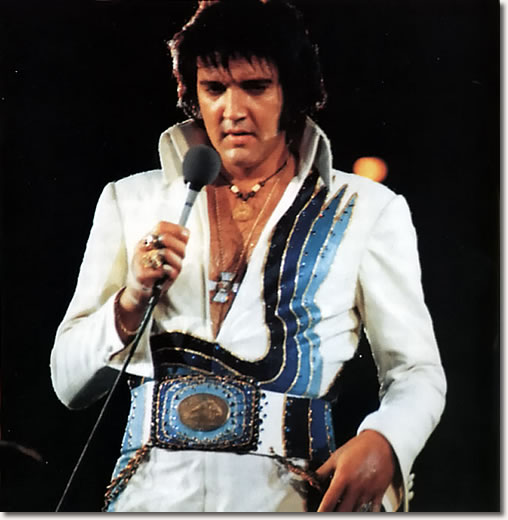
Elvis Presley’s Shocking College Park Night — The Performance That Revealed a Different Side of the King
What if one of Elvis Presley’s most fascinating performances was not the night when everything went perfectly — but the night when the cracks beneath the legend became impossible to ignore?
On September 28, 1974, thousands of fans packed the University of Maryland’s Cole Fieldhouse in College Park, Maryland, waiting for one thing: Elvis Presley.
At 8:30 that evening, the lights went down, the familiar opening atmosphere began, and the King walked onto the stage in his striking blue jumpsuit. Approximately 15,000 people were there, and for many of them, this was more than a concert. It was a chance to see a living piece of music history.
But this particular performance has remained interesting for another reason.
It captures Elvis at a complicated moment in his career.
By 1974, Elvis was no longer the young rebel who had shocked television audiences in the 1950s. He was an established superstar with decades of fame behind him. His concerts were massive productions, surrounded by brilliant musicians, singers, an orchestra, and a carefully developed stage presentation.
Yet the September 28 performance shows something much more human.
The set opened with “Also Sprach Zarathustra,” followed by “See See Rider” and “I Got a Woman.” Elvis then moved through a remarkable mixture of his old classics and newer material, including “Love Me,” “If You Love Me,” “It’s Midnight,” “Big Boss Man,” “Fever,” “Love Me Tender,” and “Hound Dog.”
Then came the band introductions — featuring musicians such as James Burton, Ronnie Tutt, Duke Bardwell and Glen D. Hardin — before Elvis continued with “Blue Christmas,” “All Shook Up,” “Teddy Bear,” “Don’t Be Cruel,” and “Tryin’ to Get to You.”
For longtime fans, these moments are fascinating because they reveal just how much was happening around Elvis. He was not performing alone. Behind him was an exceptionally experienced group of musicians and vocalists who helped create the enormous sound audiences expected from an Elvis Presley concert.
But there is another reason this recording continues to attract attention.
Some contemporary and retrospective reviews have described Elvis as being in less than ideal form during this period. One contemporary Washington Post account from the surrounding College Park concerts portrayed him as visibly tired, while later commentary on the September 28 recording has also focused on the contrast between the enormous Elvis legend and the physical reality of the man standing onstage in 1974.
And that contrast may be the most powerful part of the story.
Because Elvis still had the voice.
He still had the songs.
He still had thousands of people waiting for him.
And he still had the ability to create unforgettable moments.
Listen closely to the performance and you can hear the familiar Elvis — the man who could move effortlessly from rock and roll to gospel, from romance to raw intensity. “How Great Thou Art” brought a completely different emotional dimension to the evening, while “Blue Suede Shoes” reminded everyone of the young performer who had once helped change popular music forever.
And then came the closing moments.
“Can’t Help Falling in Love.”
The same song that had become one of Elvis’ signature romantic performances brought the evening toward its conclusion. After the final notes, the band continued into the closing vamp as Elvis left the stage.
There is something haunting about watching or hearing footage from this period today.
We know what happened later.
But the people inside that building did not.
To them, Elvis was still Elvis Presley — the King.
They did not know that history would eventually judge every 1974 performance through the knowledge of what was still ahead. They were simply there, thousands of people in one enormous room, watching a legendary performer continue to walk onto stages across America.
That is what makes the College Park recording so compelling.
It is not simply a perfect snapshot of Elvis at his peak.
It is something more revealing.
It is a snapshot of a superstar carrying the weight of his own legend while continuing to perform for the people who had never stopped believing in him.
And perhaps that is the real shock hidden inside this old recording.
The King was still standing.
The audience was still screaming.
The songs were still there.
But behind the famous name, the dazzling jumpsuit, and the enormous stage production was a man moving through one of the most complicated periods of his life.
September 28, 1974, therefore deserves to be remembered not merely as another Elvis concert.
It is a time capsule.
A rare glimpse of Elvis Presley caught between the unstoppable legend of his past and the uncertain future that was still waiting for him.
And once you hear this performance with that perspective, you may never listen to it the same way again.