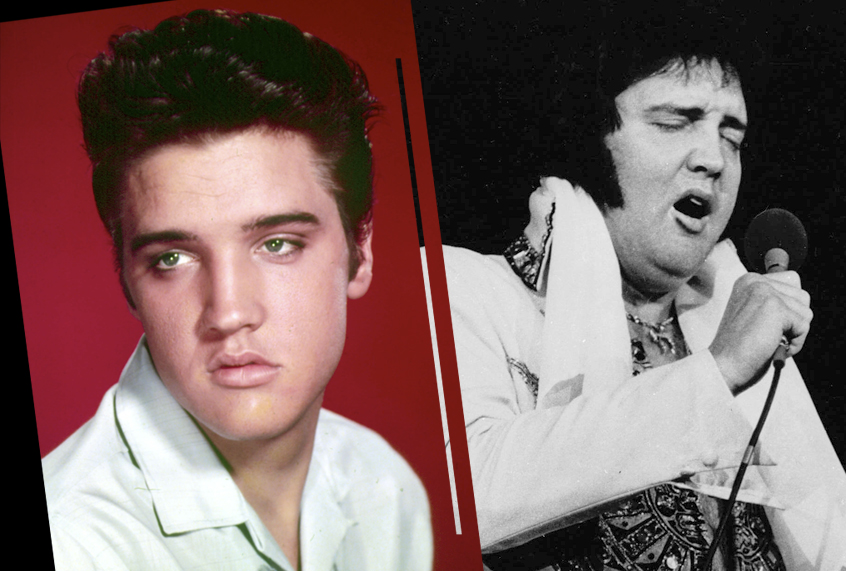
“HOLLYWOOD’S IMAGE OF ME WAS WRONG”: ELVIS PRESLEY FINALLY SPOKE ABOUT HIS MOVIE CAREER
For years, Elvis Presley’s movie career looked like a dream from the outside.
More than 30 films. Millions of dollars. Famous songs. Beautiful locations. A superstar whose name alone could sell a ticket.
But behind the lights, costumes, music, and screaming fans, Elvis said something very different was happening.
He wasn’t indifferent to his movies.
He was deeply worried about them.
And at one point, he admitted that the situation had become so painful that it made him physically ill.
During a candid conversation about his Hollywood career, Elvis looked back at the beginning of his film journey, starting with Love Me Tender, and explained why his growing frustration had been misunderstood by the public.
People had often assumed that Elvis simply didn’t care about the quality of his films.
They saw movie after movie being released, many of them following familiar formulas, and believed he had stopped trying.
But Elvis insisted that the truth was almost the complete opposite.
“I cared so much until I became physically ill,” he explained.
He said the problem was not a lack of concern.
The problem was that he felt he had very little control.
One of the biggest frustrations was his lack of final approval over the scripts. Elvis explained that he could not simply look at a screenplay and say, “This isn’t good for me,” and walk away.
He felt obligated.
He felt tied to commitments.
And he felt trapped inside a Hollywood image that, in his view, did not accurately represent the actor he wanted to become.
That may have been the most painful part.
Elvis believed Hollywood had created an image of him—and once that image became successful, the studios kept repeating it.
If one formula worked, they used it again.
And again.
And again.
The stories began to feel similar. The characters began to feel similar. Even the songs often followed the same pattern.
Elvis described reading only the first four or five pages of a script and already knowing what was coming.
To him, it could feel like the same movie with a different name—and a collection of new songs inserted into the story.
The music itself became another source of frustration.
Elvis admitted that many of the songs provided for his movies were mediocre. For an artist whose voice had once electrified an entire generation, being handed material he didn’t believe in was understandably discouraging.
But that frustration was sometimes mistaken for indifference.
That misunderstanding followed him.
The public saw Elvis making movie after movie.
They didn’t necessarily see the man behind the scenes worrying about whether the material was good enough.
He said he talked about it constantly.
He worried about it so much that it affected him physically.
And yet, he felt unable to change the direction of his career.
Elvis also refused to simply blame everyone around him.
At one point, he admitted that perhaps nobody was deliberately trying to hurt him.
That made the situation even more complicated.
It wasn’t necessarily one person making a decision to destroy his career.
It was a system.
A successful formula.
A Hollywood machine that had discovered what audiences would pay to see—and wanted to keep reproducing it.
Elvis wanted something different.
He hoped the studios might eventually find a new kind of role for him. He wanted an opportunity to demonstrate that he could do more as an actor. He wanted an interesting story—something that could challenge him rather than simply repeat the same formula.
But, as he put it, “It did not change.”
And eventually, the disappointment became discouragement.
Money couldn’t solve that problem.
Elvis made it clear that there was a point where financial success no longer mattered if he couldn’t feel any personal satisfaction from the work.
That is perhaps the most revealing part of his confession.
The man who had everything Hollywood could seemingly offer was still searching for something money could not buy:
the feeling that his work actually meant something.
He had fame.
He had wealth.
He had millions of fans.
But he wanted to be respected for something beyond the familiar Hollywood version of Elvis Presley.
And when he later performed the song “Release Me,” the moment carried an almost haunting resonance.
The song itself speaks of wanting to be released from a relationship that has become painful—a plea to be allowed to move on and find another life.
Whether or not Elvis intended the performance as a direct metaphor for his movie career, the words were impossible to ignore after hearing his explanation.
“Release me. Let me go.”
Those words suddenly sounded different.
For Elvis, the frustration wasn’t simply about making too many movies.
It was about feeling that a career he had once cared deeply about was moving in a direction he couldn’t control.
He wasn’t saying that he hated acting.
He was saying that he wanted the opportunity to act.
He wanted better stories.
He wanted better material.
He wanted to prove that there was more to Elvis Presley than the character Hollywood had created around him.
And perhaps the saddest part of his story is that he knew what was happening while it was happening.
He saw the repetition.
He recognized the mediocre material.
He understood how the public image was shaping his career.
But he didn’t know how to break free from it.
Years later, his words still reveal a side of Elvis that audiences rarely saw on the screen.
The smiling movie star.
The romantic leading man.
The man singing twelve songs in another colorful film.
Behind all of that was someone who cared intensely about his work—and who felt increasingly powerless to change it.
The world saw the movies.
Elvis saw the missed opportunities.
And that difference may explain more about his complicated Hollywood years than any box-office number ever could.