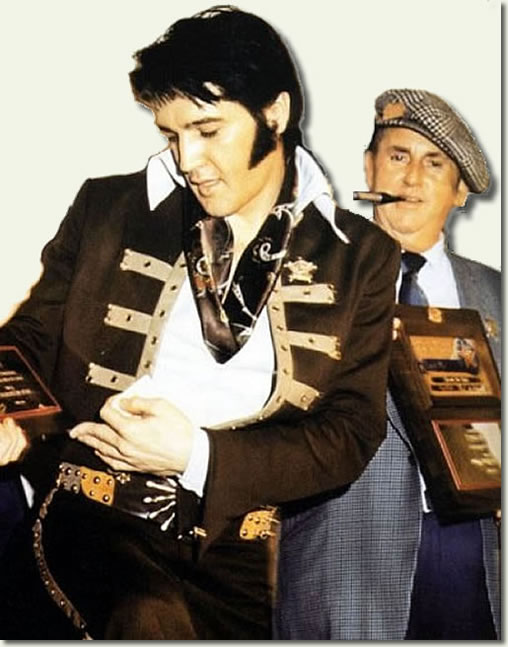
ELVIS PRESLEY’S LAS VEGAS RETURN WAS A TRIUMPH — BUT BEHIND THE GLITTER, SOMETHING MUCH DARKER WAS HAPPENING
What if Elvis Presley’s greatest comeback was also the beginning of one of the most complicated chapters of his career?
In 1969, Elvis returned to the Las Vegas stage after being away from live performance for more than a decade. To the public, it looked like a spectacular victory. The King was back. The crowds were enormous. The International Hotel was packed. His name was everywhere.
But behind the lights, posters, money, and champagne, another story was unfolding — one involving Tom Parker, gambling, increasingly complicated contracts, Elvis’s growing dependence on medication, and a struggle over how much control Elvis actually had over his own career.
Just 16 days after the legendary 1968 comeback special aired, Colonel Tom Parker finalized a deal for Elvis to perform at the newly built International Hotel in Las Vegas. The hotel had invested heavily in its enormous showroom, and Parker promised that Elvis would bring people from around the world.
The risk was obvious. Elvis had spent years making movies and had not performed regularly on a Las Vegas stage since the 1950s.
Parker, however, was confident.
He demanded $100,000 a week and negotiated additional privileges for himself and Elvis. The plan was ambitious: Elvis would perform two shows a night, seven nights a week, for four weeks.
But there was one person who had to face the pressure directly.
Elvis.
As the opening approached, the massive International stage reportedly overwhelmed him. According to the accounts presented in Alana Nash’s The Colonel, Elvis experienced severe stage fright and worried about whether his voice could carry him through the demanding schedule.
Then came July 31, 1969.
At 10:15 that night, Elvis walked onto the stage.
What happened next transformed the atmosphere.
Instead of collapsing under the pressure, Elvis delivered a high-energy performance, mixing early classics with newer material from the Memphis recording sessions. He moved across the stage with confidence, dropped to his knees, slid and even performed a cartwheel.
The audience responded with a standing ovation.
The comeback was real.
And the numbers were staggering.
The first engagement drew approximately 101,500 people and generated more than $1.5 million in gross revenue. The International immediately understood what Elvis could do for the hotel.
Yet the financial story became more complicated.
Parker negotiated a five-year arrangement worth $125,000 a week for two engagements each year. The deal looked impressive on paper, but hotel executives later suggested that Elvis could have commanded substantially more if the contract had included bonuses tied to attendance or revenue.
This is where Las Vegas became more than a stage for Elvis.
It became a crucial part of Colonel Parker’s world.
Parker was spending enormous amounts of time in the casino. Accounts cited in the chapter describe him gambling for hours, sometimes betting huge sums at roulette and craps. Some associates later described extraordinary losses, although exact figures varied.
At the same time, Elvis was becoming increasingly tied to the Las Vegas machine.
The King’s name helped fill hotel rooms, restaurants and casinos. Parker’s advertising campaign saturated the city with Elvis posters, billboards and promotions. The strategy worked so effectively that reservation requests reportedly overwhelmed the hotel and crowds stretched for blocks.
But the price of success was beginning to show.
Elvis continued performing demanding schedules, and by the early 1970s the routine had become increasingly exhausting. His medication use was becoming more concerning to people around him, while his behavior became increasingly unpredictable.
Then came another turning point.
In December 1970, Elvis secretly traveled to Washington, D.C., determined to obtain a federal narcotics badge. After failing to get what he wanted from narcotics official John Finlator, Elvis pursued a meeting with President Richard Nixon.
He eventually walked into the White House wearing an extravagant outfit, complete with a cape, jewelry, sunglasses and a cane.
The meeting produced one of the most famous photographs of Elvis’s later life.
He received the Federal Narcotics Badge he had desperately wanted.
For Parker, however, the episode was deeply troubling. Elvis had acted independently, without his manager’s control.
And Elvis was increasingly trying to establish a world of his own.
Meanwhile, Parker continued expanding the concert business. Touring eventually became more profitable than Elvis’s movie career, leading to new arrangements involving RCA and Concerts West. Elvis returned to major American arenas, often drawing enormous crowds.
But even as Elvis became one of the biggest touring attractions in America, his relationship with Parker was becoming more complicated.
By 1971, the Las Vegas routine was taking a toll. Elvis was performing long shows repeatedly, sometimes twice a night. People close to him described growing exhaustion and frustration with the repetitive schedule.
At the same time, his personal life was deteriorating.
His marriage to Priscilla was breaking apart, and rumors about relationships outside the marriage intensified. By February 1972, Priscilla acknowledged her relationship with Mike Stone and asked Elvis for a divorce.
While Elvis’s personal life was collapsing, Parker was thinking about the next business opportunity.
Elvis wanted to perform internationally, particularly in Europe. Parker resisted the idea, citing practical concerns involving money, security, travel and logistics.
Then Parker found another possibility.
Instead of sending Elvis around the world, why not bring the world to Elvis?
The answer was satellite television.
The idea eventually developed into the massive international concert project that would become Aloha from Hawaii.
It was another example of the strange paradox surrounding Elvis in the early 1970s.
The bigger his career became, the more complicated the machinery around him became.
Las Vegas had given Elvis a spectacular stage and helped revive his live career after years in Hollywood.
But it also created an exhausting cycle of performances, contracts, gambling interests and managerial control.
The glitter was real.
The money was real.
The audiences were real.
And so was the pressure.
What looked from the outside like the unstoppable rise of the King was, behind the scenes, becoming a complicated struggle between Elvis the performer and the enormous business empire built around him.
The Las Vegas years did not simply show how powerful Elvis Presley had become.
They also revealed how much was being demanded from him — and how difficult it could become for the King to step away from the machine that carried his name.
And perhaps that is the most shocking part of this chapter:
Elvis had finally regained the stage he had been fighting to reclaim. But once he conquered Las Vegas, escaping from it would become another battle entirely.