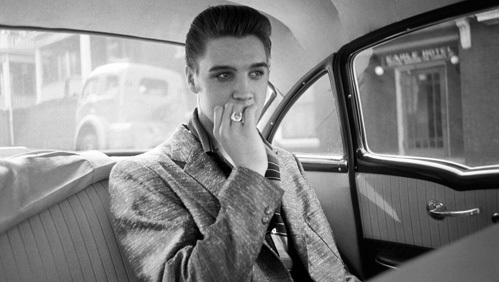
Elvis Presley’s Private Side: The Hidden Loneliness Behind the King
What if the man who could make thousands of people scream was sometimes the loneliest person in the room?
Behind the dazzling costumes, screaming crowds, RCA Victor records, and the extraordinary fame that turned Elvis Presley into an international superstar, there was another side of the King that fans rarely saw. It was quieter, more vulnerable, and surprisingly personal.
In one revealing conversation, Elvis was asked about something that had nothing to do with music, movies, money, or fame: Was he in love?
His answer was strikingly honest.
Elvis admitted that he was not in love at that moment. He explained that he had once believed he was in love, but that feeling had eventually passed. Rather than pretending to have all the answers, he simply acknowledged that he had not yet met the woman he truly wanted to spend his life with.
And then came the part that reveals something much deeper about Elvis.
He said he hoped it would not take too long because he sometimes felt lonely.
That confession is easy to overlook when we think about Elvis Presley. After all, how could a man surrounded by thousands of admirers possibly feel alone?
But Elvis himself offered the answer.
He described a strange kind of loneliness that could happen right in the middle of a crowd. Fame could put him in front of countless people, yet that did not necessarily mean he had found the person he genuinely wanted beside him.
For Elvis, the issue was not simply having people around him. He was talking about having a special person with whom he could share a deeper emotional connection.
That makes these private words especially fascinating.
The public saw Elvis as the confident performer who could walk onto a stage and immediately command attention. Fans saw the charisma, the smile, the voice, and the unmistakable presence that made him one of the most recognizable entertainers of his era.
But in this moment, there was no stage persona to hide behind.
There was simply Elvis talking about love and loneliness.
He imagined that one day he would meet the woman he was looking for. And when that happened, he hoped that he would no longer feel lonely no matter where he was.
That final thought is perhaps the most revealing part of the entire conversation.
It suggests that Elvis understood something many people discover regardless of fame or success: being surrounded by people is not the same as feeling truly connected to someone.
For a superstar whose records were being played by disc jockeys across the country and whose name was becoming synonymous with rock and roll, this was an unexpectedly human confession.
He could have talked endlessly about his success.
Instead, he talked about wanting someone special.
And perhaps that is why moments like this remain so interesting decades later. They remind us that behind the legendary image of Elvis Presley was a man who experienced the same basic emotions as everyone else—hope, uncertainty, affection, and loneliness.
Before ending the conversation, Elvis thanked the listener for allowing him to speak openly and for listening to his RCA Victor records. He also expressed appreciation to the disc jockeys who played his music.
Then he said goodbye.
It was a simple ending to a conversation, but his words about loneliness leave a much stronger impression than the polite farewell.
The King could fill a room with his presence—and still wish for one person who would make him feel at home.
That may be one of the most fascinating contradictions in Elvis Presley’s life: the more famous he became, the more difficult it could be to separate the man from the legend.
Fans knew Elvis Presley.
The world knew Elvis Presley.
But somewhere beneath the fame was Elvis—the man who admitted that he was still waiting for love, still searching for that special connection, and still capable of feeling lonely in the middle of a crowd.
And perhaps that is the private side of Elvis that deserves to be remembered most.
Not the superstar.
Not the icon.
Just Elvis, a human being, hoping that someday he would find the person who could make the loneliness disappear.