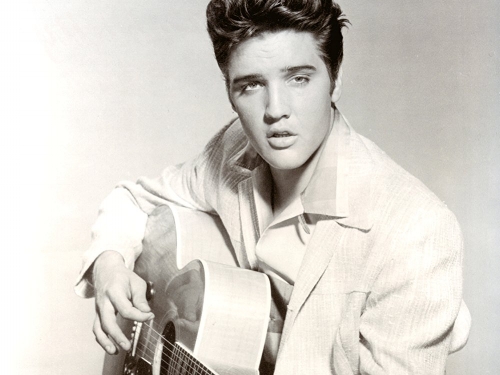
Elvis Presley: The Shocking Facts Most People Never Knew About the King
He was one of the biggest stars the world had ever seen. Millions screamed his name, crowds watched his every move, and eventually he became known simply as The King. But behind the legendary jumpsuits, unforgettable performances, and powerful voice was a very different Elvis Presley — a young man who could be surprisingly shy, nervous, and even afraid of opportunities that would later seem impossible to refuse.
One of the most fascinating facts about Elvis is that the superstar we remember as the ultimate performer was reportedly an exceptionally shy young man. Long before he became famous, Elvis had already developed a remarkable singing voice. Yet when he was around 12 years old, he reportedly had an opportunity to sing on a local radio program and turned it down because he was simply too frightened.
That detail is almost impossible to reconcile with the Elvis who would later command enormous stages.
And there was another early rejection that could have changed music history.
At about 19, Elvis reportedly auditioned for the gospel group The Songfellows, hoping to become part of a musical group. He was not accepted. Looking back, that rejection seems almost unbelievable. The young singer who was turned away would soon begin recording music that changed popular culture forever.
Then came “That’s All Right.”
When the song began receiving radio exposure in Memphis, listeners reportedly became fascinated by the unusual new voice. According to stories surrounding the record’s early reception, some listeners even questioned whether the singer was Black because of the sound of his voice. Elvis, of course, was white, but he had grown up deeply influenced by the musical traditions of the American South, including gospel, blues, and rhythm and blues.
His appearance also became part of the legend. Elvis famously darkened his naturally brown hair, helping create the distinctive black-haired image that became instantly recognizable.
Then came “Heartbreak Hotel” in 1956.
The song was inspired by a newspaper story about a man who died after jumping from a hotel window, and its dark subject matter contrasted sharply with Elvis’s explosive public image. Yet the record became a major breakthrough and his first million-selling single. There is another interesting fact that often gets overlooked: Elvis was primarily an interpreter rather than a songwriter. Many of his biggest hits were written by other songwriters, while Elvis’s extraordinary talent was in transforming songs through his voice, phrasing, rhythm, and stage presence.
Before “The King” became the permanent title, Elvis was given another nickname that became legendary: “Elvis the Pelvis.” The nickname emerged after his controversial performances, particularly his appearance of “Hound Dog” on television. His movements were so provocative for the era that they became almost as famous as his voice.
But there was also a private side of Elvis that fans rarely saw.
Stories about his personal habits describe him as extremely concerned about germs. One often-repeated anecdote claims that he would drink from the part of a glass above the handle because he believed nobody else would have touched that area. Whether every detail of the story is accurate or not, it contributes to the fascinating contrast between Elvis’s enormous public confidence and his private eccentricities.
And then there was Colonel Tom Parker.
Parker presented Elvis as an attraction and played a central role in transforming him into a worldwide celebrity. His business relationship with Elvis was enormously successful — but it was also controversial. After Elvis’s death, investigations and later accounts raised serious questions about Parker’s financial arrangements and the enormous share of Elvis’s earnings that went to his manager.
Perhaps the strangest story associated with Parker is the famous claim that he once painted sparrows yellow and sold them as canaries. The story has become part of the mythology surrounding Parker, often used to illustrate his reputation as a clever and unconventional promoter. However, it should be treated as an anecdote rather than unquestioned historical fact.
That is what makes Elvis’s story so fascinating.
The man who seemed fearless on stage could once be too shy to sing on the radio. The singer who was rejected by a gospel group became one of the most influential performers in history. The young man who was once simply Elvis Presley eventually became The King of Rock and Roll.
And behind the legend were countless contradictions — shyness and confidence, vulnerability and power, innocence and controversy.
Perhaps the most shocking fact about Elvis isn’t any single strange story.
It is how completely different the quiet young man from Memphis was from the global superstar the world would eventually see.