Elvis Presley’s Huntsville Secrets: The Fans Who Saved Memories Time Could Never Replace
For decades, Elvis Presley’s story has been told through photographs, recordings, concert footage, biographies, and the memories of people who stood closest to him.
But what if some of the most important pieces of Elvis history were never recorded by the people inside his inner circle?
What if they were preserved by ordinary fans who simply happened to be in the right place at the right moment?
That is the powerful idea behind the new “Huntsville Sessions,” a project created by Elvis historians and longtime fans who traveled to Huntsville, Alabama, to collect firsthand memories connected to Elvis Presley’s appearances there. Rather than focusing only on famous figures who knew or worked with Elvis, the project turns its attention toward people who were actually there—fans whose personal memories may otherwise disappear with time.
And the first story comes from Wayman Burke, a lifelong Huntsville resident whose connection to Elvis stretches back to his childhood.
Burke was born in Huntsville in 1951. Like many children growing up in the 1950s, his earliest exposure to Elvis did not necessarily come from television. His family listened to the radio, and television did not arrive in his home until around 1961 or 1962.
But Elvis was already everywhere.
Burke remembered becoming aware of Elvis as a cultural presence during his childhood. One of the most important connections came through his Aunt Dita, a teenage girl who owned Elvis records and allowed her young nephew to play them on her record player.
One song in particular came back to him: “Hound Dog.”
Years later, that childhood memory took on a new meaning when Burke acquired the very same record player from his aunt at a yard sale. He had it restored, turning an ordinary piece of household equipment into a deeply personal connection to his childhood—and to the moment when Elvis’s music first captured his imagination.
But that was only the beginning.
Burke also preserved an original copy of “Mystery Train,” one of Elvis’s early Sun recordings. For him, the song represented more than music. The image of a train leaving town carried a familiar idea in rock and country music: escape, adventure, and the possibility of leaving ordinary life behind.
Then came another remarkable piece of Elvis history.
When the hotel where Elvis had stayed during his Huntsville appearances was eventually demolished, Burke realized that something important could disappear forever.
Inspired by seeing other famous pieces of music history preserved as memorabilia, he decided to save the doors from Elvis’s room.
He worked with a former student connected to Huntsville’s property management, identified the correct doors, and purchased them from the salvage company for roughly $10 each. He had them restored to their original appearance.
One door was donated to the Huntsville Public Library’s Heritage Room.
The other remained with Burke and his family.
According to Burke, the room associated with Elvis was Suite 328—and the same room had also hosted other notable visitors over the years, including Ronald Reagan in 1984 and, he recalled, B.B. King.
For Burke, however, the door represented something much more personal.
It was a physical reminder that Elvis Presley had actually been there.
And then came the memory that perhaps makes the Huntsville Sessions truly special.
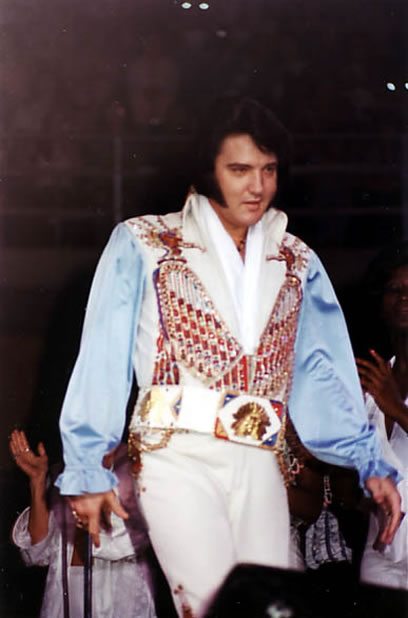
In 1975, Elvis performed a series of shows at Huntsville’s Von Braun Center. Burke and his wife managed to obtain tickets after the demand became overwhelming and additional performances were added.
They attended the third show on May 31, 1975.
Burke remembered the atmosphere as extraordinary. The venue was packed, and Elvis’s appearance had become a major event in the city. When the stage introduction began and the lights and camera flashes filled the arena, he remembered the experience as almost surreal.
The opening performance included “C.C. Rider,” and from the moment Elvis appeared, the energy inside the building was overwhelming.
Burke and his wife were seated far from the stage, in what he jokingly called the “nosebleed section.”
But distance did not matter.
They were there.
And that, in itself, became the memory.
Years later, Burke also recalled another extraordinary encounter—this time at the Huntsville airport.
Elvis’s aircraft had become an attraction during his stay, with fans gathering nearby hoping to catch a glimpse of the singer. Burke and his wife went to the airport late at night, bringing along their three-month-old son, Jason.
They waited with other fans.
Then Elvis’s entourage appeared.
A white Pontiac pulled up, escorted by a police vehicle. Elvis was sitting in the back seat. For a brief moment, the window came down.
Burke remembered Elvis looking toward them and waving at their young son.
It lasted only seconds.
But decades later, that moment remained vivid in Burke’s memory.
Jason would eventually grow up to become a guitarist and develop his own love of music, although he has no personal memory of that night.
And perhaps that is exactly why stories like this matter.
Elvis Presley left behind millions of photographs, recordings, films, and documents. But history is also made of small moments—an old record player, a preserved hotel door, a concert remembered from the nosebleed section, or a brief wave from a car window.
The people who experienced those moments will not be here forever.
That is why the Huntsville Sessions are attempting to preserve them now.
Not simply as stories about Elvis.
But as memories of what it actually felt like to be there.
Because someday, when the last eyewitnesses are gone, these personal recollections may become the closest thing future generations have to hearing the story directly from someone who stood inside the crowd.
And Wayman Burke’s memories prove something remarkable:
Sometimes, the most extraordinary pieces of Elvis Presley’s history are not locked away in museums.
Sometimes, they are sitting in someone’s home—waiting for someone to ask the right questions.