Elvis Presley Punched a Gas Station Man in 1956 — The Next Morning, 207 Women Filled the Courtroom
October 18, 1956. Memphis, Tennessee.
Elvis Presley was only 21 years old, but by then, he was already one of the most recognizable people in America.
Everywhere he went, crowds followed.
And on one ordinary afternoon in Memphis, that fame turned a routine stop at a Gulf service station into a physical confrontation, three arrests, a courtroom battle—and one of the strangest celebrity scenes Memphis had ever witnessed.
The next morning, 207 women and girls reportedly packed into city court just to see Elvis.
But what happened the day before was far more complicated than the simple story that “Elvis punched a gas station manager.”
It began with a car.
Elvis had pulled into the Gulf station at Second and Gayoso because something was wrong with his vehicle. His expensive Continental Mark II was attracting attention, just as Elvis himself did everywhere in 1956.
It didn’t take long for people to gather around him.
Fans surrounded the car, asking for autographs and trying to get a closer look at the young rock-and-roll sensation. A Memphis police officer later testified that the car was essentially surrounded by teenagers and other people, making it difficult for Elvis to drive away.
For the station manager, Edd Hopper, this was becoming a serious problem.
The crowd was interfering with the business.
Hopper wanted Elvis to move the car.
According to testimony reported after the incident, Elvis agreed that he would move—but the crowd was preventing him from leaving. While the situation continued, the tension between the singer and the station manager escalated.
Then everything exploded.
A physical fight broke out between Elvis, Hopper, and station employee Aubrey Brown.
Elvis struck Hopper, leaving him with a badly bruised eye. Brown became involved as well, and police eventually broke up the confrontation. All three men were arrested and booked on assault-and-battery and disorderly-conduct charges.
But there was another side to the story.
Police officers testified that Hopper had struck Elvis first. One officer also produced a small pocketknife that police said belonged to Hopper and said it had been found after the confrontation. Hopper denied pulling a knife. The accounts of exactly what happened were therefore not identical.
That detail matters.
Because the popular version of the story often makes it sound as if Elvis simply lost his temper, walked over, and attacked an innocent man for asking him to move.
The historical record is more complicated.
And the next morning, the entire incident became a spectacle.
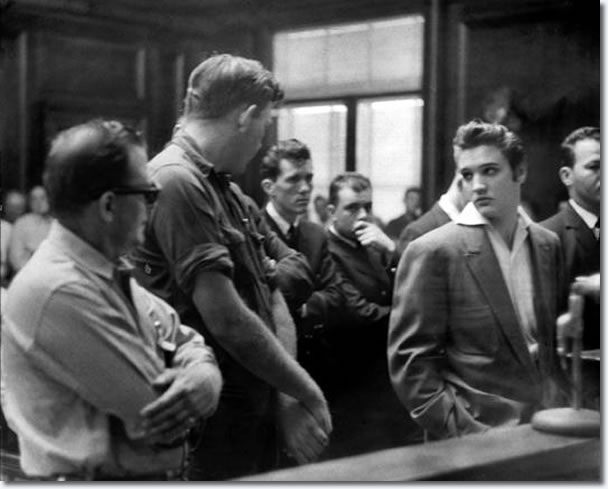
On October 19, 1956, Elvis appeared in Memphis City Court.
He arrived with his father, Vernon Presley, and the courtroom was already packed.
According to contemporary reporting, 207 women and girls were counted inside the courthouse, having arrived by cars, taxis, and even trucks. They weren’t there because Elvis was performing.
They were there because Elvis was on trial.
The sight must have been extraordinary.
A courtroom dealing with assault charges had effectively become an Elvis Presley event.
When the young singer entered, cameras flashed and fans reacted excitedly. Elvis sat through the proceedings while the judge heard testimony from the people involved and from police officers who had witnessed the aftermath.
Then came the decision.
Elvis was cleared.
The charges against him were dismissed.
Hopper and Brown, meanwhile, were fined for their roles in the confrontation. Contemporary accounts report fines of roughly $25/$26 for Hopper and $15/$16 for Brown, with the exact figure varying slightly between reports.
And just like that, Elvis walked out of court.
The crowd was waiting.
More than 200 women and girls had come to watch their idol face an assault case—and they got to see him walk away cleared.
The incident also produced one of the most bizarre details of the entire story.
When Elvis was being booked after the fight, he reportedly joked that perhaps the police should put down “Carl Perkins” as his name—a reference to another major rockabilly performer.
The joke didn’t work.
The police booked him as Elvis Presley.
And when reporters later tried to get Elvis’s reaction, they were reportedly told by Vernon Presley that his son was “out in the back yard feeding the mule.”
It was an almost surreal image.
The most famous young entertainer in America had just been arrested after a fight at a Memphis gas station.
And at home, he was apparently feeding a mule.
But beneath the strange humor was a very real problem.
Elvis could hardly go anywhere anymore without attracting attention.
A trip to a gas station could create a crowd.
A trip through downtown Memphis could become an event.
A simple attempt to repair his car could turn into a police matter.
He was only 21.
His career had exploded with extraordinary speed, and the public fascination with him was becoming impossible to escape.
The October 1956 confrontation therefore remains one of the most revealing episodes of Elvis’s early fame—not simply because he got into a fight, but because it shows how completely ordinary life had already begun disappearing for him.
Yet it is important not to turn the incident into a simple morality tale.
Elvis was cleared in court, but that does not mean the confrontation never happened. The physical fight is well documented, and the historical accounts agree that Elvis struck Hopper and that Brown became involved. At the same time, contemporary testimony indicates that Hopper had also struck Elvis and that there was disagreement over whether a knife had been involved.
That is what makes this story so fascinating.
It wasn’t a clean story of hero and villain.
It was a chaotic collision between a frustrated business, an overwhelmed crowd, a rapidly rising superstar, and a young man whose life had suddenly become public property.
And the strangest part may still be those 207 women and girls.
They didn’t come to hear Elvis sing.
They came to watch Elvis face a judge.
And when he walked out of that courtroom cleared of the charges, the fans were waiting for him just as they had been everywhere else.
In 1956, Elvis Presley couldn’t even go to court without becoming the main attraction.
That is the real shock of the story.
The fight lasted only moments.
The fame surrounding it was already enormous.
And for Elvis Presley, this was only the beginning of a life in which almost nothing could remain private.