THE DAY ELVIS PRESLEY LOST HIS HAIR — AND FEARED THE WORLD MIGHT FORGET HIM
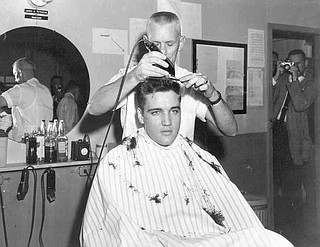
After arriving at Fort Chaffee following his induction on March 24, 1958, Elvis Presley received the military haircut that would become one of the most photographed moments of his Army career.
When he walked out a military barbershop looking like an ordinary soldier.
But what happened between those two moments was far more emotional than a simple haircut.
Before the clippers ever touched his head, Elvis reportedly understood exactly what that haircut represented. His famous pompadour was not just hair. It had become part of the image that had transformed a poor boy from Tupelo into the most controversial and electrifying performer of his generation.
And now the Army was about to take it away.
The scene itself was extraordinary. Cameras and reporters gathered around the small barbershop, turning an ordinary military procedure into a national spectacle. Other recruits could enter, receive their regulation haircut, and disappear without anyone caring.
Elvis couldn’t.
Every movement was being photographed.
Every lock of hair falling to the floor could become tomorrow’s newspaper picture.
And suddenly, something that should have been routine became deeply personal.
Imagine sitting in that barber’s chair while strangers photograph the moment your trademark appearance disappears piece by piece.
The scissors moved through the famous hair that millions of fans had talked about, admired, copied, or criticized.
Elvis tried to do what Elvis always did.
He joked.
When someone asked about losing his trademark hair, he famously responded with the kind of humor that could instantly break the tension.
“Hair today, gone tomorrow.”
The room laughed.
But behind the smile was a young man facing something much bigger than a haircut.
Elvis was about to leave the United States for military service in Germany. He had no guarantee that the enormous fame he had built before entering the Army would still be waiting for him when he returned.
That fear was not unreasonable.
The entertainment world moved quickly. New singers appeared. New stars replaced old ones. Two years could feel like an eternity in popular music.
What if the audience moved on?
What if the screaming fans found another idol?
What if Elvis Presley returned from the Army and discovered that the world had simply continued without him?
That may have been the real fear beneath the haircut.
Not losing his hair.
Losing the identity that had come with it.
Yet there was something the clippers could never remove.
His voice.
His talent.
His instinct for performing.
His ability to walk into a room and command attention.
The famous hairstyle had helped create the Elvis image, but it was never the entire reason people listened to him.
And that distinction would become incredibly important.
The photographs from that morning became part of Elvis Presley history. The shocking transformation from rock-and-roll rebel to clean-cut soldier was seen by millions.
But the story didn’t end in that barber’s chair.
In fact, Elvis’s time away from the stage would eventually become one of the most fascinating chapters of his career.
When he returned, he wasn’t forgotten.
If anything, his absence had made the public even more curious about him.
The young man who entered the Army with a famous pompadour eventually returned with a different appearance, a different perspective, and an even more complicated relationship with fame.
That is why the March 24, 1958 haircut remains so powerful.
It looks like a story about hair.
It wasn’t.
It was a story about identity.
About fear.
About fame.
And about a young Elvis Presley discovering that the world could take away the image—but it couldn’t take away the man underneath it.