For years, Elvis Presley had been slowly watching his own career slip away.
The man who once shook the world with his voice, his movements, and his unforgettable presence had become trapped inside a machine that seemed determined to keep him there. Movie after movie rolled into theaters. The songs were often secondary. The scripts became predictable. The excitement that had once surrounded Elvis Presley was fading.
And then came 1968.
What happened next was so dramatic that it is almost impossible to understand Elvis’s later career without understanding the ’68 Comeback Special.
Before the special, Elvis had spent years appearing in lightweight Hollywood movies that critics increasingly dismissed as repetitive and formulaic. After returning from the Army, he scored major successes with films such as G.I. Blues and Blue Hawaii, but the quality of the material steadily declined. Movies like Jailhouse Rock and King Creole had demonstrated that Elvis could genuinely command the screen. But by the mid-1960s, he was frequently being handed stories built primarily to sell records, merchandise, and movie tickets.
The formula became painfully obvious.
A movie would arrive. Elvis would sing. An album would follow. The album helped promote the movie, and the movie helped sell the album.
Meanwhile, the cultural world was changing around him.
The Beatles and the British Invasion had captured the attention of a new generation. Rock music was evolving rapidly, while Elvis appeared increasingly disconnected from the musical revolution he had helped create.
By 1968, critics were questioning whether Elvis was finished.
Then Colonel Tom Parker proposed something that sounded almost laughably ordinary: a television Christmas special.
But behind the scenes, something completely unexpected was happening.
Producer Bob Finkel and director/co-producer Steve Binder did not simply want another Elvis program. They wanted to rediscover the man behind the manufactured movie star.
Most importantly, Binder reportedly asked Elvis a question that had become almost revolutionary in his life:
“What do you want to do?”
After years of being told what to sing, what movies to make, and how to present himself, Elvis was finally being given a chance to reclaim his own identity.
And he did.
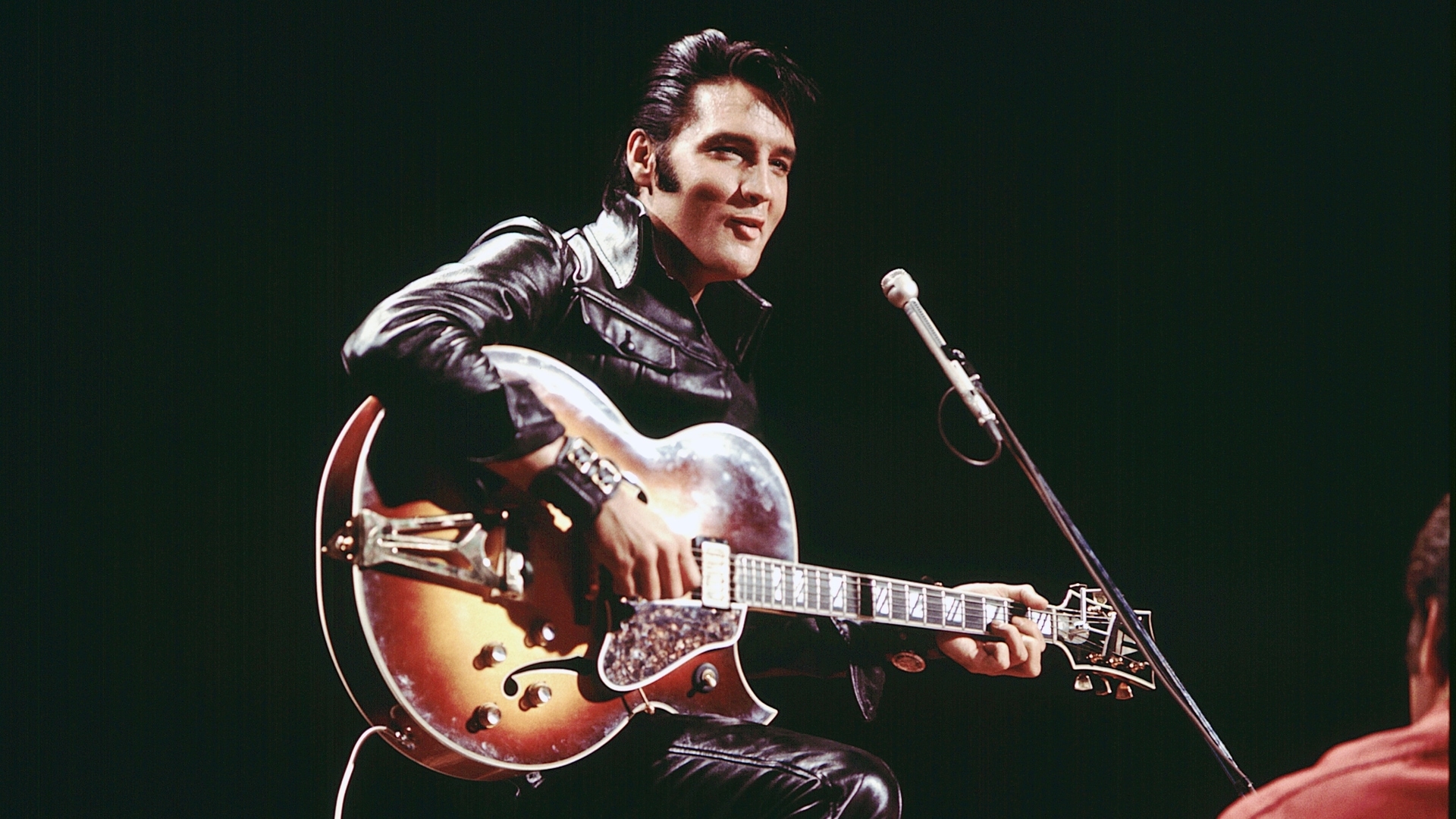
Suddenly, there he was — dressed in the legendary black leather suit, looking confident, dangerous, youthful, and completely alive.
This wasn’t the polished, predictable movie Elvis.
This was the original Elvis.
He returned to the songs that had made him famous: “Hound Dog,” “Heartbreak Hotel,” “Don’t Be Cruel,” and other classics. But something had changed. His voice had matured. It was richer, deeper, more powerful, and sometimes rough around the edges.
He wasn’t trying to recreate 1956.
He was showing the world what Elvis Presley sounded like in 1968.
Then came one of the most important moments: Elvis reunited with musicians from his early career for the famous informal jam sessions. Sitting among fellow musicians and surrounded by an intimate audience, he appeared relaxed and spontaneous in a way fans had not seen from him in years.
And then came “Guitar Man.”
The special’s dramatic sequences connected Elvis’s personal story to the story of a struggling musician trying to find his way. It was almost impossible not to see the parallels.
But the ultimate shock came at the end.
“If I Can Dream.”
The song transformed the special from a simple entertainment program into something much larger. Its message of hope, unity, and a better future resonated with a country experiencing enormous social and political turmoil.
Suddenly, Elvis wasn’t yesterday’s star.
He was relevant again.
The ’68 Comeback Special became the spark that reignited his career and sent him toward an entirely different chapter.
Soon afterward came the historic Memphis recording sessions that produced From Elvis in Memphis and supplied additional material later issued as part of From Memphis to Vegas / From Vegas to Memphis and subsequently released separately as Back in Memphis.”
And then came Las Vegas.
In 1969, Elvis opened at the International Hotel in Las Vegas and began one of the most famous performance residencies in entertainment history. His first engagement consisted of 57 performances, and the shows were a tremendous commercial success.
The man Hollywood had nearly buried beneath years of formula movies was suddenly commanding enormous stages again.
The comeback didn’t stop there.
Tours followed. Concert documentaries followed. That’s the Way It Is arrived. Elvis on Tour followed. Then came the spectacular Aloha from Hawaii era.
The trajectory had completely changed.
And that’s why the ’68 Comeback Special is not simply another chapter in Elvis Presley’s biography.
It is the turning point.
Without it, the Elvis story might have ended very differently.
The special didn’t merely remind the world that Elvis could sing.
It reminded Elvis himself who he was.
The black leather suit. The guitars. The intimate stage. The old songs. The rebellious energy. The mature voice. The confidence. The final cry of “If I Can Dream.”
All of it came together at exactly the right moment.
Elvis Presley had spent years being told what he should be.
In 1968, he finally showed the world who he actually was.
And once America saw that Elvis again, there was no turning back.
The King wasn’t finished.
He was just getting started all over again.
Video
https://youtu.be/IEZW1CW-YVY?si=O_OJ34wX-3YJIFYT