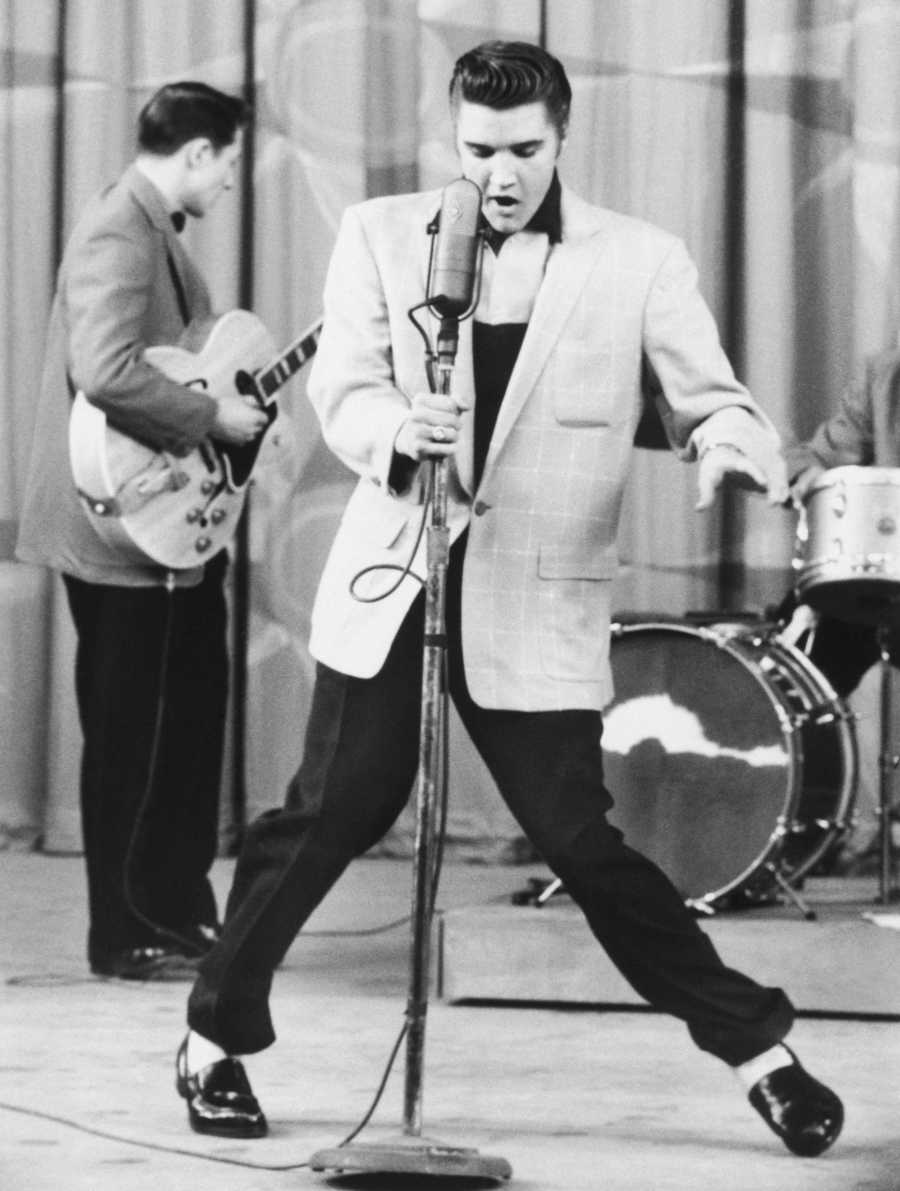
What happened on June 5, 1956, was far more than another television appearance. It was the night Elvis Presley walked onto The Milton Berle Show and changed the relationship between rock ’n’ roll, television, and American culture forever.
Elvis was only 21 years old, but he already possessed something television had never quite encountered before: a stage presence that seemed impossible to contain inside a television screen.
And then came “Hound Dog.”
There was no elaborate choreography, no huge production, and no safety net. Elvis stood before the cameras with Scotty Moore, Bill Black, and D.J. Fontana—and simply performed. His movements, his confidence, and his raw energy immediately captured attention.
But the reaction was explosive.
For many Americans watching at home, Elvis wasn’t just another young singer. He represented something unfamiliar and rebellious. Television was still a relatively new phenomenon in the mid-1950s, and families commonly gathered around the set together after dinner. Suddenly, millions of parents were watching the same young performer whose style seemed to challenge everything they believed respectable entertainment should look like.
The backlash came almost immediately.
According to Milton Berle, the show received hundreds of thousands of letters afterward. Many weren’t compliments. They were angry complaints from viewers who accused the program of putting an inappropriate and provocative performer in front of their families.
Some viewers were reportedly so outraged that they threatened never to watch “Uncle Miltie” again.
But here is where the story takes an extraordinary turn.
Instead of simply seeing the flood of complaints as a disaster, Berle reportedly recognized what the controversy really meant: America had noticed Elvis Presley.
Berle recalled contacting Colonel Tom Parker and telling him about the enormous response. The message was essentially that Parker had something extraordinary on his hands—a genuine star.
And that may have been the most important part of the entire episode.
The controversy itself became publicity.
People who had never heard Elvis before were suddenly talking about him. Parents were discussing him. Teenagers were fascinated by him. Newspapers and television commentators had something new to debate.
Was Elvis dangerous?
Was he vulgar?
Was rock ’n’ roll destroying traditional American values?
Or was he simply the face of a new generation?
Whatever the answer, one thing was becoming impossible to deny: Elvis Presley had become a national phenomenon.
The Milton Berle appearance demonstrated the enormous power of television to transform a performer almost overnight. Before television, Elvis could electrify audiences in theaters and concert halls. But television placed him directly inside America’s living rooms.
That changed everything.
Imagine the alternative.
What if Elvis had never been given that opportunity? What if Milton Berle had decided that this young rock ’n’ roll singer was too controversial for national television? What if the performance had never happened?
Would Elvis still have become Elvis?
Perhaps. His talent, ambition, and growing popularity were already undeniable. But television accelerated the explosion.
The June 1956 appearance became part of the mythology surrounding Elvis Presley—the moment when a young performer stopped being merely a rising star and became a cultural lightning rod.
And that is why the story remains so fascinating decades later.
Elvis didn’t simply perform on television that night.
He disrupted it.
He forced America to pay attention. He exposed a generational divide that was already forming beneath the surface, and he gave teenagers a new musical hero while leaving many adults wondering what had just happened in their living rooms.
Seventy years later, the question still feels powerful:
What if Uncle Miltie had never opened that door?
Because on that unforgettable night in 1956, television didn’t just broadcast Elvis Presley.
It helped create the legend.
Video
https://youtu.be/vfdJJ92BE-4?si=uCF3qzqdZ73U24DU