BLUE HAWAII: THE ELVIS PRESLEY MOVIE THAT CHANGED EVERYTHING
A few weeks ago, I found myself watching Blue Hawaii again, and a surprisingly uncomfortable question kept coming back to me: When did Hollywood stop trusting Elvis Presley as a serious actor?
Because the evidence had once been remarkably strong.
Before Blue Hawaii, Elvis had already shown that he could do much more than sing, smile, and charm an audience. King Creole, Flaming Star, and Wild in the Country had demonstrated that he could carry dramatic material, create believable characters, and hold his own in serious scenes.
So why did Hollywood seemingly turn away from that version of Elvis?
For years, I assumed Blue Hawaii was the answer—and that made me want to dislike the movie before I even watched it.
But something unexpected happened.
I loved it.
And the more I thought about why I loved it, the more I realized that Blue Hawaii may not have proved Elvis couldn’t act. It may have proved something far more complicated: Elvis Presley had become too valuable as a movie star for Hollywood to risk asking him to be merely an actor.
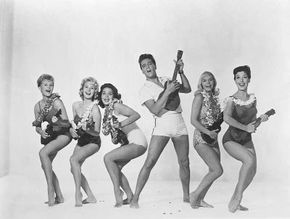
Released in 1961, Blue Hawaii was never trying to be King Creole. It wasn’t attempting to deliver a dark, demanding character study. It was selling audiences something much simpler: beautiful Hawaiian scenery, romance, comedy, music, and two hours in the company of Elvis Presley.
And on those terms, it worked spectacularly.
The Hawaiian locations are gorgeous. The movie practically functions as a tourism advertisement, and Elvis is at the center of it all—relaxed, funny, playful, charismatic, and completely comfortable in front of the camera.
That’s the important distinction.
A great actor can disappear into a character.
A great movie star can make audiences feel that being in the same movie with them is exactly where they want to be.
In Blue Hawaii, Elvis demonstrates the second quality brilliantly.
His chemistry with Joan Blackman is warm and effortless, and even when the script gives him relatively little dramatic material, it’s difficult to look away from him. The camera simply loves Elvis Presley.
And audiences loved him too.
The film became one of Elvis’s biggest commercial successes and ranked among the major box-office hits of 1961. Suddenly, the people controlling his career had something more powerful than critical opinion: money.
And money sends a very clear message in Hollywood.
Why gamble on another challenging dramatic role if audiences will happily pay to see Elvis in paradise?
That success helped establish the formula that would dominate much of his movie career: exotic locations, attractive co-stars, romantic plots, comedy, and plenty of songs.
The tragedy wasn’t that Blue Hawaii succeeded.
The tragedy was what Hollywood learned from its success.
Instead of asking, “What challenging role should Elvis play next?” the industry increasingly seemed to ask, “How can we make another movie that sells like this one?”
There was even a revealing incident during production involving Elvis’s wardrobe. When the director was attempting to film Elvis running into the surf, Colonel Tom Parker reportedly intervened because Elvis was wearing his own watch. Under the terms of Elvis’s contract, supplying his own wardrobe could have triggered an additional payment. The scene was reportedly reshot after the watch was removed.
Whether viewed as a funny Hollywood anecdote or evidence of something more troubling, the story illustrates just how tightly Elvis’s professional world was being managed.
And there are elements of Blue Hawaii that are much harder for modern audiences to accept.
The subplot involving Jenny Maxwell’s character, Ellie Corbett, is particularly uncomfortable today. The movie treats her flirtation with Elvis’s character as comedy, including a spanking scene and jokes about her being “oversexed” and underage. Maxwell herself was 19 during filming, but the character was written as a teenager.
What played as broad comedy in 1961 can feel deeply awkward to a modern viewer.
Then there is Angela Lansbury.
She is fantastic in the film—but the casting creates an almost unbelievable Hollywood age puzzle. Lansbury, born in 1925, was only about ten years older than Elvis, yet she played his mother. Hollywood frequently asked actresses to portray mothers of men who were barely younger than themselves, while male actors were allowed to continue playing romantic leads as they aged.
It’s a pattern that says a great deal about the industry’s treatment of women—and it wasn’t unique to Blue Hawaii.
But despite all these issues, the most fascinating thing about the movie remains Elvis himself.
He didn’t suddenly forget how to act.
He hadn’t lost the ability to perform serious roles.
Instead, Hollywood discovered another version of his talent—and audiences rewarded it enormously.
That is why Blue Hawaii is both wonderful and heartbreaking.
It’s colorful. It’s funny. It’s romantic. It’s beautifully photographed. And Elvis is almost impossible to resist.
The movie gives you exactly what it promises.
That’s precisely why it changed everything.
After Blue Hawaii, the question wasn’t whether Elvis could act.
The question became whether Hollywood was willing to let him prove it again.
And unfortunately, the box office had already provided the answer.
Audiences had shown that they would happily buy tickets to watch Elvis sing in paradise.
Hollywood listened.
And for one of the most naturally charismatic performers of the twentieth century, that may have been the moment when being a great movie star became a curse for the serious actor hiding inside him.