ELVIS PRESLEY’S SECRET TCB RING: THE SHOCKING REASON HE HAD A FAKE MADE FOR HIS OWN FATHER
In 1975, somewhere in North Carolina, Elvis Presley reportedly did something that, by itself, was almost completely ordinary for him.
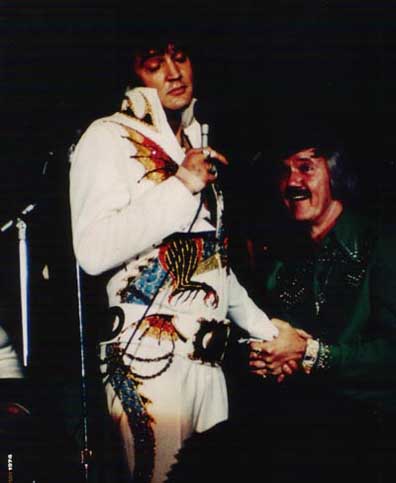
Standing before thousands of fans, he took a spectacular ring from his own finger and handed it to someone he knew.
Elvis had done things like this countless times.
Cars. Jewelry. Watches. Rings. Gifts could leave his hands almost as quickly as they arrived.
But what happened after that particular concert turned a familiar Elvis habit into a remarkable story about money, family, guilt—and a son who apparently did not want his father to know what he had done.
According to jeweler Lowell Hayes, Elvis immediately asked him to make a replacement.
And not just another ring.
He wanted an extremely convincing copy of the one he had just given away.
Why?
Because his father, Vernon Presley, was about to rejoin the tour.
Elvis apparently did not want Vernon to notice that the ring was missing.
That detail is what makes this story so fascinating.
THE RING THAT BECAME ELVIS’S SIGNATURE
Lowell Hayes was a jeweler who worked closely with Elvis for years. According to Hayes’s account, Elvis personally helped design his famous TCB jewelry.
“TCB”—short for “Taking Care of Business”—was more than a slogan. It became one of the defining expressions associated with Elvis, eventually becoming the name of his backing musicians.
Elvis wanted that philosophy represented in gold.
The early versions did not last.
According to Hayes, Elvis gave away an earlier TCB design almost immediately. Another famous version, associated with the 1973 Aloha from Hawaii era, featured a large horseshoe design.
That ring was given away too.
Eventually came the design most closely associated with Elvis: a black onyx face, lightning-bolt details, TCB initials and a massive gold-and-diamond presence designed to be noticed from across an arena.
It was not subtle.
And Elvis loved it.
Until he gave it away.
THE MAN WHO RECEIVED IT
The recipient was J.D. Sumner, the legendary gospel bass singer and leader of The Stamps.
Sumner was not some random fan Elvis spotted from the stage.
He had known Elvis for decades.
Their relationship went back to Elvis’s youth, long before worldwide fame, RCA Records or the enormous concert tours of the 1970s.
By the early 1970s, J.D. Sumner and The Stamps had become an important part of Elvis’s live performances.
So when Elvis handed Sumner the TCB ring during a 1975 concert in Asheville, North Carolina, he was giving it to someone who had been part of his musical world for years.
And according to auction documentation associated with the ring, that original piece eventually became a highly valuable Elvis artifact.
But there was another ring.
THE “DECOY” RING
This is where the story becomes almost unbelievable.
Hayes’s account says Elvis knew Vernon was coming back onto the tour.
Vernon had a very specific role in Elvis’s financial life.
Elvis was famously generous and notoriously impulsive with money. His father, by contrast, was much more concerned with controlling expenses.
According to accounts from Priscilla Presley and others, Elvis had placed Vernon in a position where he could monitor his spending and push back when necessary.
So imagine the situation.
Elvis gives away an expensive TCB ring.
His father is about to see him again.
And Elvis apparently knows exactly what Vernon is likely to notice.
Rather than simply admit, “I gave it away,” Elvis reportedly went back to Hayes and ordered a replacement.
The goal was simple:
Make the ring look like the original.
Put it back on Elvis’s hand.
And make sure Vernon never realizes what happened.
WHY WOULD ELVIS GO TO THAT MUCH TROUBLE?
That is the question that makes this story more than another tale about Elvis giving something away.
Elvis could have afforded the ring.
He could have afforded another ring.
He could have simply ignored his father’s reaction.
But instead, according to Hayes, he went to the trouble of commissioning a replica.
That suggests something complicated about the relationship between Elvis and Vernon.
Elvis was one of the most famous entertainers in the world. On stage, millions watched him. His name could command enormous sums of money.
Yet inside his own family, he was still someone’s son.
And Vernon had been given a responsibility Elvis himself had created: keep an eye on the money.
Elvis apparently knew that if Vernon noticed the missing ring, there would be a conversation.
So Elvis found another solution.
He made the problem disappear.
ELVIS’S EXTRAORDINARY GENEROSITY
The story also fits a much larger pattern.
Elvis was extraordinarily generous.
He could become emotionally attached to an object and then suddenly decide someone else should have it.
According to Hayes’s recollections, there were occasions when Elvis’s jewelry collection was brought out during performances and pieces were given away.
Hayes reportedly became frustrated watching expensive jewelry disappear.
In one often-repeated recollection, when Hayes complained about the amount Elvis had just given away, Elvis laughed and essentially suggested that he could simply perform a little longer to make up the money.
Whether every detail of that anecdote can be independently established is a separate question.
But the broader pattern is well documented: Elvis frequently gave away expensive possessions.
The TCB ring was simply one of the most dramatic examples.
A FORTUNE MOVING THROUGH HIS HANDS
By the mid-1970s, Elvis was earning enormous amounts from touring.
Yet his financial world was complicated.
Management fees, expenses, taxes, staff, gifts and his own spending habits all affected what ultimately remained.
Colonel Tom Parker’s financial arrangements with Elvis were also famously unusual and have been heavily scrutinized by historians.
Against that backdrop, Elvis giving away a valuable ring—and then spending additional money to replace it—becomes even more striking.
He was not simply losing an object.
He was creating another expensive object to conceal the loss.
THE ORIGINAL SURVIVED
The story has an extraordinary ending.
The original TCB ring—the one Elvis gave to J.D. Sumner—did not disappear forever.
It eventually entered the collectibles market and became a valuable piece of Elvis Presley memorabilia, reportedly selling for hundreds of thousands of dollars decades after the 1975 concert.
And the replica?
According to the account surrounding the piece, it survived as well.
The ring that was allegedly created to fool Vernon Presley eventually became an artifact in its own right.
Think about the irony.
Elvis wanted the replacement ring to attract no attention.
He wanted it to make his father believe nothing had changed.
He wanted the object to disappear into normality.
Instead, the “fake” became part of the Elvis story.
DODGE OR RESPECT?
So how should we interpret what Elvis did?
Was it simply an enormously wealthy man avoiding an uncomfortable conversation with his father?
Absolutely, that is one possible reading.
Elvis gave away something valuable and did not want to be confronted about it.
But there may be another interpretation.
Perhaps Elvis knew exactly how much pressure Vernon already carried.
Vernon had been placed in the uncomfortable position of telling his famous, wealthy son “no.”
Maybe Elvis did not want to force him into that role again.
That does not make the deception disappear.
It was still deception.
But the extraordinary effort involved raises another possibility.
If Elvis truly did not care what his father thought, why bother?
Why pay a jeweler to recreate the ring?
Why make the replacement?
Why go to such lengths to prevent Vernon from noticing?
Maybe the answer is hidden in the effort itself.
Elvis did not necessarily fear his father.
He may have simply hated disappointing him.
And perhaps the replica was not only about protecting Elvis from criticism.
Perhaps, in a strange and very Elvis-like way, it was about protecting his father from having to deliver it.
That is what makes the story so compelling.
The ring was worth money.
The replica cost money.
But the real value of the story may be what it reveals about the complicated relationship between a superstar son and the father who was trying to keep him grounded.
Elvis Presley could command an arena with a single gesture.
He could give away jewelry worth enormous sums without hesitation.
But apparently, when it came to his father’s disappointment, even Elvis Presley sometimes went to extraordinary lengths to avoid being caught.
The ring was supposed to hide a secret.
Decades later, that secret became part of Elvis’s legacy.
And perhaps that is the strangest part of all:
The object created to make Vernon see nothing became an artifact the world would never stop looking at.