ELVIS PRESLEY’S SHOCKING PHILADELPHIA NIGHT: THE AMERICAN EAGLE RETURNS IN 1974
More than five decades later, one Elvis Presley performance still feels remarkably alive.
June 23, 1974. Philadelphia, Pennsylvania. The Spectrum. Elvis Presley walked onto the stage for the evening show wearing the spectacular 1974 American Eagle jumpsuit—and the atmosphere inside the arena was electric.
This wasn’t the young Elvis who had shocked America in the 1950s. It wasn’t the Hollywood Elvis audiences had seen on the big screen. This was the seasoned touring superstar of the 1970s: more experienced, more commanding, and still capable of making thousands of people forget everything except the man standing beneath the spotlight.
And thanks to surviving fan-shot photographs and footage, we can still catch glimpses of that extraordinary night.
THE NIGHT PHILADELPHIA SAW ELVIS
On June 23, Elvis performed two shows at the Spectrum.
For the afternoon performance, he appeared in the famous white Peacock jumpsuit. But for the evening show, he changed into something considerably more dramatic—the 1974 American Eagle jumpsuit.
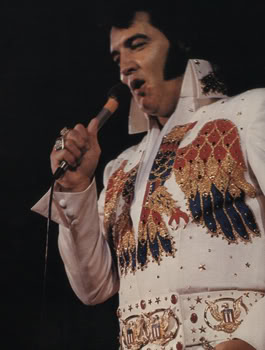
The white suit featured a powerful eagle motif with striking red, gold, and blue details. It was patriotic, theatrical, and unmistakably Elvis.
The design was related to the legendary American Eagle look Elvis had worn during the 1973 Aloha from Hawaii period, but the 1974 version had its own identity and stage presence.
And Elvis knew exactly how to wear it.
Under the lights, the eagle seemed to come alive.
With his dark hair, distinctive sideburns, microphone in hand, and sometimes a black guitar resting across his shoulder, Elvis looked like the ultimate image of 1970s rock-and-roll royalty.
BUT THE PHOTOGRAPHS TELL ANOTHER STORY…
What makes this particular concert so fascinating is the amount of material preserved by fans.
People brought personal cameras into the Spectrum and captured Elvis from the audience. These weren’t carefully staged publicity photographs. They weren’t polished television images.
They were memories captured by ordinary people who knew they were witnessing something special.
Some photographs show Elvis intensely focused on a song. Others capture him moving across the stage or interacting with the audience.
Together, they provide something that professional footage sometimes cannot:
the feeling of actually being there.
You can almost imagine the noise inside the Spectrum—the screams, the applause, the music, and thousands of people watching Elvis perform only a few dozen yards away.
THIS WASN’T JUST A CONCERT
By 1974, Elvis had been performing professionally for roughly two decades.
His career had transformed dramatically.
He had gone from a rebellious young singer in Memphis to a global superstar, a Hollywood actor, a Las Vegas headliner, and one of the most recognizable entertainers on Earth.
Yet something remarkable remained.
When Elvis stepped onto a stage, people still reacted.
The audience wasn’t simply waiting to hear songs.
They came to see Elvis Presley.
They came for the voice, the humor, the movement, the clothes, the personality, the unpredictability—and that mysterious connection he seemed able to create with an enormous crowd.
That is why surviving footage from Philadelphia matters so much.
It allows us to see the performer behind the legend.
THE AMERICAN EAGLE MOMENT
There is something almost cinematic about seeing Elvis in the 1974 American Eagle jumpsuit.
At one moment, he could appear completely absorbed in the music, eyes partly closed and expression intense.
Then suddenly, he could become the larger-than-life entertainer everyone had come to see.
The microphone.
The guitar.
The spotlight.
The eagle.
The screaming crowd.
The unmistakable Elvis silhouette.
For a few minutes, everything comes together into one extraordinary snapshot of the 1970s.
And more than 50 years later, that image still works.
WHY THIS FOOTAGE FEELS SO SPECIAL
The surviving material isn’t necessarily perfect.
Some footage is rough. Some images are dark. Some details have been lost with time.
But perhaps that’s part of the magic.
These weren’t recordings created to make Elvis look perfect.
They were created because someone in that audience wanted to remember the night.
Modern restoration and enhancement can help reveal details that were difficult to see originally, but the goal isn’t to rewrite history.
It’s to bring the surviving material a little closer to our eyes today.
To see the expression.
To notice the details of the jumpsuit.
To watch Elvis move.
And, for a moment, to imagine what it must have felt like sitting inside the Spectrum in 1974.
MORE THAN 50 YEARS LATER…
Think about that.
A fan pressed a camera shutter in Philadelphia in 1974.
That tiny moment survived.
Decades passed.
Elvis became a legend.
The people who were teenagers or young adults in that audience grew older.
And yet those photographs and fragments of footage remain.
They connect two completely different generations through one unforgettable night.
That’s the extraordinary thing about Elvis Presley.
His concerts didn’t simply disappear when the final note ended.
They continued living in photographs, recordings, memories, stories, and the people who were fortunate enough to be there.
June 23, 1974 wasn’t just another date on Elvis’s touring schedule.
It was another night when Elvis Presley stepped onto a stage, put on the American Eagle, faced an enormous Philadelphia audience—and reminded everyone why his name still meant something extraordinary.
So here’s the question:
Which American Eagle do you prefer—the legendary 1973 Aloha version, or the powerful 1974 version Elvis wore in Philadelphia?
And if you were actually inside the Spectrum that night, your story is even more valuable.
Because photographs can show us what Elvis looked like.
But only the people who were there can truly tell us what it felt like when Elvis Presley walked onto that stage.
More than half a century later, Philadelphia still remembers.