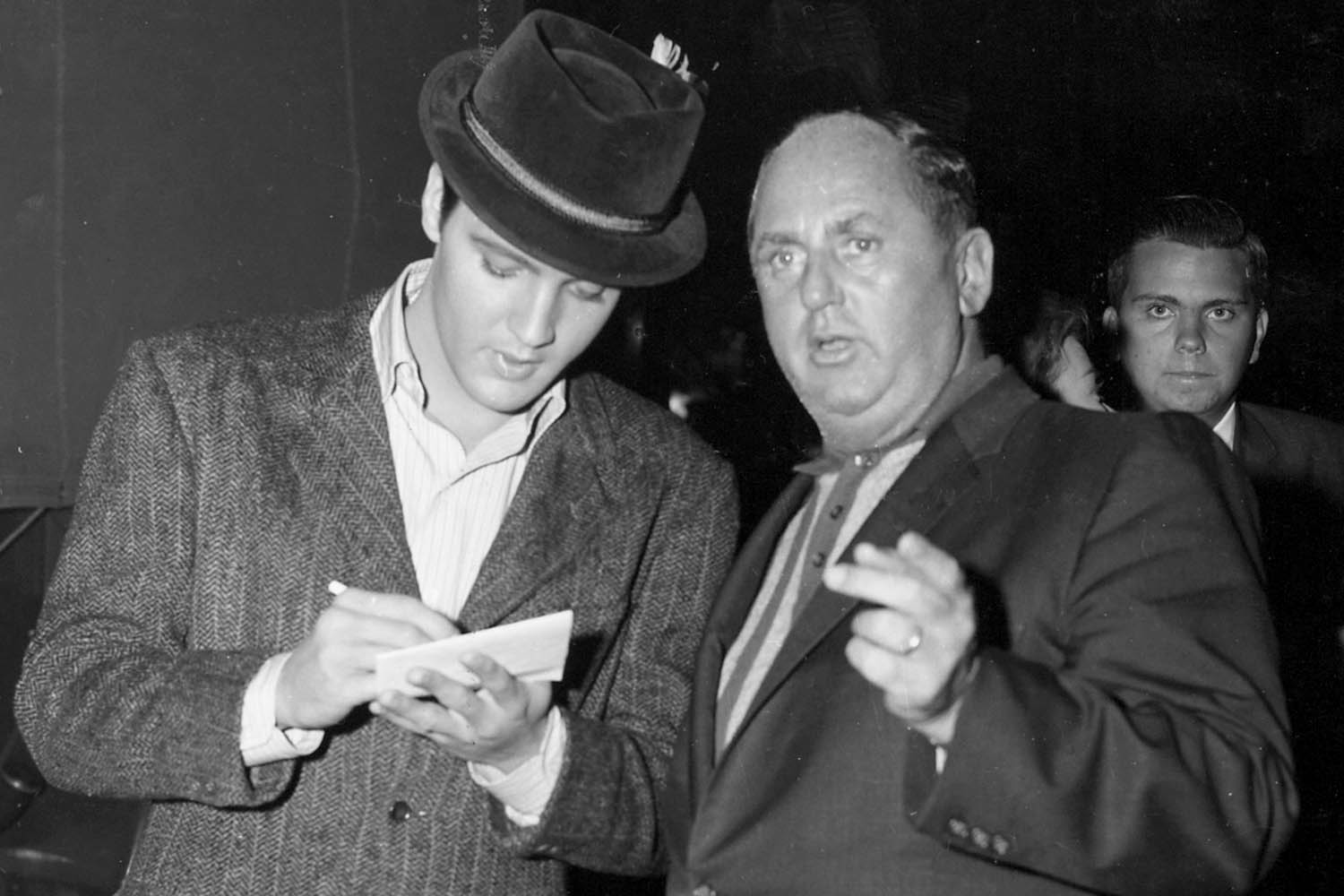
He didn’t write Elvis’s songs. He didn’t play guitar. He didn’t sing a note. Yet Colonel Tom Parker may have understood one thing better than almost anyone around Elvis Presley: how to turn a superstar into a business.
Long before Elvis became known as “The King,” Parker had learned the basic rules of entertainment from the carnival world: give people the biggest thrill, make them feel they are seeing something extraordinary—and make sure there is money changing hands.
When Parker became closely involved with Elvis, that philosophy followed him everywhere.
Elvis wasn’t simply a singer. He became a brand.
Records. Movies. Soundtracks. Fan clubs. Merchandise. Personal appearances. Television. Concerts. Las Vegas.
Everything could be turned into another opportunity to sell Elvis.
And that is where the partnership between Elvis and Colonel Parker became both incredibly successful—and increasingly complicated.
One of the earliest major tensions involved country star Hank Snow, with whom Parker had previously worked in music promotion. Elvis appeared on shows associated with Snow, but the young Memphis performer was hardly the traditional country star Snow represented.
Elvis was different.
He moved differently. He dressed differently. He performed differently.
To some established country performers, Elvis seemed almost outrageous.
But the young man everyone underestimated was about to change popular music forever.
When Parker eventually became Elvis’s exclusive manager, his relationship with Snow deteriorated. The business arrangements surrounding Elvis became increasingly important, and Parker’s attention shifted toward building the career of the young singer who was suddenly becoming a national sensation.
Then came the Army.
For many performers, military service could have destroyed their momentum.
Parker refused to let that happen.
While Elvis served in the U.S. Army, his name continued appearing in the public eye. Records were released, and his music remained commercially active. The goal was simple: don’t let America forget Elvis Presley.
When Elvis returned in 1960, Parker immediately began pushing the next phase of the career.
Hollywood.
This is where the Parker strategy became particularly powerful.
Elvis made a movie.
The movie had a soundtrack.
The soundtrack sold records.
The movie promoted Elvis.
The records promoted Elvis.
And then came another movie.
And another.
The system could generate enormous revenue while keeping Elvis constantly visible to the public.
But there was a darker side to the machine.
Elvis increasingly wanted to be taken seriously as an actor and musician. Instead, he became locked into a production system that often emphasized speed, predictability, and commercial safety.
Movie after movie.
Soundtrack after soundtrack.
The formula worked financially—but eventually, Elvis became frustrated with it.
Then the Beatles arrived.
The British Invasion changed the musical landscape almost overnight. Suddenly, Elvis was no longer the only young superstar dominating popular culture.
And yet Parker continued selling Elvis.
Because that was what Parker understood.
Marketing.
He understood that fans didn’t simply buy music. They bought an experience.
They bought the fantasy of Elvis Presley.
They bought photographs, records, souvenirs, fan-club memberships—and almost anything that carried the Elvis name.
Some of Parker’s promotional schemes became legendary for their sheer audacity. Stories about novelty fan clubs and even blank books sold as promotional merchandise illustrate the bizarre creativity associated with his marketing style.
Whether every version of those stories has survived accurately is another question.
But the larger truth is undeniable:
Parker knew how to sell Elvis.
And then came Las Vegas.
In 1969, Elvis returned to live performance at the International Hotel in Las Vegas after years dominated by Hollywood. There was enormous pressure surrounding the comeback. Elvis’s earlier Las Vegas appearance in the 1950s had been poorly received, so the stakes were high.
This time was different.
Elvis walked onto the stage with a powerful new band and backing vocalists. James Burton, Ronnie Tutt, Glen D. Hardin, John Wilkinson and other musicians helped create a sound that was dramatically different from the Elvis of the movie years.
The audience responded.
And Parker saw something immediately.
Opportunity.
There is a famous story that Parker negotiated a long-term Las Vegas arrangement while Elvis was performing, with the deal reportedly sketched out on a tablecloth.
Whether every detail of the tablecloth story is literally accurate or has been embellished over time, it captures something essential about Parker’s personality.
He saw an opportunity—and he wanted to close the deal.
The result helped establish Elvis as one of the defining live attractions of Las Vegas.
That was Colonel Parker’s genius.
He understood Elvis’s value as entertainment.
But Elvis was the talent.
Elvis created the music.
Elvis created the excitement.
Elvis walked onto the stage and made people scream.
Parker packaged it, promoted it, negotiated it, and monetized it.
And that may be the most complicated truth about their partnership.
Neither man was the whole story.
Elvis needed someone who could turn fame into a massive commercial operation.
Parker needed a once-in-a-generation performer whose name could sell almost anything.
Together, they created one of the most successful entertainment partnerships in American history.
But success came at a price.
The same machine that made Elvis extraordinarily wealthy also helped trap him inside increasingly repetitive movies, contracts, appearances, and commercial expectations.
Parker kept asking one question:
“How much can we make?”
Elvis increasingly wanted to ask another:
“What do I actually want to create?”
That difference would become impossible to ignore.
Colonel Tom Parker didn’t create Elvis Presley.
But he understood how to sell him to the world.
And once the world bought Elvis…
there was almost no turning the machine off.
Video
https://youtu.be/CpDJRd_xGs4?si=KHzjF4v-Ks68xNKw