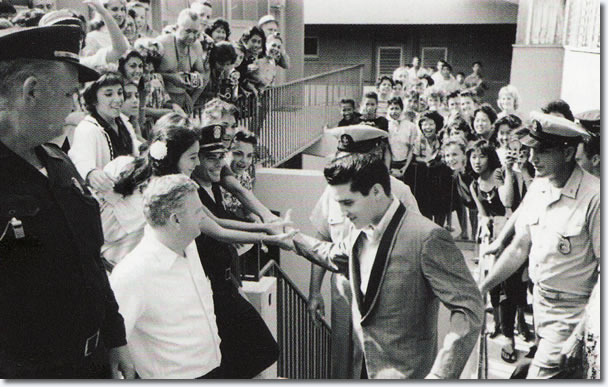
THE ELVIS PRESLEY STORY HISTORY ALMOST FORGOT: How One Night in Hawaii Helped Build America’s Most Sacred WWII Memorial
Most people believe they know Elvis Presley.
They remember the screaming crowds. The gold records. The movies. Graceland. The dazzling jumpsuits. The legendary concerts in Las Vegas.
But very few know that one of the greatest things Elvis Presley ever accomplished had nothing to do with music charts or Hollywood.
It happened on a single night in Hawaii.
It wasn’t for fame.
It wasn’t for money.
It wasn’t even for himself.
It was for 1,177 American heroes whose final resting place lay beneath the waters of Pearl Harbor.
And without Elvis Presley, one of America’s most powerful memorials might have remained nothing more than an unfinished dream.
On the morning of December 7, 1941, America changed forever.
Just before 8 a.m., a Japanese armor-piercing bomb ripped through the deck of the USS Arizona before detonating inside her forward ammunition magazine. The explosion was so violent that eyewitnesses believed the massive battleship actually lifted from the water before collapsing into the harbor.
Only nine minutes later, the proud battleship was gone.
More than 1,177 sailors and Marines lost their lives aboard the Arizona—nearly half of all Americans killed during the attack on Pearl Harbor.
Even more heartbreaking, over 900 of those men were never recovered.
The Navy made the painful decision to leave them where they had fallen.
Their ship became their tomb.
Even today, the Arizona rests beneath the calm waters of Pearl Harbor, where tiny droplets of oil still rise slowly to the surface.
Veterans have long called them “the black tears of the Arizona.”
It is as though the battleship is still mourning her crew over eighty years later.
Following World War II, many believed a grand national memorial would quickly be built above the wreck.
Instead…
Nothing happened.
Years passed.
Then more years.
America moved forward into the age of jet aircraft, rockets, television, and the Space Race.
The men beneath the Arizona remained forgotten by much of the nation.
Although President Dwight D. Eisenhower authorized construction of a memorial in 1958, Congress provided only part of the funding.
The remaining money had to come from public donations.
At first, Americans responded with enthusiasm.
Children mailed nickels.
Families donated whatever they could.
A television special honoring Medal of Honor recipient Rear Admiral Samuel Fuqua generated nearly $95,000.
Model ship companies contributed profits.
But eventually…
The donations stopped.
By the end of 1960, the project had stalled with only about half the money required.
The memorial was dying before it had ever been built.
At almost exactly that moment, Elvis Presley returned home from military service in Germany.
Many forget that Elvis wasn’t simply drafted.
He served honorably as Sergeant Elvis Presley.
Rather than accepting celebrity privileges through the Army’s Special Services entertainment program, Elvis insisted on serving like every other soldier.
He drove military vehicles through freezing German winters.
He earned his promotions.
He shared barracks with ordinary servicemen.
Those who knew him believed those two years transformed him forever.
The death of his beloved mother, Gladys Presley, shortly before his deployment had left deep emotional scars, making him quieter, more thoughtful, and deeply appreciative of the sacrifices made by military families.
After returning to America, Colonel Tom Parker quickly pushed Elvis back into Hollywood.
Movie after movie followed.
Concerts disappeared.
Fans wondered if the King of Rock and Roll would ever truly return to the stage.
Then fate intervened.
Colonel Parker learned that the USS Arizona Memorial Fund desperately needed help.
An extraordinary idea was born.
Elvis would perform one benefit concert in Hawaii.
Every dollar raised would go directly toward completing the memorial.
But Elvis added remarkable conditions.
No expenses would be deducted.
No hidden costs.
No free tickets—not for politicians, military leaders, promoters, or even Elvis himself.
If anyone wanted a seat, they had to buy one.
Including the star.
In one of the most astonishing gestures of his career, Elvis personally purchased a $100 ringside ticket to his own concert.
Colonel Parker bought one too.
The headline performer literally paid to watch himself perform.
On March 25, 1961, nearly 4,000 people packed into Bloch Arena at Pearl Harbor.
Few realized the heartbreaking history of that very building.
The night before Pearl Harbor was attacked in 1941, members of the USS Arizona’s own ship band had performed there during a Navy music competition.
Less than twelve hours later…
Every member of that band was dead, killed while passing ammunition below deck during the attack.
Nineteen years later, Elvis stood on the same stage where those young musicians had played their final songs.
The symbolism was impossible to ignore.
When Elvis appeared wearing his famous gold lamé jacket, the crowd erupted.
Many critics had questioned whether two years away from touring had diminished his magic.
They received their answer within seconds.
For forty-five unforgettable minutes, Elvis reminded the world why he was unlike anyone else.
He exploded through classics including Heartbreak Hotel, That’s All Right, All Shook Up, Are You Lonesome Tonight, It’s Now or Never, A Fool Such As I, I Got A Woman, Reconsider Baby, and finally Hound Dog.
Witnesses later described it as one of the greatest performances of his entire career.
The audience screamed from beginning to end.
The walls of the Navy gymnasium shook.
By the time the evening ended, the concert had raised over $60,000—well over half a million dollars in today’s value.
Elvis even contributed an additional $5,000 from his own pocket.
More importantly…
The concert reignited national attention.
Newspapers across America suddenly began covering the stalled memorial project once again.
Public donations resumed.
Congress soon approved additional funding.
Within months, the financial goal that had seemed impossible for years had finally been reached.
On Memorial Day 1962, the USS Arizona Memorial was officially dedicated.
Families finally had a sacred place to mourn.
Survivors finally had a place to honor fallen shipmates.
Perhaps the most astonishing fact of all is this:
That Pearl Harbor benefit became the final full-length concert Elvis Presley performed before disappearing into Hollywood for more than eight years.
His last major public performance of the early 1960s wasn’t designed to promote a movie.
It wasn’t organized to sell records.
It wasn’t even intended to make money.
It was a gift.
A gift to more than 900 sailors who never came home.
Years later, Elvis returned to Hawaii repeatedly, filming Blue Hawaii and eventually making history with his groundbreaking Aloha from Hawaii satellite concert, which also raised significant money for charity.
Giving simply became part of his relationship with the islands.
Yet Elvis rarely spoke publicly about the Arizona benefit.
He never boasted.
He never turned it into a publicity campaign.
He simply moved on to helping the next person who needed him.
That quiet humility explains why his legacy has endured for generations.
Today, approximately 1.4 million visitors travel to the USS Arizona Memorial each year.
They stand silently above the sunken battleship.
They watch the black tears of oil rise through the water.
They read the names of 1,177 heroes carved forever into white marble.
Almost none realize that a 26-year-old rock-and-roll superstar wearing a gold jacket played an extraordinary role in making that sacred place possible.
Perhaps that is the greatest measure of Elvis Presley.
His voice changed music.
His performances changed entertainment.
But on one unforgettable night in Hawaii…
His heart helped preserve history.
And while the brave men of the USS Arizona have continued standing their eternal watch beneath the waters of Pearl Harbor, Elvis Presley stood watch for them when America needed someone most.
That may be the greatest encore the King of Rock and Roll ever gave.