Introduction:
A Quiet Tribute That Spoke Louder Than Applause: The Night the Grammys Stood Still
In an era where performances are often engineered for spectacle, true emotional authenticity has become a rare currency. Yet, at the 2026 Grammy Awards, one moment gently defied expectation—eschewing grandeur in favor of something far more enduring. It was not a performance designed to dazzle, but one that resonated deeply, settling into the hearts of listeners with quiet, unmistakable power.
This was not nostalgia packaged for mass appeal, nor an attempt to recreate a bygone era. Instead, it was a deeply personal tribute—a brother’s remembrance, intimate and sincere. At its core lay the enduring legacy of Bee Gees and the memory of Robin Gibb, whose voice once helped define a generation but whose absence still lingers profoundly.
The evening began as expected. Inside the Dolby Theatre, anticipation buzzed through a room filled with music’s brightest stars. The promise of dazzling performances and headline-making moments hung in the air. But what followed was something entirely different—something quieter, yet infinitely more powerful.

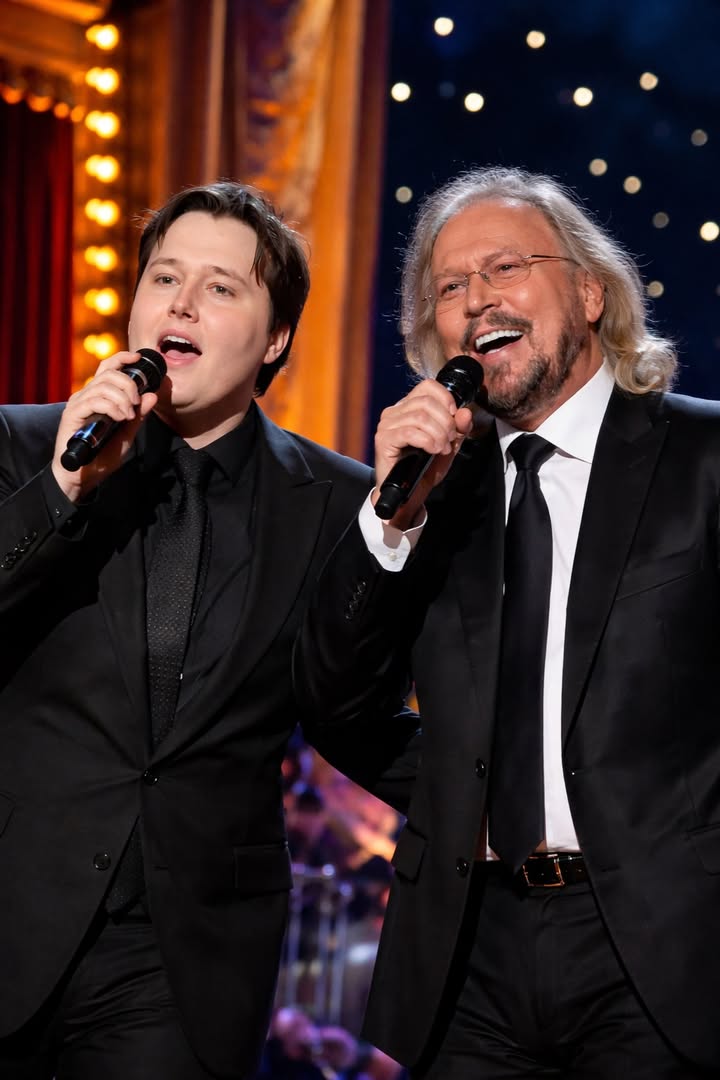
As the lights dimmed, a single spotlight illuminated the stage. Into that soft glow stepped Barry Gibb. For decades, Barry has been more than a performer; he is a living bridge to a musical legacy that has soundtracked countless lives. His presence alone commanded silence—no introduction necessary.
Moments later, he was joined by his son, Robin-John Gibb. Their connection required no explanation. It was evident in the way they stood, in the quiet understanding between them. This was not merely a duet—it was a continuation of something deeply rooted in family and memory.
The opening chords of How Deep Is Your Love rang out, instantly transforming the atmosphere. Time seemed to slow. The usual distractions of an awards show faded away, replaced by a collective stillness. The song, once synonymous with romance, now carried a deeper emotional weight—woven with loss, remembrance, and enduring love.
Barry’s voice, softened by time yet unwavering in its sincerity, carried each lyric with deliberate care. When Robin-John joined in, their harmonies intertwined effortlessly. It was not imitation, but evolution—a passing of something sacred from one generation to the next. Together, they created a sound that felt both familiar and entirely new.
What made the performance unforgettable was its restraint. There were no elaborate visuals, no swelling orchestras—only two voices, bound by blood and memory. This simplicity stripped the moment to its essence, allowing the emotion to speak without interference. It felt less like a performance and more like an invitation into a private space of remembrance.

As the final chorus approached, a quiet reverence filled the room. Each note carried the presence of Robin, not as absence, but as memory—alive within the music itself. When the last note faded, the silence that followed spoke volumes.
The applause, when it came, was gentle and heartfelt. It was not the roaring approval of spectacle, but something deeper—a shared acknowledgment of what had just been experienced. For a brief moment, the Grammys became more than a celebration of success; they became a space for reflection, for connection, for love.
Beyond the theater walls, audiences around the world felt it too. Conversations weren’t about technical brilliance or stage design, but about emotion—about how deeply the performance had moved them.
That night, Barry and Robin-John Gibb offered something rare. Not just music, but meaning. Not just a tribute, but a continuation of a legacy built on harmony—both musical and familial.
In the end, it wasn’t just a performance. It was a full circle moment. A quiet reminder that while time may pass, and voices may fade, love—like music—endures far beyond the final note.