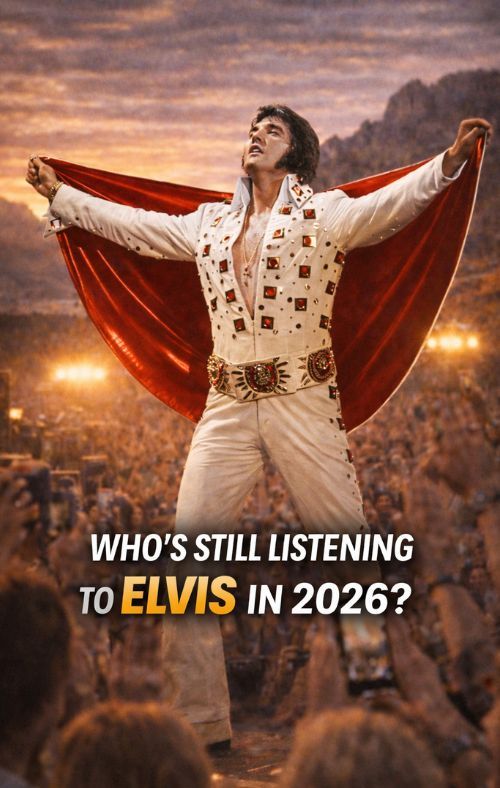
Introduction:
There are performances that entertain—and then there are moments so charged with energy that they seem to transcend the very idea of a stage. When Elvis Presley launched into “Burning Love” during Aloha from Hawaii, the result was not simply a highlight of a concert. It was a cultural ignition point—an instant when music, charisma, and global attention fused into something unforgettable.
By the time Elvis stepped onto that stage in Honolulu, the event itself had already entered the realm of legend. Broadcast via satellite to audiences across the world, Aloha from Hawaii was unprecedented in scale. Yet history has shown that scale alone cannot create magic. What transformed that night into something timeless was the presence of Elvis himself—an artist fully aware of the magnitude of the moment and utterly capable of rising to meet it.
When the opening notes of “Burning Love” rang out, there was an immediate shift in atmosphere. Elvis did not approach the song as a routine performance. He attacked it with urgency and purpose, as though every lyric carried the weight of the global audience watching him. His voice was sharp, vibrant, and commanding, cutting through the air with a sense of controlled fire. His movements—confident, fluid, unmistakably his own—turned the stage into an extension of his personality. It was not just performance; it was possession.

What made this moment especially electrifying was the way Elvis balanced grandeur with immediacy. Many performers who reach his level of fame risk becoming distant, their larger-than-life image overshadowing their humanity. Elvis, however, retained something rare. Even at the height of his myth, he still felt accessible. In “Burning Love,” he was not a relic of past glory or a figure trapped by his own legend. He was alive in the moment—fully engaged, fully present, and fully in control.
The song itself played a crucial role in this transformation. “Burning Love” is built on urgency—its rhythm pulses with energy, its lyrics burn with intensity. It is a song that demands commitment, and Elvis met that demand completely. Rather than simply delivering the melody, he embodied its spirit. The iconic white jumpsuit, the commanding stance, the dynamic vocal delivery—all combined to create the impression that he was not just singing about fire, but becoming it.
For audiences who remember Elvis at his peak, this performance serves as a powerful reminder of what made him unique. He was never just a vocalist. He was movement, magnetism, and emotional force wrapped into one. Even after years of fame, reinvention, and personal challenges, he could still step onto a stage and generate a level of excitement that felt almost elemental.

There is also something deeply satisfying about the timing of this moment. Too often, discussions about legendary artists focus on decline or nostalgia. But “Burning Love” during Aloha from Hawaii captures Elvis in forward motion. He was not reflecting on past triumphs—he was creating a new one in real time. The performance radiates energy, not memory. It reminds us that greatness is not only something to be remembered, but something that, in rare moments, can still feel immediate and alive.
That is why this performance continues to resonate decades later. It offers more than admiration—it delivers exhilaration. It allows viewers to witness an artist operating at full intensity, transforming a song into an experience and a concert into a moment of history.
In the end, “Burning Love” was never just another hit in Elvis Presley’s catalog. In that electrifying performance, it became something far greater: a declaration of presence, a demonstration of power, and a vivid reminder of why the world once stopped to watch—and why, even now, it still does.